


TL;DR: If you just need cheaper enrichment data, skip to Cognism or Lusha. If you want prospecting and outreach in one tool, Apollo is your best bet. If you want to stop duct-taping Clay plus n8n plus Zapier together and actually have your GTM execute itself, skip straight to nRev.
This guide was put together by the nRev team. We have spent years building GTM systems at scaling companies and have hands-on experience with every tool on this list. nRev appears in this article because it solves a specific problem we will explain honestly. Where another tool is the better fit, we will tell you that too.
Clay is genuinely impressive. Over 150 data providers, a spreadsheet interface that lets you build complex enrichment workflows, and a community of GTM engineers who treat it like a second home. For technically savvy growth teams, it can feel like a superpower.
But you are here because something is not working.
Maybe the credit-based pricing got unpredictable once you started scaling. Maybe you spent your first week burning credits on broken configurations before getting a single workflow right. Maybe you realized that after all that enrichment, you still needed three other tools to actually do something with the data.
You are not alone. These are the three reasons teams start shopping for Clay alternatives over and over again.
Why Teams Look for Clay Alternatives
The credit math stops making sense.
If cost is the trigger, it is worth checking which jobs a set of free GTM tools you can run today already covers before you move platforms.
Clay overhauled its pricing on March 11, 2026, splitting credits into Data Credits and Actions. Data costs dropped 50 to 90%, which is great. But if you use your own API keys, Actions now introduce a cost where there was not one before. The pricing got better for some teams and worse for others. More on this later.
The learning curve burns credits before you learn.
Reddit and G2 reviews keep saying the same thing: "Not the easiest interface to use. One wrong move and you have wasted your credits." Clay is powerful, but that power comes with complexity that takes real time to master.
Enrichment is not execution.
This is the big one. Clay enriches data beautifully. Then it hands you a spreadsheet and says good luck. You still need an outreach tool, a CRM sync, lead routing, and follow-up sequences. You end up maintaining a four-tool stack where Clay is just one piece.
According to Gartner's research on B2B sales effectiveness, sales teams that close the gap between data enrichment and execution see significantly higher pipeline conversion rates. Root source: Gartner primary research. The data was never the bottleneck. Execution is.
We tested and compared 9 Clay alternatives, organized by what they actually replace in your stack. This is the outbound sales automation gap that most enrichment tools never solve.
How We Organized These Tools
Most Clay alternatives articles throw a dozen tools at you and call it a day. We organized this differently because not every team leaving Clay has the same problem.
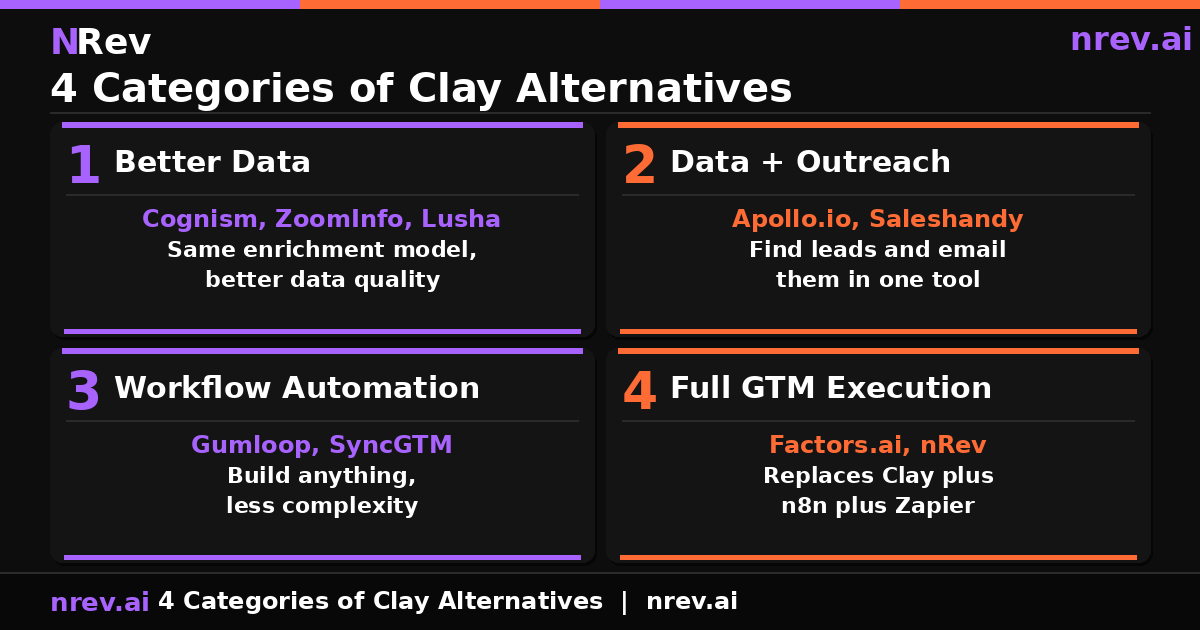
Category 1: Better Data, Same Model
You like how Clay works. You just want cheaper or more accurate data feeding into similar workflows.
Category 2: Data and Outreach in One Place
You are tired of enriching leads in Clay, exporting a CSV, importing into your outreach tool, and praying nothing breaks in between.
Category 3: Workflow Automation Without the Complexity
You love Clay's build anything philosophy but hate the learning curve and credit waste that comes with it.
Category 4: Full GTM Execution Platforms
You have realized the problem is not Clay specifically. It is the fact that you need Clay plus n8n plus Zapier plus an outreach tool to run a complete GTM motion.
If you already know which category fits your situation, jump ahead. If not, start from the top.
Category 1: Better Data, Same Model
These Clay alternatives are for teams that like Clay's enrichment-first approach but want better data quality, lower prices, or less complexity. If you are evaluating the broader Category 1: Better Data, Same Model
These Clay alternatives are for teams that like Clay's enrichment-first approach but want better data quality, lower prices, or less complexity. If you are evaluating the broader lead enrichment tools landscape, these three are the strongest options in this category.
1. Cognism: Best for European Data and Compliance
Best for: Teams targeting EMEA who need GDPR-compliant, phone-verified mobile numbers that people actually pick up.
Pricing: Quote-based. Generally more expensive than Clay for comparable volume, but you are paying for verified quality over raw quantity.
Cognism's standout feature is phone-verified mobile data. These are not scraped numbers that go to voicemail. Their team actually calls and verifies them. Users consistently report around 85% accuracy, which is a big jump from the 50% some teams see with other providers.
The platform handles DNC list checking across 15 countries, which matters if you are doing outbound into regulated European markets.
The tradeoff: Cognism is a data source, not a workflow tool. You will still need something else to build automation on top of it. If your Clay frustration is about complexity or tool sprawl, Cognism adds to the problem rather than solving it.
Bottom line: Excellent if data quality in European markets is your primary pain point. Does not solve the too-many-tools problem.
2. ZoomInfo: Best for Enterprise Data Depth
Best for: Large sales organizations (100 or more reps) that need the deepest proprietary B2B database available and have the budget to match.
Pricing: Custom. Starts around $15,000 per year for a single user. Enterprise contracts run $25,000 to $60,000 or more annually.
ZoomInfo maintains its own database of 321M plus contacts with direct dials, verified emails, org charts, and technographic data. Where Clay aggregates data from third-party providers through waterfalling, ZoomInfo is the provider. For North American enterprise accounts especially, the depth and accuracy is hard to beat from a single source.
They also offer intent data, which tells you when target accounts are actively researching topics relevant to your product. That is useful context Clay does not natively provide. For teams who want to combine this with competitive intelligence tools, ZoomInfo pairs well with CI platforms.
The tradeoff: ZoomInfo is dramatically more expensive than Clay. There is no AI workflow builder. Some features are locked behind higher-tier plans and accessing global data costs extra.
Bottom line: If budget is not a constraint and you need the most comprehensive contact database in the market, ZoomInfo is the gold standard. But it is a data warehouse, not a GTM engine.
3. Lusha: Best for Simplicity and Speed
Best for: Small teams that want accurate contact data quickly without reading a 40-page setup guide first.
Pricing: Free plan available. Paid plans start around $37 per user per month.
Lusha's biggest selling point is that you can start prospecting within minutes of signing up. No workflow building, no credit calculations, no debugging enrichment chains. Search, filter, export. Done. The Chrome extension lets you pull contact data directly from LinkedIn profiles, which is how most SDRs actually prospect anyway.
The tradeoff: Lusha's database is smaller than Clay's 150-plus provider network. It works well for common industries and roles, but if you are targeting niche segments, you might hit coverage gaps. You will likely outgrow it as your GTM motion gets more complex.
Bottom line: Perfect if you need something simple that just works today. Not a long-term replacement for teams with complex prospecting needs.
Category 2: Data and Outreach in One Place
These Clay alternatives combine contact data with built-in sequencing and outreach, so you are not bouncing between three apps just to send an email.
4. Apollo.io: Best All-in-One for Outbound Teams
Best for: Outbound sales teams and founders who want to find a lead, write an email, and send it from the same platform.
Pricing: Free plan available. Basic from $49 per user per month. Professional from $79 per user per month. Organization from $119 per user per month (minimum 3 users, billed annually).
Apollo is the most popular Clay alternative for a reason. It bundles a 275M plus contact database with email sequences, a built-in dialer, meeting scheduling, and an AI writing assistant. For teams whose workflow is basically "find lead, enrich, email, follow up," Apollo does the whole thing without requiring any other tools.
The free tier is surprisingly generous, making it accessible for solo founders and small teams just getting started.
The tradeoff: Pricing is per seat, which adds up fast with larger teams. Enrichment depth does not match Clay's multi-source waterfalling. And if your GTM motion goes beyond basic outbound, like complex data transformations or multi-channel orchestration, Apollo starts to feel limited.
G2 Rating: 4.7 out of 5 from 9,000 plus reviews.
Bottom line: If your world is cold outbound and you want one tool instead of three, Apollo is probably your best move. See how nRev enhances Apollo data into executable workflows.
5. Saleshandy: Best for Cold Email at Scale
Best for: Teams whose GTM motion is 100% cold email and who care about deliverability above everything else.
Pricing: Free trial available, then starts at $25 per month.
Saleshandy is focused on one thing: making sure your cold emails actually land in inboxes. It includes a B2B lead finder (700M plus contacts claimed), email warmup, deliverability optimization, and unlimited email accounts on higher tiers.
The tradeoff: This is not a workflow tool. There is no multi-channel support beyond email. Enrichment features are basic. If you need LinkedIn outreach, phone outreach, or any kind of complex automation, you will need other tools alongside it.
Bottom line: Purpose-built for cold email volume and deliverability. Not a Clay alternative for teams doing anything beyond email.
Category 3: Workflow Automation Without the Complexity
These Clay alternatives share Clay's build anything philosophy but take different approaches to making that power accessible without requiring deep spreadsheet engineering skills.
6. Gumloop: Best for AI-Native Workflow Building
Best for: Technical GTM teams that want flexible automation extending beyond just sales, with modern AI models built in.
Pricing: Free plan available. Paid plans from $37 per month.
Gumloop is the tool that feels most like Clay's spiritual successor but with a different architecture. Instead of a spreadsheet interface, you build visual workflows using nodes for data enrichment, AI processing, and integrations. The platform gives you built-in access to every major LLM (GPT, Claude, Gemini, DeepSeek) without separate API costs, plus web scraping capabilities baked in.
What makes Gumloop interesting is that it is not limited to sales workflows. You can build content automation, HR processes, and anything else that involves connecting data sources to AI processing.
The tradeoff: The learning curve is real. If you are leaving Clay because workflows were too complex to set up, Gumloop will not feel dramatically simpler. The community and template library are still smaller than Clay's.
Bottom line: If you are a GTM engineer who sees workflow automation as part of a bigger operational picture, Gumloop is genuinely exciting. If you just want simpler prospecting, look at Category 2 instead.
7. SyncGTM: Best Direct Clay Replacement at a Lower Price
Best for: Teams that want exactly what Clay does at roughly 40% less cost, with no feature gating.
Pricing: Starts at $99 per month. CRM integrations included on all paid plans.
SyncGTM is the most direct swap for Clay on this list. It replicates the core model: waterfall enrichment across 40 plus data providers, AI agents, action columns, and CRM sync. The key difference is that every feature ships on every paid plan. No paying $800 per month just to get CRM integrations, which was a common frustration with Clay's old Pro tier.
The tradeoff: The provider network is smaller (40 plus vs Clay's 150 plus). SyncGTM is a newer platform so the community, template library, and third-party resources are still growing. And structurally, it shares Clay's fundamental limitation: it is an enrichment and workflow tool, not an execution platform.
Bottom line: If your issue with Clay is purely price and feature gating, SyncGTM is the cleanest swap. But if you are frustrated with maintaining a multi-tool stack, switching from one data enrichment tool to another does not solve that problem.
Category 4: Full GTM Execution Platforms
Here is where things get interesting. These are not Clay but cheaper or Clay but simpler. These are platforms built on a different premise entirely: that the real problem is not enrichment quality. It is the gap between enriching data and actually doing something with it.
8. Factors.ai: Best for Signal-Driven GTM Activation
Best for: Growth engineering teams that want website intent signals, ad orchestration, and CRM automation in one connected system.
Pricing: Quote-based.
Factors.ai approaches GTM from the signals side rather than the data side. It identifies which accounts are visiting your website, combines that with intent data, and triggers actions automatically. Those actions can be outbound sequences, LinkedIn or Google ad campaigns via their AdPilot feature, CRM updates, or alerts to sales teams.
The value is in the unification. Instead of Clay enriching data in one tab and your ad platform running campaigns in another, Factors.ai connects all of it. This connects naturally to how b2b buying signals work: when an account starts showing buying intent, the system responds across channels without manual coordination. Teams also use it alongside monitoring competitors workflows to trigger displacement outreach when competitive signals fire.
landscape, these three are the strongest options in this category.1. Cognism: Best for European Data and Compliance
Best for: Teams targeting EMEA who need GDPR-compliant, phone-verified mobile numbers that people actually pick up.
Pricing: Quote-based. Generally more expensive than Clay for comparable volume, but you are paying for verified quality over raw quantity.
Cognism's standout feature is phone-verified mobile data. These are not scraped numbers that go to voicemail. Their team actually calls and verifies them. Users consistently report around 85% accuracy, which is a big jump from the 50% some teams see with other providers.
The platform handles DNC list checking across 15 countries, which matters if you are doing outbound into regulated European markets.
The tradeoff: Cognism is a data source, not a workflow tool. You will still need something else to build automation on top of it. If your Clay frustration is about complexity or tool sprawl, Cognism adds to the problem rather than solving it.
Bottom line: Excellent if data quality in European markets is your primary pain point. Does not solve the too-many-tools problem.
2. ZoomInfo: Best for Enterprise Data Depth
Best for: Large sales organizations (100 or more reps) that need the deepest proprietary B2B database available and have the budget to match.
Pricing: Custom. Starts around $15,000 per year for a single user. Enterprise contracts run $25,000 to $60,000 or more annually.
ZoomInfo maintains its own database of 321M plus contacts with direct dials, verified emails, org charts, and technographic data. Where Clay aggregates data from third-party providers through waterfalling, ZoomInfo is the provider. For North American enterprise accounts especially, the depth and accuracy is hard to beat from a single source.
They also offer intent data, which tells you when target accounts are actively researching topics relevant to your product. That is useful context Clay does not natively provide. For teams who want to combine this with competitive intelligence tools, ZoomInfo pairs well with CI platforms.
The tradeoff: ZoomInfo is dramatically more expensive than Clay. There is no AI workflow builder. Some features are locked behind higher-tier plans and accessing global data costs extra.
Bottom line: If budget is not a constraint and you need the most comprehensive contact database in the market, ZoomInfo is the gold standard. But it is a data warehouse, not a GTM engine.
3. Lusha: Best for Simplicity and Speed
Best for: Small teams that want accurate contact data quickly without reading a 40-page setup guide first.
Pricing: Free plan available. Paid plans start around $37 per user per month.
Lusha's biggest selling point is that you can start prospecting within minutes of signing up. No workflow building, no credit calculations, no debugging enrichment chains. Search, filter, export. Done. The Chrome extension lets you pull contact data directly from LinkedIn profiles, which is how most SDRs actually prospect anyway.
The tradeoff: Lusha's database is smaller than Clay's 150-plus provider network. It works well for common industries and roles, but if you are targeting niche segments, you might hit coverage gaps. You will likely outgrow it as your GTM motion gets more complex.
Bottom line: Perfect if you need something simple that just works today. Not a long-term replacement for teams with complex prospecting needs.
4. Category 2: Data and Outreach in One Place
These Clay alternatives combine contact data with built-in sequencing and outreach, so you are not bouncing between three apps just to send an email.
4. Apollo.io: Best All-in-One for Outbound Teams
Best for: Outbound sales teams and founders who want to find a lead, write an email, and send it from the same platform.
Pricing: Free plan available. Basic from $49 per user per month. Professional from $79 per user per month. Organization from $119 per user per month (minimum 3 users, billed annually).
Apollo is the most popular Clay alternative for a reason. It bundles a 275M plus contact database with email sequences, a built-in dialer, meeting scheduling, and an AI writing assistant. For teams whose workflow is basically "find lead, enrich, email, follow up," Apollo does the whole thing without requiring any other tools.
The free tier is surprisingly generous, making it accessible for solo founders and small teams just getting started.
The tradeoff: Pricing is per seat, which adds up fast with larger teams. Enrichment depth does not match Clay's multi-source waterfalling. And if your GTM motion goes beyond basic outbound, like complex data transformations or multi-channel orchestration, Apollo starts to feel limited.
G2 Rating: 4.7 out of 5 from 9,000 plus reviews.
Bottom line: If your world is cold outbound and you want one tool instead of three, Apollo is probably your best move. See how nRev enhances Apollo data into executable workflows.
5. Saleshandy: Best for Cold Email at Scale
Best for: Teams whose GTM motion is 100% cold email and who care about deliverability above everything else.
Pricing: Free trial available, then starts at $25 per month.
Saleshandy is focused on one thing: making sure your cold emails actually land in inboxes. It includes a B2B lead finder (700M plus contacts claimed), email warmup, deliverability optimization, and unlimited email accounts on higher tiers.
The tradeoff: This is not a workflow tool. There is no multi-channel support beyond email. Enrichment features are basic. If you need LinkedIn outreach, phone outreach, or any kind of complex automation, you will need other tools alongside it.
Bottom line: Purpose-built for cold email volume and deliverability. Not a Clay alternative for teams doing anything beyond email.
5. Category 3: Workflow Automation Without the Complexity
These Clay alternatives share Clay's build anything philosophy but take different approaches to making that power accessible without requiring deep spreadsheet engineering skills.
6. Gumloop: Best for AI-Native Workflow Building
Best for: Technical GTM teams that want flexible automation extending beyond just sales, with modern AI models built in.
Pricing: Free plan available. Paid plans from $37 per month.
Gumloop is the tool that feels most like Clay's spiritual successor but with a different architecture. Instead of a spreadsheet interface, you build visual workflows using nodes for data enrichment, AI processing, and integrations. The platform gives you built-in access to every major LLM (GPT, Claude, Gemini, DeepSeek) without separate API costs, plus web scraping capabilities baked in.
What makes Gumloop interesting is that it is not limited to sales workflows. You can build content automation, HR processes, and anything else that involves connecting data sources to AI processing.
The tradeoff: The learning curve is real. If you are leaving Clay because workflows were too complex to set up, Gumloop will not feel dramatically simpler. The community and template library are still smaller than Clay's.
Bottom line: If you are a GTM engineer who sees workflow automation as part of a bigger operational picture, Gumloop is genuinely exciting. If you just want simpler prospecting, look at Category 2 instead.
7. SyncGTM: Best Direct Clay Replacement at a Lower Price
Best for: Teams that want exactly what Clay does at roughly 40% less cost, with no feature gating.
Pricing: Starts at $99 per month. CRM integrations included on all paid plans.
SyncGTM is the most direct swap for Clay on this list. It replicates the core model: waterfall enrichment across 40 plus data providers, AI agents, action columns, and CRM sync. The key difference is that every feature ships on every paid plan. No paying $800 per month just to get CRM integrations, which was a common frustration with Clay's old Pro tier.
The tradeoff: The provider network is smaller (40 plus vs Clay's 150 plus). SyncGTM is a newer platform so the community, template library, and third-party resources are still growing. And structurally, it shares Clay's fundamental limitation: it is an enrichment and workflow tool, not an execution platform.
Bottom line: If your issue with Clay is purely price and feature gating, SyncGTM is the cleanest swap. But if you are frustrated with maintaining a multi-tool stack, switching from one data enrichment tool to another does not solve that problem.
6. Category 4: Full GTM Execution Platforms
Here is where things get interesting. These are not Clay but cheaper or Clay but simpler. These are platforms built on a different premise entirely: that the real problem is not enrichment quality. It is the gap between enriching data and actually doing something with it.
8. Factors.ai: Best for Signal-Driven GTM Activation
Best for: Growth engineering teams that want website intent signals, ad orchestration, and CRM automation in one connected system.
Pricing: Quote-based.
Factors.ai approaches GTM from the signals side rather than the data side. It identifies which accounts are visiting your website, combines that with intent data, and triggers actions automatically. Those actions can be outbound sequences, LinkedIn or Google ad campaigns via their AdPilot feature, CRM updates, or alerts to sales teams.
The value is in the unification. Instead of Clay enriching data in one tab and your ad platform running campaigns in another, Factors.ai connects all of it. This connects naturally to how b2b buying signals work: when an account starts showing buying intent, the system responds across channels without manual coordination. Teams also use it alongside monitoring competitors workflows to trigger displacement outreach when competitive signals fire.
The tradeoff: Factors.ai is focused on account-level signal activation. It is not a prospecting database. If your motion is high-volume cold outbound from scratch, this is not the right fit.
Bottom line: Strong choice for teams whose GTM is account-based and signal-driven. Not a fit for pure cold outbound.
9. nRev: Best for Teams Done Maintaining a Four-Tool Stack
Best for: GTM operators and RevOps teams at B2B companies who want to replace Clay plus n8n plus Zapier with one platform that actually executes.
Pricing: Starts at $149 per month (15,000 credits). Plans scale to $2,499 per month for high-volume teams. Free credits available to start. Full pricing here.
Full disclosure: this is us. But here is why we built nRev and why it belongs in this conversation.
We spent years running GTM at scaling companies. We built elaborate Clay workflows. We maintained Zapier connections that broke at 2 AM. We duct-taped n8n automations to outreach tools and watched them silently fail. And we kept asking the same question: why does running a GTM motion require maintaining four different platforms?
nRev is an Agent OS for GTM teams. Instead of building enrichment spreadsheets and manually connecting them to outreach tools, you describe what you want in plain English and AI agents build and run the workflow for you.
One of our customers runs a workflow that monitors job changes at target accounts on LinkedIn. When a VP-level contact moves to a company matching their ICP, nRev automatically enriches the new company data, checks for recent funding signals, drafts a personalized congratulations email referencing the career move, and routes it to the assigned SDR for approval. The whole thing runs without anyone touching a spreadsheet.
With 10,000 plus deployed workflows and active customers running real GTM motions through the platform, this is not theoretical. The AI builder breaks your request into components, asks intelligent clarifying questions when something is ambiguous, and produces deterministic workflows you can inspect and edit.
nRev is SOC 2 compliant, integrates with major CRMs and GTM tools, and includes a human-in-the-loop approval system so you are never surprised by what your agents send.
This is what GTM workflow automation looks like when it is built as a system rather than assembled from parts. Every outbound automation workflow runs inside a single platform with full visibility and human-in-the-loop approval.
The tradeoff: nRev is purpose-built for GTM. If you need a general-purpose automation tool for HR, finance, or IT workflows, this is not that. Teams with very unusual or highly custom data transformation needs might find Clay's raw flexibility more accommodating.
Bottom line: If you have been running a Clay plus n8n plus Zapier stack and spending more time maintaining it than using it, nRev replaces all three. If you just need cheaper enrichment data, the tools in Categories 1 and 2 will serve you better.
Quick Clay Comparison Table
| Tool | Category | Best For | Starting Price | Built-in Outreach | AI Agents | CRM Sync |
|---|---|---|---|---|---|---|
| Cognism | Data | European markets, compliance | Quote-based | No | No | Yes |
| ZoomInfo | Data | Enterprise data depth | ~$15,000 per year | No | No | Yes |
| Lusha | Data | Speed and simplicity | $37 per user per month | Basic | No | Yes |
| Apollo.io | Data + Outreach | All-in-one outbound | $49 per user per month | Yes | Basic | Yes |
| Saleshandy | Outreach | Cold email at scale | $25 per month | Email only | No | Limited |
| Gumloop | Workflow | AI-native automation | $37 per month | Via integrations | Yes | Via integrations |
| SyncGTM | Workflow | Direct Clay replacement | $99 per month | Via integrations | Yes | Yes (all plans) |
| Factors.ai | GTM Execution | Signal-driven activation | Quote-based | Yes (multi-channel) | Partial | Yes |
| nRev | GTM Execution | Full-stack GTM automation | $149 per month | Yes | Yes (plain English) | Yes |
What Changed in Clay's March 2026 Pricing
Before you pick a Clay alternative, it is worth understanding what Clay just changed, because it shifts the calculus for some teams.
On March 11, 2026, Clay split its credit system into two separate currencies. Data Credits pay for third-party enrichment data. Actions pay for platform work: running enrichment steps, triggering AI models, pushing data to your CRM, exporting rows.
The big headline is that data costs dropped 50 to 90% across the board. Clay also negotiated volume pricing with its 150 plus data partners and passes it through with zero markup. For teams primarily frustrated with enrichment costs, this is a meaningful improvement.
The less-discussed change is that Actions are now metered separately. If you were using your own API keys and getting platform usage essentially for free, that is no longer the case. Each plan includes an Actions allotment (15,000 on Launch at $185 per month, 40,000 on Growth at $495 per month), and Clay says 90% of users will not hit the caps.
Plans also consolidated. The old Starter ($149), Explorer ($349), and Pro ($800) tiers became Launch ($185 per month) and Growth ($495 per month), plus Enterprise. CRM integrations and Web Intent moved down from the old $800 Pro plan to Growth at $495. That is $305 less per month for features most scaling teams actually need.
Legacy customers can stay on old plans indefinitely, with the option to switch between legacy tiers until April 10, 2026.
What this means for your decision: If your frustration with Clay was purely about data costs, the new pricing might solve your problem. Stay on Clay. But if your frustration is about maintaining a multi-tool stack, the learning curve, or the gap between enrichment and execution, cheaper data credits do not change any of that. The structural limitations remain the same.
How to Choose the Right Clay Alternative
Here is the simplest way to think about it.
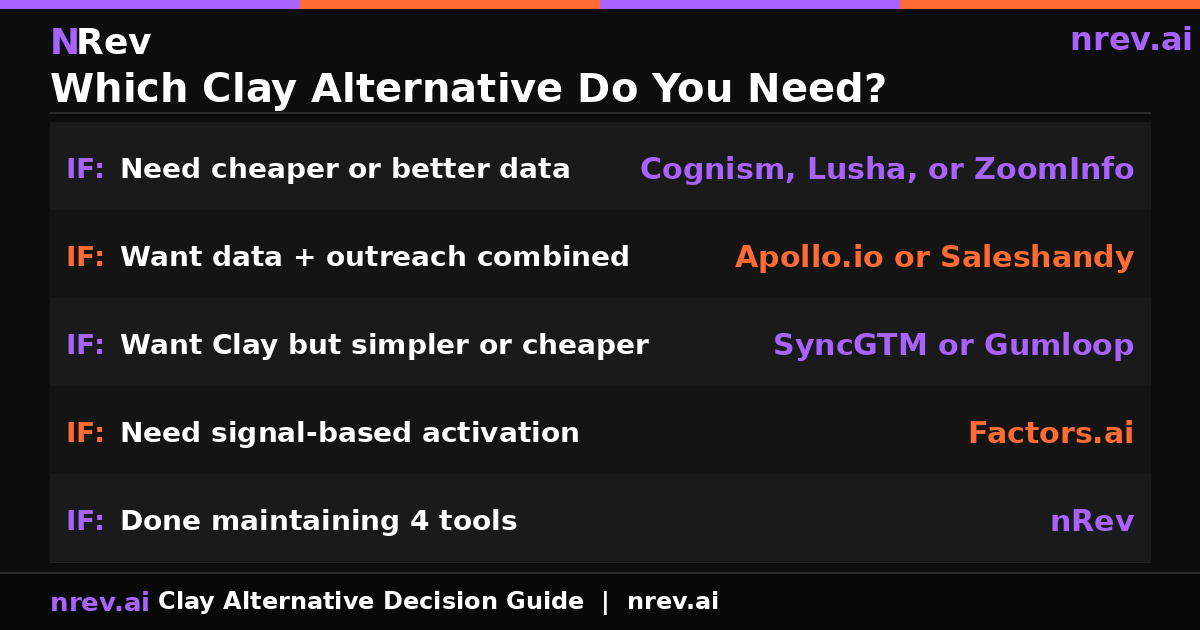
Alt text: Which Clay alternative do you need decision guide data enrichment tool outreach workflow GTM execution 2026Caption: Pick the row that matches your frustration. The tool in that row is your answer. Everything else is noise.
According to Forrester's research on sales technology, teams that consolidate their GTM stack see faster ramp times and higher quota attainment. Root source: Forrester primary research. The tool count is not a vanity metric. It directly affects how fast your team moves.
"I just need cheaper or more accurate data." Look at Cognism (if you are targeting Europe), Lusha (if you want simplicity), or ZoomInfo (if you need enterprise-grade depth and have the budget).
"I want data and outreach in one tool." Apollo.io handles the full prospecting-to-email workflow. Saleshandy is the pick if cold email deliverability is your primary concern.
"I like Clay's flexibility but want it cheaper or simpler." SyncGTM is the most direct swap at lower cost. Gumloop is more flexible if you want AI-native automation beyond just sales.
"I need signal-based activation, not cold prospecting." Factors.ai connects intent signals to automated multi-channel actions.
"I am done maintaining four tools to run one GTM motion." That is what nRev was built for.
The honest answer is that there is no single best Clay alternative because these tools solve different problems. The biggest mistake we see teams make is swapping one data enrichment tool for another when the real issue is that enrichment alone was never going to be enough.
Figure out which category your frustration falls into. The right tool follows from there.
If you have read this far, you have a good sense of which category fits your situation. For teams in Categories 1 to 3, we genuinely think those tools are solid choices for their specific use cases.
If you are in Category 4, the team that is done maintaining a multi-tool stack, we would love to show you what nRev looks like in action.
Start with free credits and see for yourself
Frequently Asked Questions
What is the best free Clay alternative?

Is Apollo better than Clay?
What is the cheapest Clay alternative?
Can I replace Clay plus Zapier plus n8n with one tool?
What changed in Clay's pricing in March 2026?
Do I need Clay if I already use Apollo?
How is nRev different from Clay?