


Agentic Workflow for GTM: Why Rules Beat Black-Box AI
In early 2024, a revenue leader noticed something unsettling.
Nothing was broken. No alerts. No incident tickets. Yet the pipeline dashboard did not look right.
A few deals had shifted stages. Some accounts were suddenly marked high risk. Forecast confidence dipped overnight. After digging through logs and Slack threads, the reason surfaced: an AI agent had been quietly running a CRM hygiene routine nobody had signed off on.
Nothing catastrophic happened. But something far more dangerous did. Trust quietly disappeared.
This moment captures a growing tension inside GTM teams today. AI is powerful. But when it starts acting inside systems that decide revenue, commissions, renewals, and contracts, unpredictability becomes a liability. This blog explains why GTM teams need a deterministic agentic workflow with clear rules, not black-box autonomous AI agents that nobody can explain.

Two Types of AI Agents and Why the Difference Matters
Not all AI agents work the same way. Before talking about what GTM teams should do, it helps to understand what they are actually choosing between.
Autonomous Agents
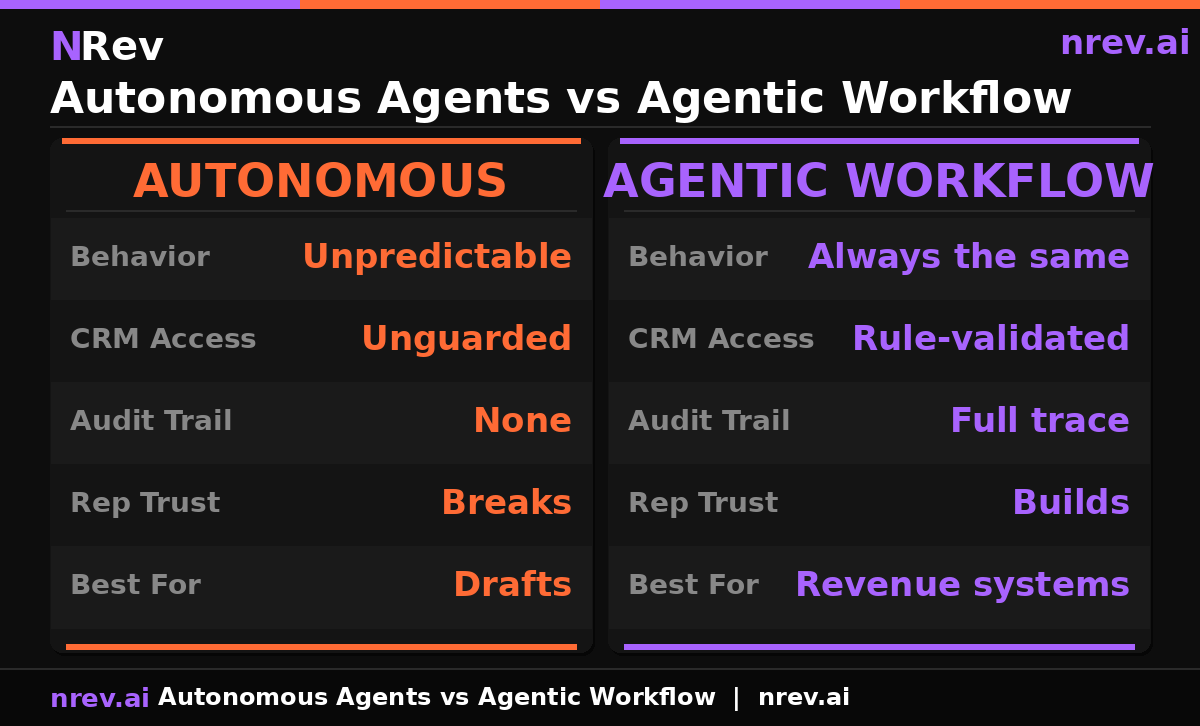
These agents run on AI models that can give different answers to the same question. Give them the same instruction twice and you may get two different results. They are great at open-ended tasks: drafting emails, summarizing calls, generating ideas.
But their internal reasoning is invisible. Their behavior can shift without warning. Think of them as very smart interns. Fast, creative, and sometimes surprising. That is fine for a first draft. It is not fine for your revenue data.
Agentic Workflows
These systems still use AI, but differently. AI recommends. Rules decide.
For the same inputs, the output is always the same. Every action is logged. Every change is traceable. Think of it as AI with a seatbelt and a full audit trail. You can see what happened, why it happened, and undo it if needed.
For GTM teams, this is not a theoretical distinction. It is an operational one that shows up in forecast confidence, commission accuracy, and whether your reps trust the system they work in.
The Practical Difference Most Teams Miss
Autonomous agents work like an intern you hand a goal to. You say "get me 50 webinar leads" and they decide how to do it from start to finish. Agentic workflows flip this model entirely.
With an agentic workflow, humans define the steps and rules. Who to target. How to follow up. What counts as a qualified lead. What gets written to CRM and when. AI handles specific tasks inside that structure, not outside it.
The simplest version of the distinction: autonomous AI agents try to run your GTM motion. Agentic workflows use AI to power it.
In outbound sales automation, this difference is what separates a system your reps actually trust from one they quietly disable after three weeks.
A Simple Way to Think About AI in GTM Systems
Most GTM teams do not actually need fully autonomous AI. They need what you could call asymmetric intelligence.
AI is great at thinking: generating, summarizing, drafting, spotting patterns. Deterministic systems are great at doing: executing, logging, routing, writing to CRM.
The mistake happens when teams let one replace the other. The pattern that works is simple: AI observes, AI recommends, rules execute, humans stay accountable.
Ideas can be fuzzy. Revenue systems cannot be. If AI creativity touches CRM directly, trust breaks. If AI creativity feeds structured rules, GTM scales.
This is the core of what makes a well-built GTM workflow automation system different from a chaotic one.
Why GTM Teams Feel AI Risk Faster Than Others
Sales and revenue systems are not just tools. They are systems of record.
Forecasts drive hiring and board decisions. CRM data drives commissions and renewals. Account ownership affects real customer relationships.
When AI behaves differently without a clear reason, it creates forecast volatility, commission disputes, and RevOps fire drills. Reps stop trusting the tools they are supposed to use.
According to G2's 2026 Best Agentic AI Software report, AI agent programs with a human in the loop were twice as likely to deliver cost savings of 75% or more. Root source: G2 primary research, 2026. Structure produces results. Autonomy without guardrails produces risk.
This is exactly why b2b buying signals and any AI-driven enrichment that touches CRM records needs to run through validated, rule-based execution rather than open-ended agent autonomy.
Real Brand Stories That Changed Enterprise AI Thinking
These are real stories. They shaped how nRev thinks about building agentic workflows.
Salesforce: Agents Yes, Chaos No
In 2024, Salesforce introduced Agentforce while consistently emphasizing governance, permissions, and predictable execution tied to Customer 360.
In 2025, Salesforce publicly disclosed it had reduced customer support headcount by around 4,000 roles after deploying AI agents. Salesforce later clarified this was part of workforce rebalancing, underscoring the real challenges around AI's impact on enterprise GTM teams.
The message was clear: AI agents are powerful, but enterprise data requires guardrails. Autonomy without control does not scale in GTM systems.
Microsoft Copilot: From Magic to Managed
Across 2024, Microsoft shifted Copilot messaging from "AI that does things for you" to "AI that works within your policies."
Admins gained clearer control over what Copilot can read, what it can write, and where approvals are required. This was not a rollback. It was a realization: AI touching business data needs deterministic boundaries.
Klarna: When Speed Outran Control
In mid-2024, Klarna acknowledged that its aggressive AI-led customer support automation had gone too far. Costs dropped initially. But customer satisfaction suffered. Edge cases piled up. Trust eroded.
Klarna rolled back parts of the automation and reintroduced stronger oversight. The lesson: speed without predictability eventually breaks customer-facing systems.
Air Canada Chatbot Ruling
In 2024, a Canadian court ruled against Air Canada after its AI chatbot gave a customer incorrect fare information. The airline argued the chatbot was not an official source. The court disagreed.
The takeaway for GTM teams is direct: if AI speaks or acts on your behalf, you own the outcome.
The Hidden Risks of Black-Box Agents in GTM
These problems rarely appear on day one. They surface weeks later.
Silent changes in lead scoring or deal risk with no explanation. Pipeline stages that shift and nobody knows why. Commission calculations that cannot be audited. Inferred or hallucinated data becoming truth in CRM records.
Reps start disabling tools they do not trust. This is not bad AI. It is misapplied AI.
The risk is not the technology. It is the boundary. Autonomous AI agents excel at generating and suggesting. They break trust when they are allowed to decide and execute inside revenue systems without a rule layer protecting the data.
This pattern shows up consistently in revenue operations software evaluations, where teams discover the gap between what a tool promises and what it safely can do inside live CRM data.
How High-Performing GTM Teams Use AI Without Losing Control
The winning pattern is becoming clear across GTM teams that have scaled AI without losing rep trust.
AI suggests. Systems decide. CRM remains the single source of truth. Every change has a traceable reason. Creative AI tasks stay sandboxed away from revenue records.
Emails, call summaries, and talk track suggestions? Let AI generate freely. Pipeline stages, account ownership, revenue fields, records that affect commissions? Put rules in charge.
This is the foundation of how nRev approaches outbound automation: AI discovers the insight and recommends the action, but execution flows through a deterministic workflow layer that logs every step and can be audited, rolled back, or paused at any point.
It is also how an AI SDR stays useful rather than becoming a liability: the AI drafts and suggests, the rules govern what gets sent and when.
According to Salesforce's research on agentic AI trends in 2026, early adopters who combined deterministic guardrails with AI automation saw agents shift from "usually doing the right thing" to "always hitting the target outcome." Root source: Salesforce primary research, 2026. That is the difference a rule layer makes.
The AI Safety Checklist for RevOps and GTM Teams
Before enabling any AI that touches your CRM, run through this checklist. If you answer no to more than two, pause before scaling.
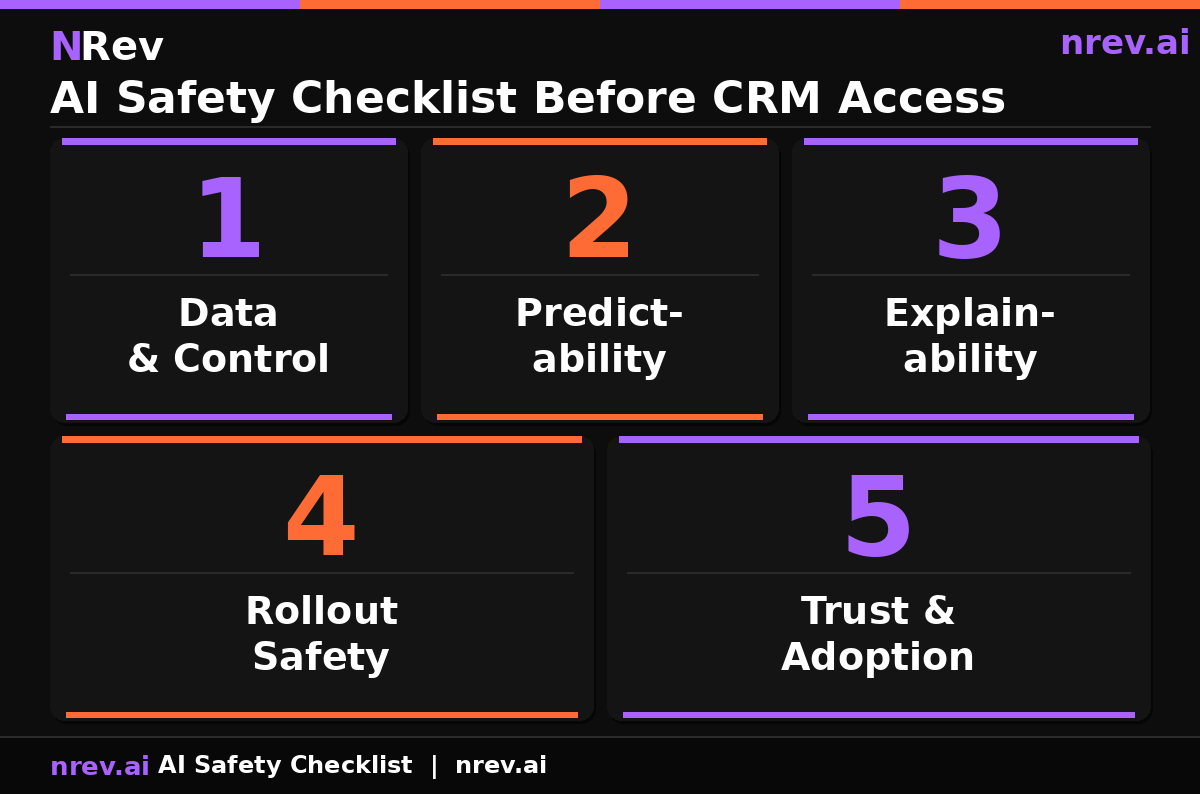
Data and ControlIs - CRM the single source of truth? Are AI write-backs validated before execution?
Predictability - Do the same inputs always produce the same outputs? Are business rules versioned and auditable?
Explainability - Can you answer "why did this change?" in one sentence? Is there a visible audit trail for every automated action?
Rollout Safety - Can AI run in suggest-only mode first? Are model changes tested on historical data before going live?
Trust and Adoption - Can reps escalate or override AI decisions? Is AI helping reps or surprising them?
The Decision nRev Had to Make
When we started building nRev AI, we faced a tempting choice.
The market was excited about fully autonomous AI agents. Systems that think, decide, and act end-to-end. We could have built that.
But every conversation with CROs and RevOps leaders surfaced the same concern: "Please do not let anything unpredictable touch my CRM."
So we chose a harder path. Instead of black-box agents, we built agentic, deterministic workflows where AI discovers insights and recommends actions, but execution happens through transparent, repeatable rules. This is the philosophy behind our manifesto and every product decision we have made since.
AI helps you see better. Rules ensure you act safely.
That choice does not make for the flashiest demo. It makes for systems teams actually trust and keep using six months after they go live. That philosophy now shapes every GTM workflow we design.
Stop Letting AI Surprise Your Revenue Team
The future of GTM is not about how autonomous your AI is. It is about how predictable your systems remain under pressure.
If the AI inside your GTM stack cannot explain its actions, changes behavior silently, or writes to CRM without guardrails, it is not accelerating revenue. It is quietly taxing trust.
The teams that scale are not removing humans from the loop. They are designing AI that knows exactly where it belongs. Deterministic intelligence is not a limitation. It is how modern GTM teams move fast without breaking confidence.
See how nRev AI builds agentic workflows your team will actually trust and run your first deterministic GTM play today.
Frequently Asked Questions
What is an agentic workflow?

What is the difference between deterministic AI and autonomous AI agents?
Why do GTM teams need agentic workflows instead of autonomous AI agents?