


The FOMO Is Real (And Manufactured): Scroll through LinkedIn right now and you will see it.
"GTM Engineer — $180K + equity."
"Building our outbound engine. Hiring technical GTM."
"Just wired my 47-node Clay workflow. Who else is automating?"
The tightness in the chest is familiar. Everyone else is building the future. You are still using spreadsheets.
Founders and operators respond the way they always do. They open the tutorials. Learn about nodes, triggers, webhooks, error handlers. Draw diagrams. Buy the tools.
And they hit the same wall.
The work is not hard. It is distracting. Every hour spent debugging an API response is an hour not spent on strategy, messaging, or actually talking to customers.
The FOMO is not lying. Something real is happening in GTM. But the solution the market has been sold, hire GTM Engineers, become one, or fall behind, might be the wrong answer to the right problem.
What a GTM Engineer Actually Does (The Honest Breakdown)
Let us get specific. If you are hiring or becoming a GTM Engineer, here is the actual job description.
Data enrichment waterfalls. Pulling from Clearbit, Apollo, LinkedIn, custom scrapers, then merging, deduplicating, and keeping it all fresh.
CRM automation. Routing leads by territory, score, and persona. Updating fields. Triggering sequences. Cleaning the mess when rules conflict.
Tool integration. Your outbound platform talks to your CRM, which talks to your product analytics, which feeds your scoring model.
Someone has to map those outputs, handle the edge cases, and fix it when the API changes.
Workflow logic. If this, then that. Unless this other thing. With retry logic. And error handling. And a dashboard to monitor it all.
Maintenance. Because waterfalls break. APIs throttle. Data decays. Someone has to be on call for the machine.
Here is what surprises most teams: maybe 20% of this is strategic. The rest is plumbing. Valuable plumbing, sure. But plumbing.
The GTM Engineer role exists because tools are fragmented and technical, not because GTM is inherently engineering. Teams hire humans to bridge a gap that better technology should close.
The Hidden Costs Nobody Talks About
The job postings do not mention this part.
The hiring cost. $120K to $200K in salary. Equity.
Benefits. Three months to ramp. Six months to build something stable. A year before they are truly autonomous.
The dependency cost. Every new campaign needs a ticket. Every broken workflow needs a hero.
Your best strategist, the person who should be testing messaging, is waiting in a Slack thread for a webhook fix.
The opportunity cost. While you are recruiting, interviewing, onboarding, your competitor with smarter tooling just launched three experiments.
The career cost. Talk to GTM Engineers six months in. They are not burnt out on strategy.
They are burnt out on maintenance. On being the only person who understands the spaghetti. On never building, only fixing.
Teams who hire one often hire two. Then realize their "growth infrastructure" is actually a people bottleneck wearing technical clothing.
Operators who try to become GTM Engineers themselves learn just enough Python to be dangerous, just enough SQL to be frustrated. They want to orchestrate revenue, not debug it.
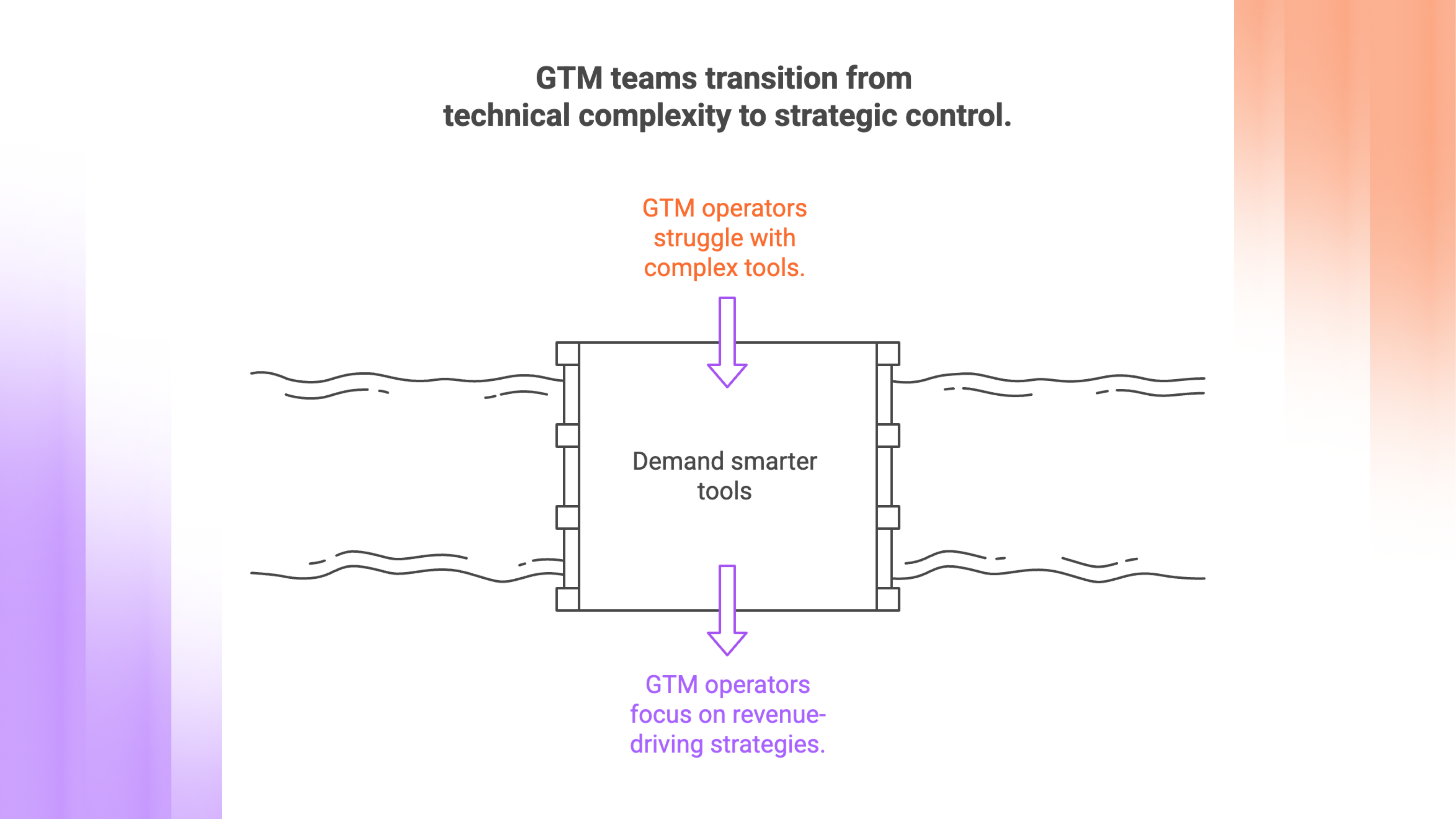
There is a tension breaking GTM teams right now. They need the outcomes these engineers deliver. But the model, hiring humans to manage complexity that tools should handle, is cracking.
The Fork: Two Paths Forward
Teams stand at a decision point. Both paths lead to functioning GTM infrastructure. Only one fits most teams.
Path A: The GTM Engineer Route
Hire technical talent. Buy best-of-breed tools. Wire them together. Accept maintenance as ongoing cost. Train operators to file tickets, not flip switches.
This works. For large teams with dedicated resources. For complex custom integrations. For regulated industries with specific data architectures.
GTM Engineer vs. GTM Native AI
It is also slow, expensive, and brittle. The person who understands the system becomes the system. When they leave, knowledge walks out the door. When they stay, they drown in upkeep.
Path B: The Abstraction Route
Deploy AI that handles the engineering layer. Let operators describe outcomes in plain language.
Let the system execute enrichment, routing, orchestration. No maintenance. No bottlenecks. No headcount dependency.
This works for early-stage teams who need speed. For founders who want control without becoming technical. For operators who would rather test messaging than debug webhooks.
Most teams default to Path A without questioning if Path B fits better. They assume sophistication requires complexity. They are wrong.
What "Door Number Three" Actually Looks Like
Theory is easy. Execution is where paths diverge.
Here is a concrete example. A team needs to find their ICP: founders hiring SDRs in Bangalore who match their target account list.
Path A approach:
Wire five tools. Scrape job boards. Validate locations. Cross-reference against account lists. Deduplicate. Handle API limits.
Build the dashboard. Document it. Maintain it. Hope the person who built it does not leave.
Path B approach:
Describe the ICP once. "Founders hiring SRs in Bangalore who match our target account list."
The system handles job scraping, location validation, cross-referencing, deduplication. The stuff that used to need a diagram and a prayer.
The interface disappears. The strategy does not.
This is what nRev built. Not a replacement for human judgment, but for the work humans never wanted to do. The engineering layer becomes infrastructure, not a job description.
Who Should Actually Hire a GTM Engineer?
Here is the contrarian truth. Sometimes you need one.
Complex custom integrations that no platform handles out of the box. Regulatory requirements that demand specific data architectures. Unique technical constraints that AI cannot yet navigate.
Even then, the math has shifted. AI handles 80% of execution. A GTM Engineer focuses on the 20% that truly requires human design. The role becomes strategic, not operational.
The problem is not that GTM Engineers exist. It is that teams hire them to solve the wrong problem. They hire plumbers because the pipes are broken, instead of demanding better plumbing.
For everyone else, for the founders who need speed, the operators who want control, the teams who cannot afford six months of infrastructure building, there is a better question than "who should we hire?"
The better question is: what if the tools just worked?
The Bottom Line: Stop Pretending
Most GTM operators did not get into this to debug webhooks. They did not dream of node-based logic and API rate limits. T
hey wanted to build pipeline, test messaging, understand customers, drive revenue.
The best operators want to orchestrate, not engineer. They want to say "find me this audience" and have it happen, not file a ticket and wait.
They want to launch a campaign today, not after the next sprint.
The industry has asked them to become something else. To learn just enough Python to be dangerous. Just enough SQL to be frustrated. To treat technical complexity as a rite of passage.
It does not have to be this way.
The future is not "become a GTM Engineer or get left behind." It is control without complexity. Strategy without the spaghetti.
Revenue operations that actually operate on revenue, not on infrastructure.
The operators who never wanted to be engineers finally get to stop pretending.
What Is Your Move?
Three options sit in front of you.
1. Hire a GTM Engineer
Invest the time, the money, the equity. Build something custom. Accept the maintenance, the dependency, the bottleneck. This is the right choice for some. Not for most.
2. Become a GTM Engineer
Learn the nodes, the webhooks, the error handlers. Spend your strategic hours on plumbing. Join the LinkedIn threads about workflow design.
This is a valid path. It is also a distraction from the work that actually scales revenue.
3. Look for door number three.
Demand tools that handle complexity without requiring you to become technical to control them. Deploy AI that executes while you orchestrate. Keep the strategy visible and the plumbing invisible.
nRev built door number three. Not because hiring is wrong, but because it should not be the default.
Not because engineers are unnecessary, but because 80% of what they do should be infrastructure, not headcount.
The teams that choose door number three move faster. They test more. They scale without adding bodies to manage the machine.
What is your move?