


You are running campaigns. The leads are coming in. The numbers look decent on paper. But the pipeline is thin, the sales team is frustrated, and nobody can clearly explain why.
This is the most common problem in B2B SaaS right now. It is not a lead shortage. It is a lead quality and timing problem. Teams are collecting contacts without context, seeing buyer signals without acting on them, and measuring the wrong things entirely.
This guide is for founders, sales leaders, and marketing teams at B2B SaaS companies who are tired of volume metrics that never translate to revenue. We cover what a modern lead acquisition strategy actually looks like in 2026, how to spot real buying signals before your competitors do, and how to build a system where the right people get contacted at the right time without manual effort.
No buzzwords. No funnel diagrams. Just a plain-language breakdown of what works and why.
What Is a Lead Acquisition Strategy and Why Most Get It Wrong
A lead acquisition strategy is the system your business uses to find, attract, and bring in potential customers who have a genuine chance of buying from you.
Most people think of it as a list of tactics: run ads, publish gated content, send outbound emails, collect names. That is not a strategy. That is a to-do list.
A real lead acquisition strategy answers three questions:
Who is worth engaging right now? What tells us they are ready? What should we do about it?
For B2B software companies in 2026, this matters more than ever. Buyers no longer follow a predictable path. They research independently, evaluate quietly, and only raise their hand when they have already made up most of their mind.
The companies winning on the pipeline today are not the ones generating the most leads. They are the ones who know which leads actually matter and act on them quickly.
The Real Reason Your Leads Are Not Converting
Your dashboards look healthy. Leads are flowing in. Campaigns are running. And yet the pipeline is thin and the sales team is frustrated.
This is not bad luck. It is a structural problem.
Most lead acquisition approaches were built for a world where buyers responded to campaigns, moved through linear funnels, and converted because someone captured their email. That world is gone.
Here is what is actually breaking down in most B2B SaaS teams today.
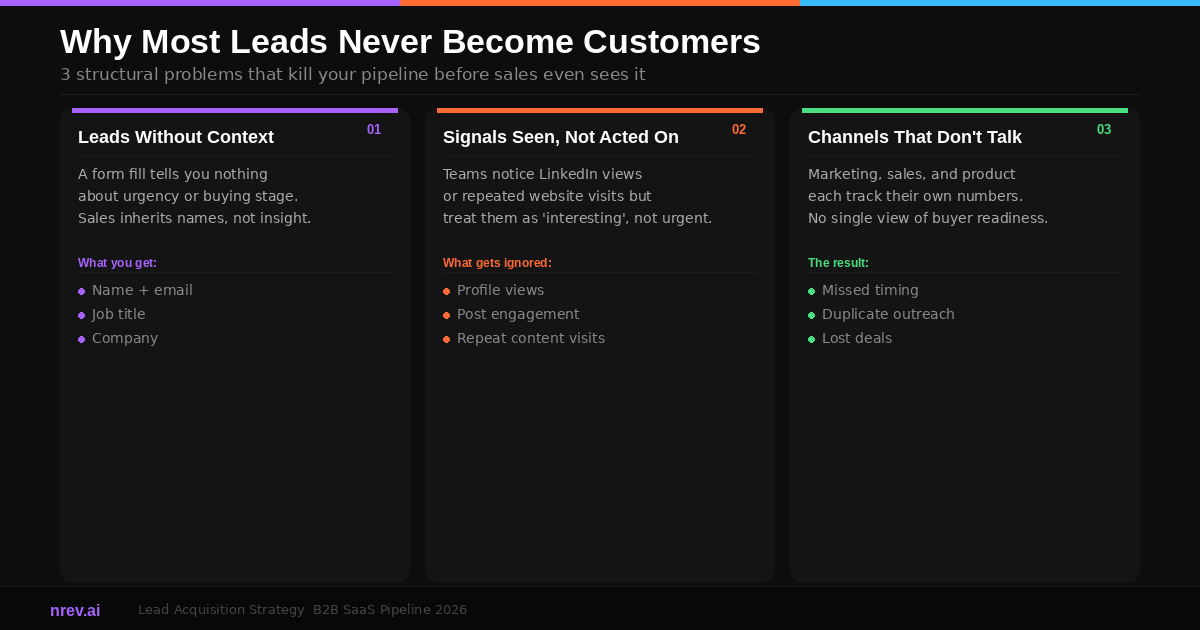
Leads captured without context. A form fill is just a data point. It tells you someone clicked something. It says nothing about whether they are ready to buy, whether their company is the right size, whether there is a budget, or whether the timing is right. Sales inherits a name and a company, not a qualified opportunity.
Signals seen but not acted on. Your team already has useful information. Someone from a target company visited your site three times this week. A prospect liked two of your LinkedIn posts. A person followed your CEO. These are real buying signals. But because there is no system to act on them, they sit unread while the moment passes.
Channels that do not talk to each other. Marketing tracks content performance. Sales tracks outbound replies. Product tracks usage. No one connects these into a single picture of whether a given account is actually showing signs of readiness. Without coordination, every team makes decisions with incomplete information.
The result is that most B2B SaaS companies generate more leads every year and convert a smaller percentage of them into real opportunities.
This is not a tool problem. It is a coordination problem.
The Shift from Collecting Leads to Reading Buyer Signals
Here is the question most teams are not asking.
Instead of "how do we get more leads?" ask "what tells us a buyer is worth engaging right now?"
The answer is signals. A signal is a real, observable behaviour that tells you something meaningful about where a buyer is in their thinking. Signals are dynamic. They appear, grow stronger, fade, and reappear as buyers move through their own internal process.
Examples of signals worth paying attention to:
Someone visits your website from the same company three times in a week. A prospect engages with your content on LinkedIn repeatedly. A buyer follows your competitor's company page. Multiple people from the same account connect with your team. A trial user explores a feature they have not touched before.
None of these require a form fill. None require a buyer to raise their hand. But all of them tell you something real about where a person is in their thinking.
When you build your lead acquisition strategy around signals instead of static contact forms, the whole system changes. You stop chasing cold leads and start having warm conversations with people who are already paying attention.
This is the foundation of what modern teams are calling a signal-driven approach to outbound automation.
How LinkedIn Fits Into a Modern Lead Acquisition Strategy
LinkedIn is often treated as a place to post content and collect likes. That is fine but it misses the real opportunity.
In a modern lead acquisition strategy, LinkedIn plays two distinct roles: it creates awareness and it generates signals.
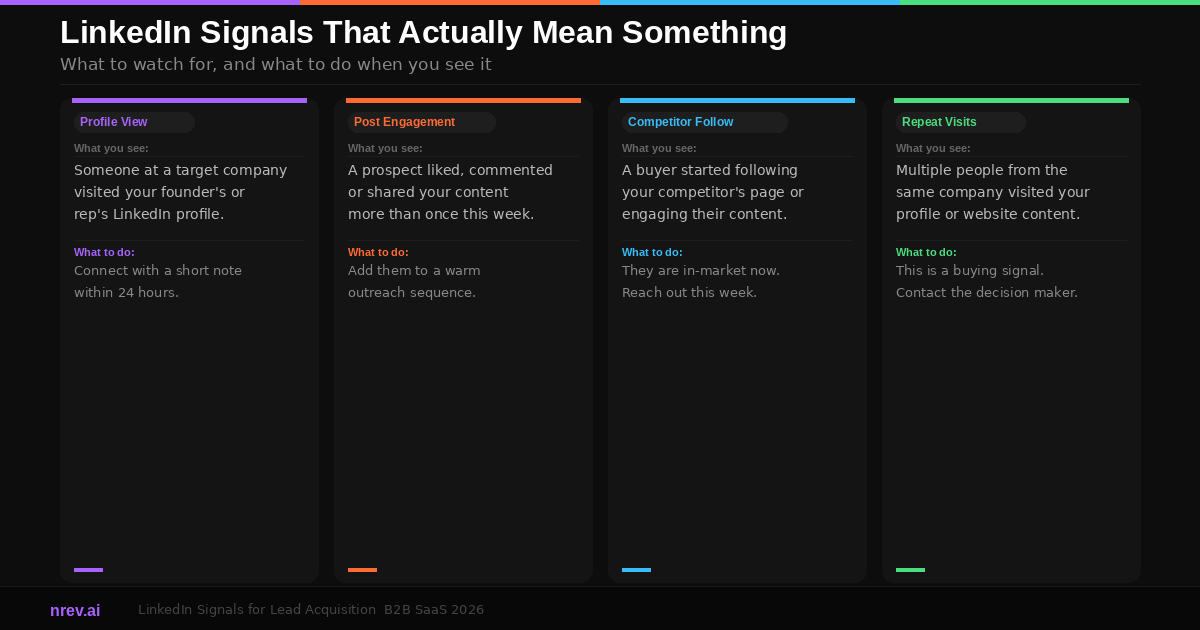
Every profile view, comment, connection request, and competitor follow is a piece of behavioural data. When you know how to read it, LinkedIn becomes a live feed of who is paying attention and why.
Here is how different roles on your team can use it:
Your founder or CEO on LinkedIn. When your founder posts consistently about the problems your product solves, they attract exactly the kind of people who have those problems. Every profile view from someone at a target company is a warm signal. That person already knows who you are before you reach out.
Your sales reps on LinkedIn. Before sending a cold message, reps should spend time engaging with the content of people at target accounts. Like posts. Leave thoughtful comments. Connect without pitching. By the time they send a message, it is not cold. The prospect has seen their name several times already.
Monitoring competitors on LinkedIn. Some of the strongest buying signals have nothing to do with your brand. When someone starts following your competitor, they are in-market and evaluating options. That is the moment to make contact. This is something you can systematise using LinkedIn warm network automation workflows.
The point is not to use LinkedIn more. The point is to use it as an intelligence layer, not just a broadcasting platform.
The 5-Layer Lead Acquisition Framework
A lead acquisition strategy is not a list of channels. It is a decision system. It determines who to engage, when to engage, and what to do next.
For B2B SaaS companies, the most effective strategies share five foundational layers.
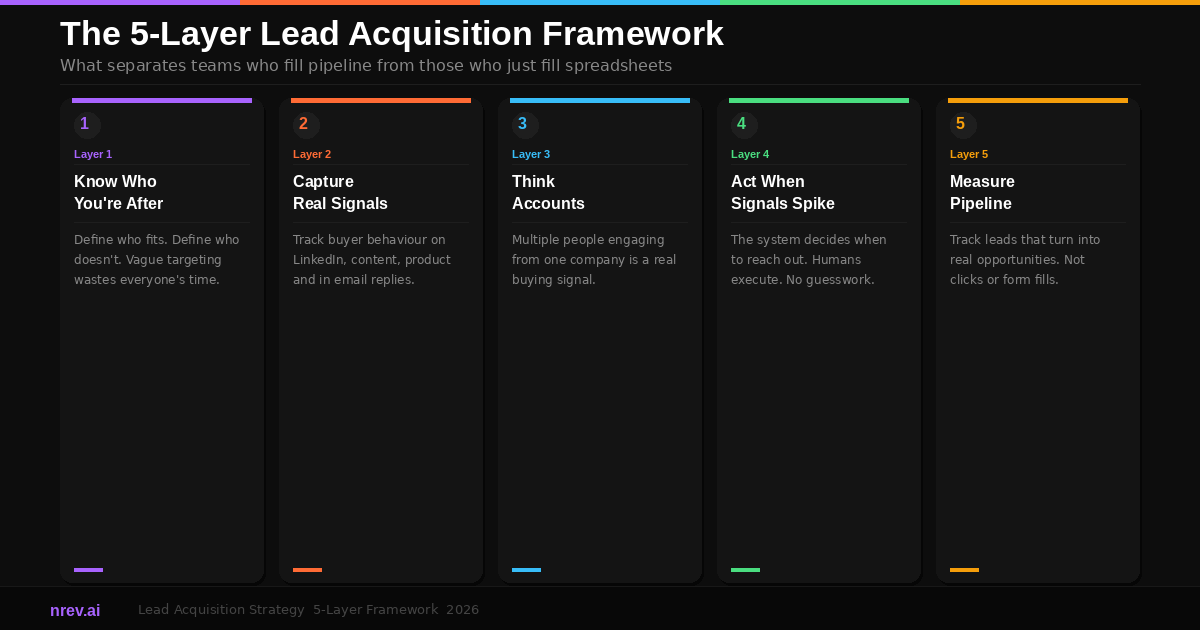
Layer 1: Know Exactly Who You Are After
Broad targeting feels efficient. It is not.
When you try to speak to everyone, you end up building content, campaigns, and outreach that resonates with no one strongly enough to convert. The clearest sign of a weak lead acquisition strategy is a long list of potential customers and very little pipeline.
Strong targeting means knowing who fits your product well and being explicit about who does not. Define the company types, sizes, industries, and roles that consistently become good customers. And have the discipline to ignore leads that look attractive but do not actually match.
This is not about limiting your market. It is about focusing your efforts where they produce real results. See how targeting connects to B2B lead scoring in practice.
Layer 2: Capture Signals Across Every Channel
Once you know who you are targeting, you need a way to know when those people are showing genuine interest.
Signals come from many places: LinkedIn engagement, repeat visits to your website or content, product usage patterns if you have a trial, outbound email replies, and competitor following behaviour.
The goal is not to collect more data. It is to identify patterns that indicate real buying intent. Someone downloading your whitepaper once is not a strong signal. Someone reading four pieces of your content in a week while also following your company page on LinkedIn is a very different story. Our guide to buying signals covers what to look for in more detail.
Layer 3: Think in Accounts, Not Individuals
One person at a company showing interest is often just curiosity. Three people from the same company showing interest independently is a genuine buying signal.
This is one of the most important shifts in how modern teams think about lead acquisition. Most scoring systems focus on individual behaviour. But purchase decisions in B2B are almost never made by one person. Multiple people evaluate, advocate internally, and collectively move toward a decision.
When your system can aggregate signals across multiple people at the same company and surface accounts where momentum is building, your pipeline quality goes up significantly.
Layer 4: Act Quickly When You See a Signal
Collecting signals and not acting on them is one of the most common failure points in lead acquisition.
Timing matters enormously. A buyer who was actively researching your category two weeks ago may have already made a decision if you waited too long. The workflows you build around signals need to produce fast, coordinated responses.
This means clear rules for what triggers action, clear ownership of who acts, and a coordinated response across channels. The system should decide when a human should reach out, not the human manually combing through a spreadsheet.
Layer 5: Measure What Actually Matters
The metrics most teams track for lead acquisition are activity metrics: number of leads, cost per lead, form fills per campaign. These numbers describe how busy your team is. They say nothing about whether your efforts are producing revenue.
The numbers worth tracking are further downstream: what percentage of leads turned into real sales conversations, how long it takes for an interested account to become a closed deal, and what the cost of acquiring a customer looks like over time.
LinkedIn Playbooks That Feed Your Lead Acquisition Strategy
Here are five LinkedIn-based plays that work well within a signal-driven lead acquisition strategy.
Play 1: Founder-Led Demand Creation
Your founder or CEO posts consistently on LinkedIn about the real problems your product addresses. Not product announcements. Not company milestones. Specific, honest content about problems your best customers face.
Over time, this builds an audience of people who fit your target profile. Every person who follows, comments, or repeatedly engages is a warm prospect. That list feeds directly into your outbound prioritisation.
Play 2: Warm Reps Before Cold Outreach
Your reps identify target accounts and begin engaging with the content of people at those companies weeks before sending any message. They become familiar names in that person's LinkedIn feed before any pitch is made.
When the message eventually arrives, it does not feel cold. This approach dramatically improves response rates compared to standard cold outreach.
Play 3: Competitor and Category Signal Monitoring
Your team monitors who is engaging with competitor content, following competitor pages, and asking questions in industry communities. These are people already thinking about solutions in your category.
Reaching them before they request a competitor demo is a high-value, often overlooked lead acquisition opportunity. This play is a core part of how nRev approaches signal-based outbound.
Play 4: Engagement-Triggered Follow-Ups
Instead of sending follow-ups on a fixed schedule, you send them when something meaningful happens. A prospect likes three posts in a week. Multiple people from the same company engage with your content in the same period. A person who went quiet for a month suddenly starts engaging again.
These moments are invitations to re-engage and they are far warmer than any arbitrary follow-up cadence.
Play 5: Consistent Value Over Volume
The teams that win on LinkedIn long-term are not the ones posting the most. They are the ones whose content is consistently useful to the specific people they are trying to reach.
When your sales team, founders, and marketing all operate around a shared understanding of who you are helping and what those people care about, your content compounds. Each piece builds recognition and trust with the exact people who matter.
When you measure these things, your entire team makes better decisions. Marketing stops optimising for clicks. Sales stops chasing low-quality inbound. Everyone focuses on what actually moves revenue.
What to Actually Measure in Your Lead Acquisition Strategy
Your lead acquisition strategy should be measured on how much revenue it produces, not how many leads it creates.
The shift sounds obvious. Almost no one actually makes it.
Here are the four numbers that matter most.
Lead to pipeline conversion rate. Out of every 100 leads you bring in, how many turn into real sales conversations? If this is below 10%, your targeting or your qualification process is broken.
https://www.nrev.aiPipeline velocity. How long does it take for a new lead to become a closed deal? This tells you whether your strategy is attracting people who are ready to buy or just people who are curious.
Customer acquisition cost. How much does it cost you to acquire one paying customer when you add up all the people, tools, and spend involved? This tells you whether your current approach can scale.
Revenue influenced by signals. When you look at your won deals, how many of them involved observable buying signals before any sales conversation happened? This is the clearest indicator of whether your signal strategy is working.
When you track these numbers consistently, your team naturally makes better decisions. You stop celebrating lead volume and start asking harder questions about quality.
How nRev AI Helps You Tie It All Together
Most B2B SaaS teams already have the ingredients for a strong lead acquisition strategy. What they lack is the connective tissue that makes signals, channels, and people work together.
That is exactly what nRev AI is built for.
nRev is an AI workflow platform for sales and marketing teams. It connects your data sources, surfaces buying signals in real time, and automates the actions that your team would otherwise have to do manually and inconsistently.
With nRev, you can build workflows that monitor LinkedIn activity across target accounts and alert your reps when engagement spikes. You can combine data from multiple sources into a single account-level view that shows where buying intent is building. You can automate personalised outreach triggered by real signals instead of scheduled sequences. And you can track everything back to pipeline so you always know which activities are actually working.
This is what it looks like when lead acquisition stops being reactive and starts being intentional.
Start building signal-driven workflows on nRev AI and set up your first play in about 10 minutes.
Frequently Asked Questions
What is a lead acquisition strategy?

What is the difference between lead generation and lead acquisition?
How do you build a lead acquisition strategy for B2B SaaS?
What is signal-based lead acquisition?
How does LinkedIn fit into a lead acquisition strategy?
Why are my leads not converting to pipeline?
What metrics should I track for lead acquisition?