


GTM System: How to Build a Go-to-Market Strategy That Scales
Most companies believe they have a go to market strategy.
What they actually have is a launch plan.
They obsess over launch dates, messaging decks, and campaign checklists. Then they are surprised when growth stalls 60 or 90 days later. The pipeline slows. CAC creeps up. Sales blames marketing. Marketing blames the product. And leadership asks the wrong question: "Do we need another launch?"
Go to market is not an event. It is not a phase. And it is not a one time collaboration between marketing and sales.
A GTM system is an operating system. It defines who you are built for, how demand is created and converted, why customers choose you repeatedly, and how your company adapts as markets shift. Product launches may introduce something new. A GTM system determines whether it scales, compounds, and survives competitive pressure.
GTM as a System, Not a Strategy Document
Most go to market strategies do not fail because they are wrong. They fail because they are finished.
A GTM plan gets written, reviewed, approved, and archived, while the market it was designed for keeps moving. Buyers change how they evaluate. New competitors appear. Channels that once worked quietly decay. But the GTM strategy remains untouched, frozen in time like a launch artifact from a different phase of the company.
This is the first and most common GTM mistake: treating GTM as a document instead of a system.
In many organizations, GTM exists as a ritual. A slide deck created ahead of launch. A cross functional meeting to align on messaging. A timeline that ends when campaigns go live. Once the product ships, GTM ownership quietly dissolves. Marketing moves to the next campaign. Sales focuses on this quarter's number. Product starts building the next feature. Nobody owns the systemic question of whether the market is responding the way the company expected.
A launch can create attention. Only a GTM system creates momentum.
The Fundamental Difference Between GTM and a Product Launch
A product launch answers a narrow question: how do we introduce this product to the market?
That is also why product-launch signals from competitors matter more than your own launch calendar. The market moves whether or not you shipped.
A GTM system answers a much harder one: how does this company repeatedly create, convert, and retain demand from a specific type of customer?

Product launches are time bound, campaign driven, and optimized for visibility and excitement. GTM systems are continuous, feedback driven, and optimized for learning, conversion, and expansion.
Confusing the two leads to teams celebrating early signals, press, signups, demos, while missing the underlying truth: nothing is repeatable yet.
High-performing companies treat GTM the way product teams treat software. Always running. Constantly monitored. Regularly updated based on real usage.
In this model, the GTM system governs who the company is built for, why customers choose and stay, how demand is created and captured, and what gets prioritized when markets shift. This is why GTM cannot live in a single function. Marketing may drive awareness. Sales may drive revenue. Product may drive adoption. But the GTM system sits above all three, connecting intent to execution and feedback to strategy.
This is precisely the kind of system nRev AI is built to support, connecting signals, automations, and workflows into one unified GTM motion.
How GTM Evolved and Why Old Playbooks No Longer Work
Every generation of GTM strategy is shaped by the market conditions of its time. The problem is not that older GTM playbooks were wrong. It is that they were built for a different buyer, a different pace, and a different level of competition.
Most GTM failures today happen when companies unknowingly apply yesterday's assumptions to today's market.
Traditional GTM models were designed for a simpler reality. Buyers relied heavily on sales for information. Distribution channels were limited and defensible. Competitive differentiation lasted longer.
In that world, GTM was linear. Product builds. Marketing creates demand. Sales converts leads. This structure worked because buyer journeys were predictable. A prospect encountered a message, requested a demo, spoke to a salesperson, and made a decision.
That world no longer exists.
Modern buyers do not move through funnels. They navigate ecosystems. By the time a buyer speaks to sales, they have often already researched competitors, formed strong opinions, and are seeking validation, not education.
The rise of product led growth emerged as a response to buyer autonomy. If buyers do not want to be sold to, let the product sell itself. But PLG also introduced new complexity. Self-serve adoption does not equal monetization. Usage does not guarantee expansion. Many teams mistake PLG for a GTM strategy. In reality, it is one motion within a broader GTM system.
As GTM complexity increased, something else happened quietly: GTM ownership shifted. No single function could see the entire system anymore. This is why RevOps emerged, not as an efficiency function, but as a systems function.
GTM is no longer a department. It is an organizational capability.
The GTM Engine: Core Components That Actually Matter
Most GTM failures do not happen because teams lack the right components. They happen because those components operate in isolation.
Ask any B2B company about its GTM strategy and you will hear familiar answers: a defined ICP, segmented markets, a value proposition, multiple channels, and a launch plan. On paper, everything is present. In practice, growth stalls.
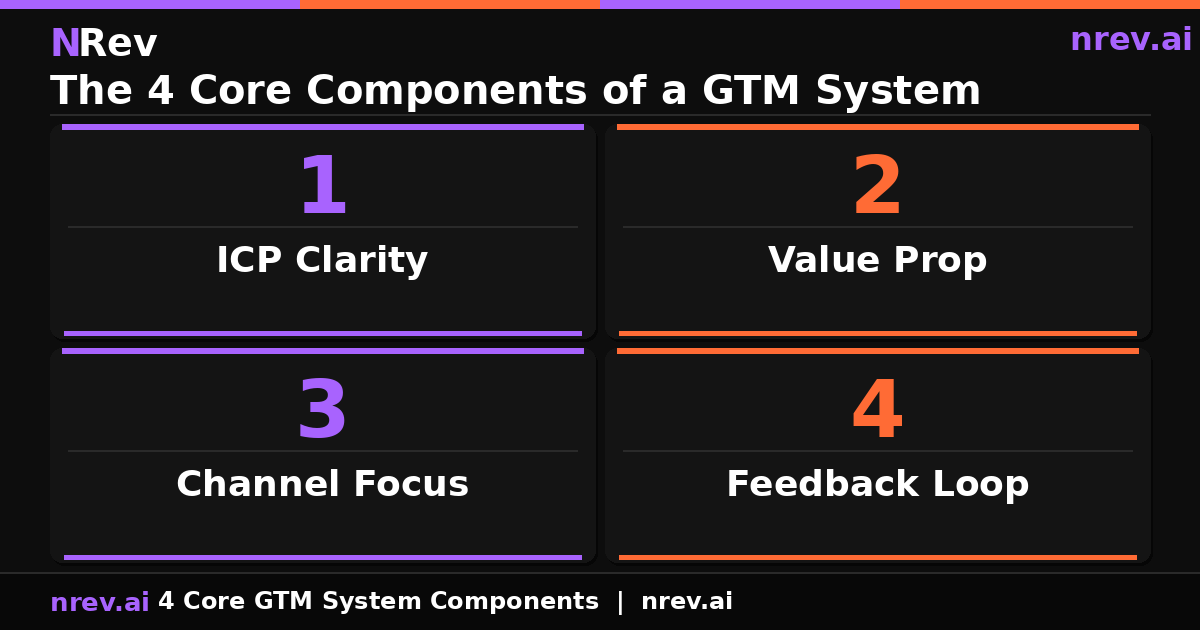
GTM is not a checklist. It is an engine. And engines fail not when parts are missing, but when they are poorly connected.
ICP Clarity Beats Broad Market Ambition
The most dangerous GTM decision a company can make is to define its market too broadly.
Ambition often masquerades as strategy. "Our product is horizontal." "Multiple industries can use this." "We do not want to limit growth." In reality, unclear ICP definitions dilute every downstream GTM decision: messaging, channels, pricing, and sales motion.
Strong GTM systems treat ICP as a constraint, not an aspiration. ICP clarity enables faster qualification, sharper positioning, and more predictable expansion. A product launch may aim to attract as many users as possible. A GTM engine is designed to attract the right ones repeatedly.
This is the kind of B2B buying signals work that separates GTM teams with real pipeline from those with a lot of activity and no traction.
Segmentation Is a Growth Lever, Not a Demographic Exercise
Most segmentation exercises stop at surface level attributes: company size, industry, geography. These are useful but insufficient.
Effective GTM segmentation is behavioral and economic. Who experiences the problem most acutely? Who realizes value fastest? Who expands naturally over time? When segmentation is done well, it informs which features to emphasize, which channels to prioritize, and which objections sales must handle early.
Launch thinking segments for messaging. GTM thinking segments for velocity and retention.
The Value Proposition Is a Living Hypothesis
Many companies treat their value proposition as a branding artifact, crafted once, approved by leadership, and repeated endlessly.
In reality, a value proposition is a hypothesis: we believe this specific customer will choose us for this reason. Markets constantly test that belief. Every lost deal, stalled expansion, or unexpected churn is feedback. Strong GTM systems absorb that feedback and refine the proposition. Product launches freeze the value proposition in time. GTM engines evolve it based on real buying behavior.
Channels Are Experiments, Not Defaults
Channels decay. What worked last year quietly stops working this year. Yet many GTM teams treat channels as fixed commitments.
Strong GTM engines treat channels as experiments with clear success criteria: cost of learning, speed of feedback, quality of conversion. The goal is not channel mastery. It is signal discovery.
Launch thinking asks how to get the word out. GTM thinking asks where real demand consistently converts.
Building GTM from Zero or Resetting It When Growth Stalls
Most companies do not realize their GTM is broken until growth slows. By then, the instinctive response is to push harder: more campaigns, more SDRs, more tools. But scaling effort on top of a misaligned GTM engine does not fix the problem. It amplifies it.
Whether you are building GTM for the first time or trying to restart a stalled motion, the work is the same: strip GTM back to first principles and rebuild it as a learning system.
When growth stalls, the worst move is acceleration. Before adding headcount or budget, high-performing GTM teams pause to ask: who is actually buying and who is just showing interest? Where does momentum consistently slow down? Which assumptions are no longer true?
Most GTM resets begin with an ICP slide. Strong resets begin with customer conversations. The goal is not to validate the original ICP. It is to discover where value is actually being realized. Which customers expand without pressure? Which deals close fastest? Which segments require the least customization?
This is how companies uncover their true growth wedge, often narrower and more specific than expected. Launch thinking asks who should want this. GTM thinking asks who already does.
A GTM reset sacrifices optionality in the short term to regain momentum in the long term. One of the most common GTM mistakes is optimizing too early. Before improving conversion rates or CAC, teams must answer a simpler question: what is the primary GTM motion that works?
Is it founder led sales? Product led with sales assist? Mid-market outbound? Channel partnerships? Strong GTM resets pick one primary motion, support it deeply, and defer everything else.
During GTM resets, the most actionable metrics reveal whether GTM is becoming more efficient. Time to first value. Win rate by segment. Expansion velocity. Payback period by cohort. Launch metrics show attention. GTM metrics show traction.
Tools like outbound sales automation become significantly more effective once the GTM motion is clear. Automating a motion that is not working just produces faster noise.
Data Is Useless Without Decisions
Modern GTM teams are drowning in data and starving for clarity.
Dashboards are full. Attribution models are sophisticated. AI can summarize calls, score leads, and forecast pipeline. Yet despite all this intelligence, many GTM decisions still feel reactive, subjective, and slow.
The problem is not a lack of data. It is a lack of decision ownership.
As GTM became more complex, teams responded by measuring everything. The assumption was simple: more visibility would lead to better decisions. Instead, many organizations ended up with conflicting dashboards across teams, metrics optimized locally but harmful globally, and endless reporting with little behavioral change.
A useful GTM metric has one defining trait: it forces a decision. If a metric does not clearly inform what should change, it is operational noise.
Lead volume without conversion context creates false confidence. CAC without payback timing hides cash flow risk. Churn without cohort analysis obscures root causes.
AI has transformed GTM execution: faster prospecting, automated enrichment, real time call analysis, predictive scoring. But AI does not define strategy. It accelerates whatever strategy already exists. In strong GTM systems, AI shortens feedback loops and surfaces anomalies early. In weak ones, AI simply scales misalignment.
According to Gong's research on sales conversations, teams that act on deal signals within hours consistently outperform those that rely on end-of-week reviews. Root source: Gong primary research. Speed of feedback is a GTM advantage, not just an operational nicety.
The strongest GTM advantage today is not superior data quality. It is feedback velocity. The shift that changes everything is to stop asking what the data says and start asking what decision this data demands.
The Biggest GTM Failure Is Organizational, Not Strategic
When GTM breaks down, the first instinct is to revisit strategy: new positioning, new channels, new tools. But in most cases, the strategy is sound. What is broken is the organization's ability to execute it coherently.
GTM rarely fails because teams do not know what to do. It fails because teams are rewarded for doing different things.
Marketing is rewarded for volume. Sales is rewarded for closed revenue. Product is rewarded for shipping. None of these metrics, on their own, measure GTM health. The result is predictable: each function optimizes locally, while the GTM system degrades globally.
The most damaging GTM misalignments are subtle. Marketing generates demand that sales cannot qualify efficiently. Sales closes deals that do not retain or expand. Product builds features for edge cases instead of core users. Each team can point to success while growth stalls.
In high-performing organizations, GTM has an owner, not a department. This role may sit with a dedicated GTM leader, a CRO with systems authority, or a RevOps leader empowered beyond reporting. The title matters less than the mandate: define the ICP, enforce segmentation discipline, align metrics across functions, resolve trade offs when incentives conflict.
GTM cuts across silos by design. Product decisions shape demand. Marketing decisions shape expectations. Sales decisions shape retention. But most organizations are not designed for shared accountability.
Cross functional GTM only works when feedback flows faster than hierarchy, decisions are reversible, and leaders prioritize system health over functional wins.
Ultimately, GTM maturity reflects leadership maturity. Leaders who treat GTM as a series of initiatives create fragmented execution. Leaders who treat GTM as a system create compounding advantage.
Channels Do Not Win Markets. Focus Does.
Every GTM team feels the same pressure: be everywhere.
The assumption is simple and deeply flawed. More channels equal more growth. In reality, channel sprawl is one of the fastest ways to destroy GTM efficiency.
When teams spread effort across too many channels, messaging becomes generic, feedback loops slow down, and signal gets lost in noise. Each channel begins to look underperforming, not because it is ineffective, but because it is under resourced.
High-performing GTM teams treat channels as constraints, not opportunities. Limited attention. Finite learning capacity. Real opportunity cost. This forces hard choices: which channel gives the fastest signal? Where does the ICP already trust information? Which motion aligns with how buyers actually buy?
GTM focus is not about doing less forever. It is about doing less until something works. Strong GTM systems select one primary channel, support it deeply, instrument it carefully, and only expand after signal is clear.
Channel effectiveness depends on buyer urgency, deal complexity, trust requirements, and sales motion. Strong GTM teams resist trends and prioritize fit.
Every channel experiment should have a clear hypothesis, a defined time window, and explicit success and failure criteria. Without exit criteria, experiments linger, draining attention and budget.
When a channel truly works, it compounds. Sales becomes fluent in objections. Messaging sharpens naturally. Conversion improves without constant reinvention. This is why focused GTM systems often appear lucky from the outside. In reality, they have simply stayed with what works long enough to master it.
GTM workflow automation is most effective when applied to a channel that already has proven signal. Automating a channel before that point just produces faster noise
GTM Is a Continuous Feedback Loop
The most dangerous GTM assumption a company can make is that it has already figured things out.
Markets do not stand still. Buyer expectations evolve. Competitive landscapes shift quietly. Channels decay without warning. GTM success is not about correctness. It is about responsiveness.
Strong GTM teams do not aim to be right. They aim to learn faster than their assumptions expire.
Static GTM models assume stability: a defined ICP, a fixed value proposition, a predictable buying journey. But these assumptions degrade over time. What once felt like product market fit slowly drifts into mismatch. Messaging that resonated becomes background noise. Sales plays that closed deals stall.
Most GTM teams believe they have feedback. In reality, they have telemetry. True GTM feedback answers why a deal stalled, why a customer expanded, and why a segment churned faster. These answers do not live in dashboards. They live in conversations, objections, onboarding friction, and renewal discussions. Strong GTM systems treat qualitative insight as first class input, not anecdotal noise.
Feedback loses value when it moves slowly. In weak GTM systems, sales feedback reaches marketing quarterly. Product insights surface after churn. Leadership reviews lagging indicators. In strong ones, feedback flows weekly, insights are shared in plain language, and decisions follow quickly.
Effective GTM experiments start with a hypothesis, target one variable at a time, and generate learning regardless of outcome. The best GTM insights often come from customers who do not convert or do not stay. Strong GTM systems study churn without defensiveness and analyze expansion paths intentionally.
According to Forrester's research on revenue team performance companies that build rapid feedback loops between sales, marketing, and customer success consistently outperform peers on revenue growth and retention. Root source: Forrester research. Speed of learning is not a soft advantage. It is a measurable one.
Each feedback loop strengthens the system. ICP definitions sharpen. Value propositions clarify. Channels become more efficient. Over time, this creates compounding returns, not through scale, but through precision.
The most effective GTM teams internalize one belief: every GTM decision is provisional. This does not create chaos. It creates adaptability.
The Future of GTM: Adaptive, AI Assisted, and Ethical
The future of GTM will not be defined by louder launches, more automation, or faster execution. Those are already becoming commodities.
It will be defined by how well companies adapt, how thoughtfully they deploy intelligence, and how responsibly they earn trust.
For decades, GTM advantage came from scale: bigger sales teams, larger marketing budgets, dominant channels. Today, scale is easier to replicate than ever. Adaptability is not.
AI is already reshaping GTM execution: automated prospecting, personalized outreach, real time call analysis, predictive forecasting. But AI does not eliminate the need for judgment. It amplifies it. In strong GTM systems, AI shortens feedback loops and surfaces patterns humans miss. In weak ones, it simply accelerates misalignment.
The differentiator will not be who uses AI first. It will be who integrates it responsibly into a coherent GTM system. This is the philosophy behind how nRev AI approaches automation: AI discovers, humans decide, workflows execute.
As automation increases, trust becomes scarcer. Buyers are growing resistant to over personalized outreach, aggressive automation, and inauthentic messaging. The most effective future GTM strategies will respect buyer autonomy, prioritize relevance over volume, and build long term relationships over short term conversion. Ethical GTM is not a moral stance. It is a competitive one.
The biggest shift ahead is conceptual. GTM will fully move away from being treated as a launch, a campaign, or a phase. It will be recognized for what it is: a continuous, adaptive system for staying aligned with a moving market.
The companies that win the next decade will not be the ones that shout the loudest at launch. They will be the ones that listen best, learn fastest, and adapt continuously through a GTM system designed not for certainty, but for change.
Stop Launching. Start Building.
If GTM is still something your team does before launch day, you are already behind.
The market does not reward perfect launches. It rewards companies that evolve faster than their assumptions. A strong GTM system does not eliminate uncertainty. It makes uncertainty visible and actionable.
nRev AI is built for GTM teams that want a system, not a sequence. Signal-based outbound, automated workflows, and real time pipeline intelligence, all connected into one operating model that learns as you go.
Build your GTM system on nRev AI and start scaling beyond the launch.
Frequently Asked Questions
What is a GTM system?

What is the difference between a go to market strategy and a GTM system?
Why do most GTM strategies fail?