


B2B Buying Signals: How to Spot Them, Respond in Real Time, and Turn Them Into Pipeline
Your best prospects are already signaling that they want to buy. Most sales teams miss it entirely.
A B2B buying signal is any observable action, event, or change that suggests a company or contact is moving closer to a purchase decision. These signals show up constantly: a prospect revisits your pricing page multiple times in one week, a target account announces a new round of funding, a VP of Sales joins a company you have been tracking, or a competitor's G2 review page suddenly shows increased activity from one of your ICP accounts.
When your team spots these signals and responds fast, with a message that references the exact trigger, outreach stops being cold and starts being relevant. That is the difference between a 3 percent reply rate and a 15 to 25 percent reply rate.
This guide covers the full list of B2B buying signals, how to prioritize them by strength, and how to build a response system that converts them into booked meetings before your competitors even know the window opened.
What Are B2B Buying Signals
A B2B buying signal is any observable event that indicates a company or contact is more likely to purchase a product or service in the near future. Signals are not random. They are patterns that emerge when a buyer's situation changes in a way that creates demand.
The most important distinction in B2B buying signals is between passive interest and active intent. A prospect reading a blog post shows curiosity. A prospect visiting your pricing page three times in one week, while their company is actively hiring for a role that involves your product category, is showing active intent. That second scenario deserves a same-day response. The first deserves to stay on a nurture list.
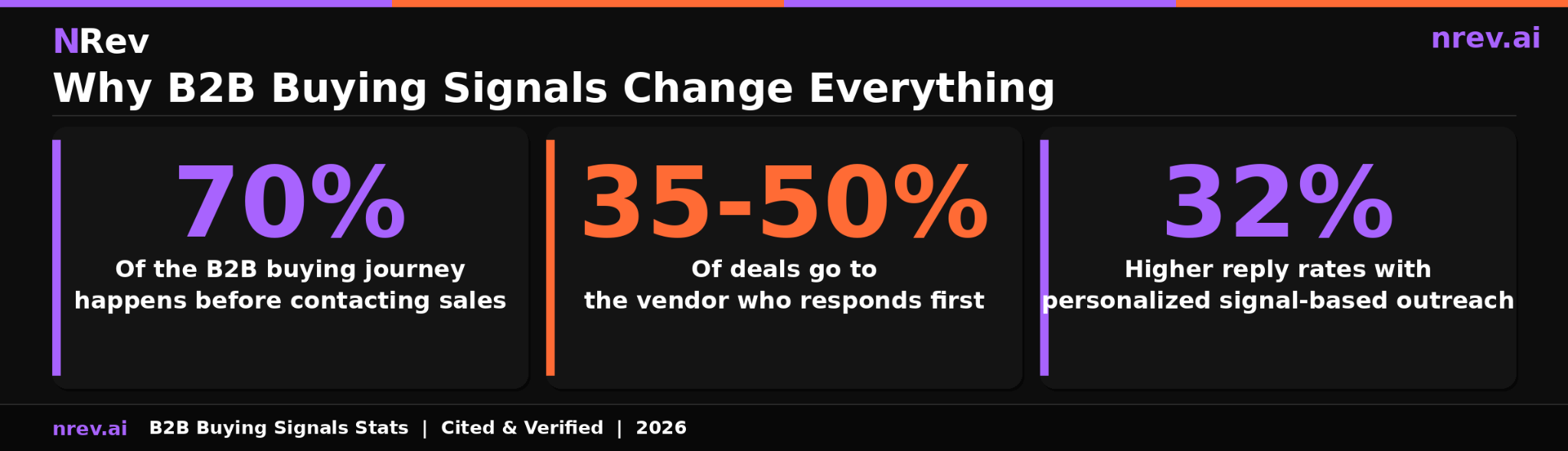
The reason buying signals matter so much in 2026 is timing. Most deals are won before the buyer ever reaches out. According to 6sense's 2025 Buyer Experience Report, which surveyed nearly 4,000 B2B buyers, buyers complete roughly 70 percent of their purchase journey before making first contact with any vendor.
By the time they fill out your demo form, they have already built a shortlist and formed strong preferences. If your brand is not already on their radar, you are fighting for the remaining 15 percent of deals.
Buying signals are how you get on the shortlist early. When you detect that a target account is showing intent and reach out with a specific, relevant message before they ever fill out a form, you become part of their consideration set during the anonymous research phase rather than arriving after decisions have already been made.
Why Buying Signals Data Changes the Math on Outbound
The standard argument against outbound in 2026 is that reply rates are too low to justify the effort. That argument is true for volume-based, untargeted outbound. It does not apply to signal-based outbound.
According to SPOTIO's 2026 sales statistics, which cites Inside Sales research as the root source, 35 to 50 percent of sales go to the vendor that responds first to a buying signal or inquiry. Speed combined with relevance is the competitive edge.
The same source, citing Salesloft's 2024 personalization research, reports that personalized cold emails produce 32 percent higher reply rates compared to generic outreach. When personalization is built around a specific buying signal, that number climbs further.
The math shifts completely when outreach is signal-triggered. Generic cold outreach averages 3 to 5 percent reply rates.
Signal-based outreach that references a real trigger achieves 15 to 25 percent reply rates, according to research cited by Salesmotion's buying signals guide, which sources the data from Autobound's analysis of thousands of outbound campaigns. That is a five-to-eight-times improvement from the same number of emails sent.
The Complete List of B2B Buying Signals by Tier
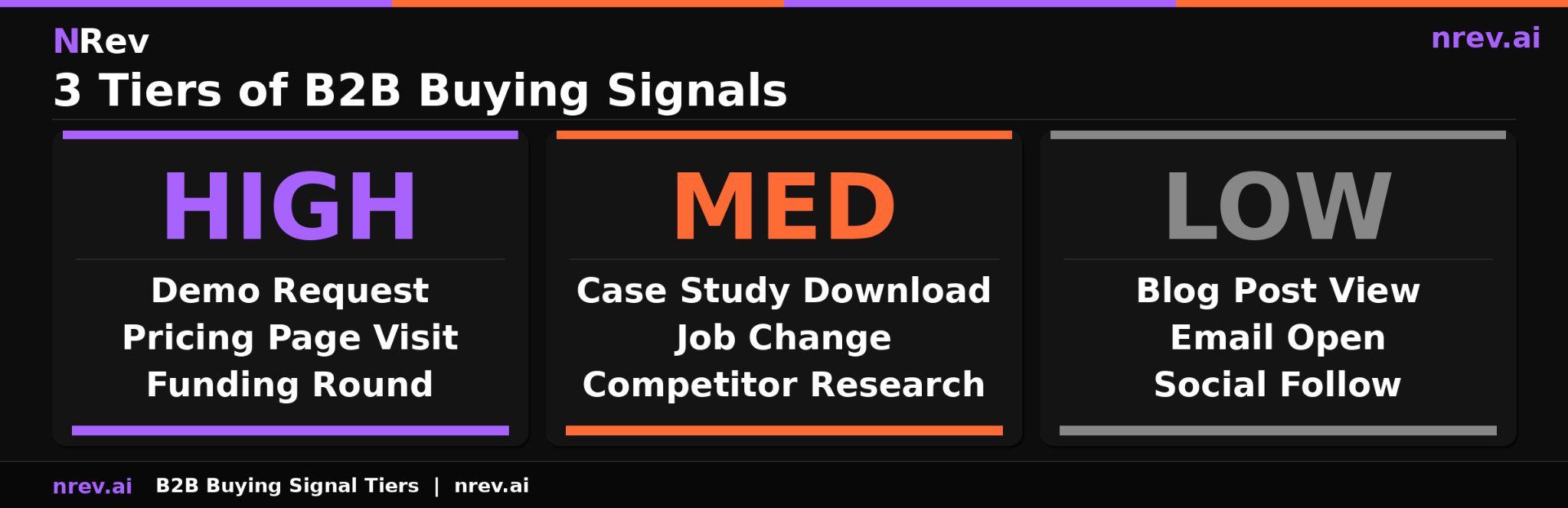
Not all buying signals carry the same weight. A prospect opening your newsletter and a prospect submitting a demo request are both signals, but they require completely different responses. Organizing signals by tier prevents your team from either ignoring genuine intent or wasting effort chasing low-value engagement.
You can also browse all buying signal types with a page and examples for each.
Tier 1: High-Intent Buying Signals
These signals indicate that a purchase decision is actively in progress. Respond the same day, ideally within hours.
Demo request. This is the strongest first-party signal that exists. The prospect has raised their hand. They are comparing final options. The first vendor to respond thoughtfully wins a disproportionate share of deals from this signal.
Pricing page visit, especially multiple visits from the same account in a short window. Budget conversations are already happening internally. Your job is to make the ROI case before a competitor does.
Funding round announcement. A company that has just raised capital has budget to spend and pressure to deploy it productively. The ideal response window is within two to four weeks of the announcement, while spending plans are still being formed.
New VP of Sales or CRO joins a target account. New executives evaluate their entire tech stack in the first 30 to 90 days. This is the highest-converting external signal pair in outbound when combined with ICP fit.
RFP or security review request. The buying committee is actively evaluating vendors. You need to be in the conversation now or you will not be considered at all.
Tier 2: Medium-Intent Buying Signals
These signals indicate active research and evaluation. They warrant prompt, value-led follow-up within two to three business days.
Competitor research activity. A prospect visiting G2 comparison pages, comparing you directly to a competitor, or publicly discussing dissatisfaction with their current tool has entered active evaluation mode. They are choosing between vendors, not deciding whether to buy.
Case study or ROI calculator download. This is decision-stage content consumption. Someone building an internal business case is reading case studies from vendors like you. Follow up with a relevant example from their industry or company stage.
Job posting that signals a buying need. A company hiring a Head of Revenue Operations is signaling infrastructure investment. A company hiring a demand generation manager is signaling pipeline investment. If what you sell aligns with the role they are hiring for, the job post is a buying signal.
Job change of a past champion. Someone who bought from you before, or who you were in conversations with, just moved to a new company that fits your ICP. That is a warm introduction to a new account. Reach out and reference the shared history.
Multiple people from the same account engaging with your content. One person visiting your site is curious. Multiple people from the same company visiting your pricing page, your case studies, and your competitor comparison page in the same week is a buying committee forming.
Tier 3: Low-Intent Signals
These signals indicate early awareness. They do not warrant direct outreach but should trigger inclusion in nurture sequences.
Blog post views. Someone is doing research in your category. They are not yet evaluating vendors.
Email open without click. The subject line was interesting enough to open. The content did not motivate action.
Social follow or LinkedIn connection. Awareness-level interest. Worth noting and watching for stronger signals from the same account.
Webinar registration without attendance. Shows interest in the topic. Follow up with the recording and monitor whether they engage further.
Company Buying Signals: Third-Party Triggers
Company buying signals are external, publicly observable events that indicate a business is in a state of change that creates demand for your category of product or service. These are the signals that most sales teams miss because they require monitoring systems rather than inbound tracking.
1. Funding announcements.
Companies that just raised capital are actively allocating budgets. A Series A company that sells to SMBs just became a Series B company that sells to mid-market teams. Their tool needs change. Their headcount is growing. Their processes need to scale. If your product helps companies scale revenue operations, a Series B announcement at a target account is a Tier 1 buying signal.
2. Hiring surges.
A company that grows headcount by 20 percent or more in a 90-day window is signaling organizational investment and operational change. The specific functions being hired for reveal what problems they are trying to solve. Hiring five SDRs means they need outbound infrastructure. Hiring a VP of Customer Success means churn is a priority. Match the hire pattern to what you sell.
3. Technology changes.
A company adopting tools that sit next to yours in the stack is a warm prospect. A company ripping out a competitor's tool is an even warmer one. Technology adoption signals both that the company is investing in the category and that they have active vendor evaluation in progress.
4. Leadership changes.
New executives, particularly in revenue, marketing, or operations functions, routinely evaluate and replace tools within their first 90 days. A new CRO at a target account is one of the highest-converting company buying signals in outbound. They are motivated to make changes, they have authority to make them, and they are open to new vendor relationships that were not part of their predecessor's stack.
5. Mergers, acquisitions, and public company milestones.
These events create immediate technology consolidation needs, new budget cycles, and personnel changes that all generate demand for tools and services across multiple categories.
Behavioral Buying Signals: First-Party Intent
First-party buying signals come directly from your own digital properties. They are the most reliable indicators of intent because they represent direct engagement with your brand rather than inferred interest from third-party data.
Social signals sit next to these, and they are usually easier to collect because the activity is public.
1. Pricing page visits.
This is the clearest first-party buying signal available. Someone visiting your pricing page has moved past awareness and research into vendor evaluation. Route these visitors to an SDR within hours. When multiple people from the same company visit your pricing page in a short window, treat it as a Tier 1 signal immediately.
2. Demo requests.
This requires no interpretation. Someone wants to see your product and they are comparing it against alternatives. The average B2B sales team takes 42 hours to respond to demo requests. The teams that respond within five minutes convert at dramatically higher rates. Response speed is the single most controllable variable in converting this signal.
3. Competitor comparison page views.
A prospect reading a comparison between your product and a named competitor is in active evaluation. They are building a decision matrix. Reference the specific comparison they were evaluating in your follow-up to show you understand where they are in the process.
4. Repeat visits to the same high-intent content.
One visit to your case study library is low intent. Three visits across five days to the same case study for a company in their industry is a buying committee doing due diligence. Behavioral patterns across time and pages reveal far more about intent than any single visit.
5. Email engagement with purchase-intent CTAs.
Clicking on a link to book a demo, calculate ROI, or view pricing from within a nurture email is a first-party signal that overrides wherever the contact sits in your standard sequence. Pull them out and treat them as an active buyer immediately.
How to Respond to Buying Signals: Timing and Playbook
How you respond to a buying signal is as important as catching it in the first place. A generic follow-up to a strong signal wastes the signal. The response needs to reference the specific trigger and connect it to the prospect's likely situation.
Tier 1 signals: Respond the same day, within hours where possible.
The research on response time is unambiguous. According to SPOTIO's 2026 sales statistics, citing Inside Sales as the root source, 35 to 50 percent of all deals go to the vendor that responds first. A 10x drop in lead qualification success occurs when response time extends beyond five minutes for the highest-intent signals.
For a demo request, respond in minutes with a specific meeting time proposal, not a Calendly link. For a pricing page visit, send a direct message acknowledging they are evaluating and offering to answer specific questions. For a funding round announcement, lead with congratulations and a specific observation about what typically happens to their function at that stage of growth.
Tier 2 signals: Respond within two to three business days with value-led content.
For a case study download, follow up with a second case study from a company in the same industry or at the same growth stage. For a job posting signal, reference the specific role they are hiring for and connect it to how your product helps the function they are building.
For a competitor research signal, reference the comparison they were making and offer to walk through the specific areas where you differ. Do not open with a pitch. Open with evidence that you understand what they are evaluating.
Tier 3 signals: Move into a nurture sequence with a four to six week cadence.
Early-stage awareness signals do not warrant direct outreach. They warrant consistent presence. Add the account to a content nurture sequence, monitor for escalation to higher-tier signals, and respond immediately when the signal strength increases.
The response message structure for any buying signal:
Line one: Reference the specific trigger. Not "I noticed you visited our website." Instead: "Congratulations on the Series B, I saw the announcement this morning."
Line two: Connect the trigger to a likely situation. "Teams in your stage are typically navigating how to scale outbound without adding headcount."
Line three: Offer specific value, not a demo request. "We helped [similar company name] book 40 percent more meetings in their first quarter after the B round without hiring new SDRs."
Line four: One clear, low-friction task. "Would it be worth a 20-minute conversation about how they did it?"
Real-Time Buying Signals: How to Build a Detection System
The gap between most sales teams and signal-based selling is not awareness of what signals look like. It is the absence of a system that catches signals when they happen and routes them to the right person with the right context immediately.
A real-time buying signal system has three components.
First: Account monitoring.
Set up automated monitoring of your target account list across the signal categories that matter most for what you sell. Funding announcements, executive hires, job postings in relevant functions, and technology adoptions can all be monitored programmatically. The moment a monitored signal fires, it should create an alert rather than waiting to be discovered in a weekly report.
Second: CRM enrichment and alert routing.
When a signal is detected, the account context should automatically surface: who the relevant contact is, what their current role is, what previous engagement history exists, and which sales rep is responsible for the account. The rep should receive an alert with all of this context, not a raw data notification that requires manual research before action can be taken.
Third: Templatized response playbooks by signal type.
Your team should not be writing first drafts from scratch for every signal. Each signal type should have a pre-built response framework that the rep personalizes with the specific details of the trigger event. The framework handles the structure. The rep handles the specific context. This combination produces responses that are both fast and genuinely personalized.
When these three components work together, the time from signal detection to first contact drops from days to hours. That speed difference is where the 35 to 50 percent first-responder advantage is captured.
For teams that want to connect signal detection with their outbound sales automation workflow, the integration is the most important step. A signal that creates an alert but requires manual action to trigger a sequence still relies on a rep being available and attentive at exactly the right moment. Automated signal-to-sequence triggers remove that dependency.
How nRev AI Monitors Buying Signals Automatically
nRev AI is built specifically for this problem. It monitors your target accounts in real time across every relevant signal category: funding announcements, executive hires, job postings that match buying patterns, competitor activity, technology adoptions, and engagement signals from your own digital properties.
When a signal fires, nRev does not just create an alert. It surfaces the relevant contact, enriches the account with current context, drafts a first-touch message that references the specific trigger, and queues the full outreach sequence across email and LinkedIn.
Your outbound lead generation workflow no longer depends on a rep manually checking five data sources, cross-referencing their target account list, and finding time to write a personalized first-touch email before the signal decays. The system handles all of it. The rep receives a conversation when a prospect replies.
For teams also running outbound sales software stacks across email and LinkedIn, nRev connects signal detection directly into the sequencing layer. A Tier 1 signal that fires at 9 AM triggers the first email by 9:15 AM. No manual intervention required.
This is what signal-based selling looks like when it is actually built into the system rather than bolted on as a manual process.
Start Catching Buying Signals Before Your Competitors Do
Every day your target accounts are generating buying signals. New hires are joining. Funding rounds are closing. Pricing pages are being visited. Competitor comparison pages are being read.
If your team does not have a system to catch and respond to these signals in real time, a faster competitor is capturing the conversations that could have been yours.
nRev AI monitors your target accounts continuously, surfaces the right signals at the right moment, and builds the outreach automatically. You describe the workflow. nRev runs it.
Build your first buying signal detection workflow on nRev AI and start responding to the signals your prospects are already sending.
Frequently Asked Questions
What are examples of B2B buying signals?

B2B buying signals fall into three tiers based on intent strength. High-intent signals include demo requests, multiple pricing page visits, funding round announcements, new executive hires at target accounts, and RFP submissions.
Medium-intent signals include case study downloads, competitor research activity, job postings that indicate a buying need, past champion job changes, and multiple stakeholders from one company engaging with your content.
Low-intent signals include blog post views, email opens, and social follows. The strongest signals combine multiple triggers at once, such as a funding round announcement at an account that is also visiting your pricing page and hiring for a relevant function.
How do you respond to buying signals in B2B sales?
The response to a buying signal should be fast, specific to the trigger, and focused on the prospect's situation rather than your product. For high-intent signals such as demo requests or pricing page visits, respond within hours, not days, and lead with a direct time proposal rather than a link.
For medium-intent signals such as case study downloads or competitor research, respond within two to three business days with a piece of relevant content that matches what they were evaluating.
The most effective message structure opens with a reference to the specific trigger, connects it to a situation the prospect is likely facing, provides a specific piece of evidence from a similar company, and ends with a low-friction, single ask.
According to SPOTIO's 2026 sales statistics, citing Inside Sales research, 35 to 50 percent of deals go to the vendor that responds first. Speed with context is the winning combination.
What is buying signals data in B2B sales?
Buying signals data is the combination of first-party intent data from your own digital properties and third-party data from external sources that, together, indicate which accounts are actively in a buying cycle.
First-party buying signals data includes pricing page visits, demo requests, content downloads, email engagement, and website behavior tracked through your CRM and analytics platforms.
Third-party buying signals data includes funding announcements, executive hire tracking, job posting patterns, technology adoption data, and intent signals from platforms like Bombora or G2 that aggregate buyer research behavior across the web.
The most actionable buying signals data combines both sources because first-party data tells you what a prospect did on your properties while third-party data tells you what they are doing across the market, giving you a more complete picture of where they are in their buying journey.