


Outbound Sales Lead Generation: How to Find and Convert the Right Buyers in 2026
Most B2B teams treat outbound sales lead generation as a numbers game. They build large lists, launch high-volume sequences, and measure success by how many emails went out. The result is a full CRM and an empty pipeline.
Outbound lead generation that actually converts buyers is not about sending more. It is about reaching the right people at the exact moment they have a real reason to respond. That shift from volume-based to signal-based outbound is what separates teams generating consistent pipeline from teams wondering why their sequences are not working.
This guide covers exactly how to do outbound sales lead generation in 2026: the five-step process, the stats behind what works, the channels that produce the best results, and the outbound lead generation services that can accelerate the whole system.
What Is Outbound Sales Lead Generation
Outbound sales lead generation is the process of proactively identifying potential buyers, reaching out to them directly, and moving them toward a sales conversation. Unlike inbound lead generation where buyers come to you through search or content, outbound requires your team to make the first move.
In a B2B context, this typically involves cold email sequences, LinkedIn outreach, cold calling, and multichannel campaigns that combine all three. The goal is to find accounts that fit your Ideal Customer Profile, identify the right contacts within those accounts, and reach out with a message that is specific enough to earn a response.
What makes outbound lead generation hard in 2026 is not the volume of messages that can be sent. It is the quality of targeting and personalization required to earn a reply when every decision maker is already receiving dozens of automated sequences per week.
The teams that succeed at outbound sales lead generation are not the ones with the largest lists. They are the ones who reach out at exactly the right moment, with a message that references something real about the prospect's situation, across the right mix of channels.
Outbound vs Inbound Lead Generation: Key Differences
Both motions generate pipeline. The fundamental difference is who initiates the conversation and how long the system takes to produce results.
Outbound lead generation is proactive. Your team selects targets, builds sequences, and initiates every conversation. The main advantage is speed: outbound can generate meetings within days of launch. The main challenge is that outreach must be relevant enough to earn a response from someone who did not ask for contact.
Inbound lead generation is reactive. Buyers find you through search, content, webinars, or referrals and initiate the conversation themselves. Inbound leads typically convert at higher rates because the prospect has already demonstrated intent. The trade-off is time: a well-functioning inbound system takes months to build and cannot be turned on quickly.
The most effective B2B teams run both together. Outbound creates an immediate pipeline from targeted accounts. Inbound warms up those same accounts over time so that when outbound reaches out, the prospect has already heard of the brand. The combination reduces the friction of cold outreach and makes every sequence more likely to convert.
For teams that need pipeline now rather than in six months, outbound lead generation is the only lever that can be pulled immediately and adjusted in real time based on what is working.
The 5-Step Outbound Sales Lead Generation Process
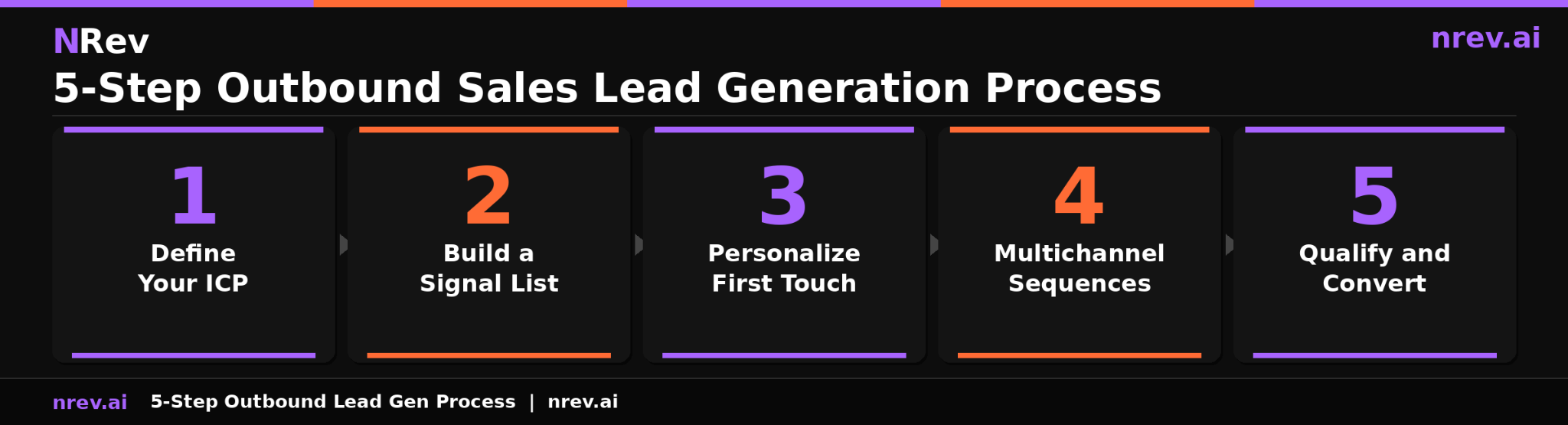
Step 1: Define your Ideal Customer Profile with precision.
An ICP for outbound lead generation needs to be specific enough to meaningfully narrow your list. Job title, seniority level, company size, industry vertical, and growth stage are the minimum criteria. The best ICPs also include behavioral patterns: what technology companies use, what content they engage with, what events they attend.
Review your last 20 closed deals and find the patterns that most closed-won accounts share but that you are not currently using as targeting criteria. Every outbound lead generation program improves immediately when the ICP definition gets sharper. A tighter list means higher reply rates, more relevant conversations, and faster conversion at every stage.
Step 2: Build a signal list, not just a contact list.
An ICP-matched contact list is the starting point, not the finished product. Buying signals are what transform a cold list into a prioritized outreach list.
A buying signal is any observable event that suggests a prospect is more likely to buy right now: a new VP of Sales just joined a target account, the company just announced a Series B funding round, a competitor just got acquired and their customers need alternatives, or the company is hiring for a role that indicates they need what you sell.
Signal-based timing is what makes outbound lead generation feel relevant. When your first message references something that happened to the prospect's company in the past two weeks, it does not feel like cold outreach. It feels like due diligence.
Step 3: Personalize the first touch around the signal.
The opening message in any outbound sequence is the most important. Most teams waste it by talking about their product or company. The prospect does not know you yet. There is no context for why your solution would be relevant to them.
The message that works opens with the signal. It names the specific reason you are reaching out: the funding announcement, the new hire, the job posting, the competitor switch. It connects that observation to a potential challenge the prospect might be experiencing. It does not pitch.
Personalized outreach generates 32 percent higher reply rates compared to generic messages, according to SPOTIO's 2026 sales statistics, citing Salesloft's 2024 email personalization research as the root source.
Step 4: Run coordinated multichannel sequences.
Email alone is no longer sufficient for consistent outbound lead generation. Buyers are present on multiple channels and have preferences. Some decision makers respond best to a well-crafted email. Others respond to a LinkedIn connection with a relevant note. Others respond only when a phone call follows up after initial contact.
Multichannel campaigns that combine LinkedIn, email, and phone outreach produce dramatically better results than any single channel used alone. According to research cited in Martal Group's LinkedIn lead generation guide, which attributes the data to Omnisend's multichannel research, omnichannel campaigns deliver 287 percent higher purchase rates compared to single-channel approaches.
The sequence structure matters as much as the channels used. Each touch should build on the previous one, add new context or value, and move the conversation forward rather than repeating the same pitch in different words.
Step 5: Qualify, score, and convert with speed.
Not every prospect who engages with your outreach is ready to buy. Lead qualification is the process of determining which engaged prospects should be prioritized for immediate follow-up and which should go into longer-term nurture sequences.
The most effective lead scoring models for outbound combine signal strength (how strong was the buying trigger?), ICP fit (how closely does the company and contact match your ideal profile?), and engagement signals (did they open multiple emails, reply with a question, or visit your website after outreach?).
Speed matters at this stage. Research confirmed in HubSpot's 2024 State of Sales data shows that responding to a lead within five minutes makes them 21 times more likely to convert compared to waiting even 30 minutes. The fastest teams to respond to engaged outbound leads consistently close more deals from the same volume of outreach.
The Channels That Drive Outbound Lead Generation in 2026
LinkedIn as the primary outbound channel.
LinkedIn is the most important single channel for B2B outbound lead generation in 2026. According to LinkedIn's own lead generation resource page, which cites Wpromote's State of B2B Marketing Report as the root source, 89 percent of B2B marketers use LinkedIn for lead generation, and the platform drives over 80 percent of all social media leads in B2B.
The targeting capabilities on LinkedIn are unmatched for B2B outreach. You can reach decision makers by exact job title, seniority, company size, industry, growth stage, and even recent job change activity. This makes it the best channel for account-based outbound lead generation where you are trying to reach specific people at specific companies.
LinkedIn outreach works best as the first touch in a sequence: a personalized connection request that references something specific about the prospect's company or recent activity, followed by a message only after the connection is accepted. This approach builds a degree of familiarity before the main outreach begins.
Cold email as the primary volume channel.
Email is the channel that scales most efficiently for outbound lead generation. It allows personalization at a level that would be impossible by phone, maintains a written record that prospects can forward internally, and can be sequenced across multiple follow-ups over weeks or months.
The challenge with cold email in 2026 is inbox saturation. Decision makers receive dozens of automated sequences per week. The reply rates for generic, high-volume email campaigns have been declining steadily. The teams that still produce strong results from cold email are those who use it for targeted, signal-based outreach with high personalization rather than mass campaigns with template personalization.
Cold calling as the conversion accelerator.
Cold calling is the most efficient channel for immediate qualification. A two-minute phone call can determine whether a prospect has a current need faster than any email sequence. And contrary to common assumptions, buyers are open to it.
According to SPOTIO's 2026 sales statistics, citing the Demand Gen Report 2024 as the root source, 69 percent of buyers have accepted a cold call from a new provider in the past year. The key is not more calls, but better-timed calls: calling accounts that have already shown a buying signal produces dramatically better connection and conversion rates than calling cold lists.
The most effective outbound lead generation programs use cold calling as the third or fourth touch in a multichannel sequence, after email and LinkedIn have established some initial awareness. A prospect who has seen your name in their inbox and on LinkedIn is far more receptive to a call than one who has never heard of your company.
Outbound Lead Generation: 6 Stats Every B2B Team Must Know
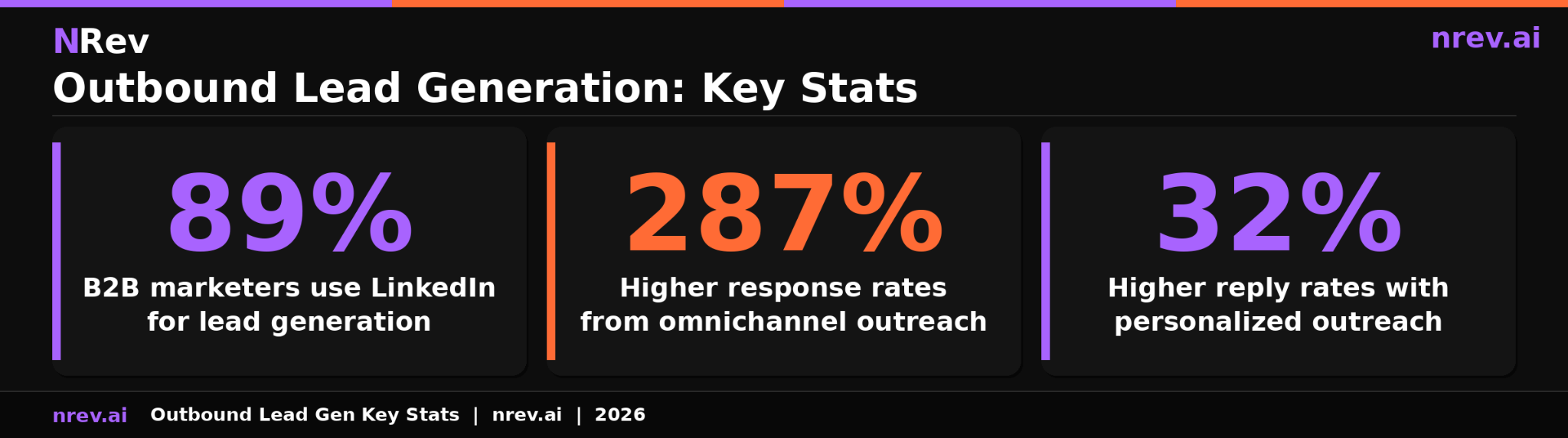
89% of B2B marketers use LinkedIn for outbound lead generation. Root source: Wpromote State of B2B Marketing Report, cited directly on LinkedIn's lead generation resource page. If your outbound program does not include LinkedIn, you are competing without the channel that most of your competitors are using.
Multichannel campaigns cut cost per lead by 31% compared to single-channel outreach. Root source: Snov.io Lead Generation Statistics 2026. This is the financial case for multichannel. You spend less to generate each qualified lead when you coordinate three channels than when you rely on one.
Omnichannel outreach produces 287% higher purchase rates than single-channel campaigns. Root source: Omnisend multichannel research, cited by Martal Group's LinkedIn lead generation guide. This is the performance case for coordinated multichannel. The effect compounds across channels.
Personalized outreach generates 32% higher reply rates. Root source: Salesloft 2024 email personalization research, cited by SPOTIO's 2026 sales statistics. Relevance is the single biggest lever available to any outbound lead generation team. Generic outreach at scale produces generic results at scale.
80% of deals require five or more follow-up touchpoints. Root source: RAIN Group 2024 sales persistence research, cited by SPOTIO's 2026 sales statistics. Most outbound lead generation programs stop too early. The pipeline lives in the follow-up touches that most teams never send.
Sellers using AI-powered tools are 3.7 times more likely to hit quota. Root source: Gartner research cited in Salesforce's 6th State of Sales Report (2024, 5,500 professionals across 27 countries). Signal detection, automated research, and AI-powered personalization are the operational foundation of high-performing outbound lead generation in 2026.
What Makes Outbound Lead Generation Services Worth Using
Outbound lead generation services are external teams or platforms that take on part or all of the outbound process on behalf of a company. They exist across a spectrum: some are fully outsourced SDR teams that make calls and send emails on your behalf; others are software platforms that automate the research, sequencing, and monitoring that would otherwise require manual work.
The most common reason teams invest in outbound lead generation services is bandwidth. Building a high-quality outbound system requires consistent effort across ICP definition, list building, signal monitoring, message writing, sequence management, and performance analysis. Most sales teams do not have the headcount to do all of this well while also handling their existing pipeline.
The outbound lead generation services that produce the best results in 2026 share a common characteristic: they are built around signal detection and real-time account monitoring rather than static list building.
A service that delivers a CSV of contacts sorted by job title and company size is solving the wrong problem. A service that identifies which accounts within your ICP are showing buying signals right now, surfaces the right contacts within those accounts, and provides context for reaching out with a relevant message today is solving the actual problem.
How to Choose the Right Outbound Lead Generation Service
Evaluating outbound lead generation services requires asking four questions before reviewing any vendor's pitch deck.
Does the service detect buying signals or just match demographics?
Demographic matching finds people with the right job title at companies of the right size. That is the minimum baseline. Signal detection identifies which demographic-matched accounts are showing active buying behavior right now. That specificity is what produces reply rates above average. Ask every service provider how they surface in-market accounts and what their lead scoring model is based on beyond firmographic filters.
Does the service run multichannel outreach or only email?
Given that multichannel campaigns cut cost per lead by 31 percent and produce dramatically higher response rates, a lead generation service that only runs email sequences is leaving significant performance on the table. Ask whether they coordinate LinkedIn, email, and phone in unified sequences and how those channels share context across each touch.
Does the service provide reporting that ties activity to pipeline?
Leads generated is a vanity metric. What matters is the conversion rate from outbound activity to qualified opportunity and from qualified opportunity to closed deal. A high-quality outbound lead generation service should be able to show you not just how many contacts they reached, but how many converted to meetings and what the pipeline value looks like per outbound lead source.
Does the service integrate directly with your CRM?
Manual data transfer between your lead generation service and your CRM creates exactly the kind of administrative overhead that the service was supposed to eliminate. Native CRM integration is not optional for any service managing outbound at meaningful volume.
How nRev AI Powers Signal-Based Outbound Lead Generation
nRev AI is an Agent OS for GTM teams that automates the most time-consuming parts of outbound sales lead generation without removing the human judgment that closes deals.
The system monitors your target accounts in real time for the buying signals that indicate a prospect is worth reaching out to today: new hires in relevant roles, funding announcements, competitor activity, technology adoption changes, and hiring patterns that signal a buying need. When a signal is detected, nRev surfaces the right contact, provides the context for why they are worth reaching out to now, and builds the personalized first-touch outreach automatically.
Your outbound sales automation workflow runs on signals rather than schedules. Instead of triggering sequences based on a calendar, nRev triggers them based on what is happening at the account right now.
The multichannel sequences nRev builds coordinate email and LinkedIn in a single workflow. Your LinkedIn lead generation touches and your email sequence share the same account context and signal history, so every message builds on what came before rather than repeating the same pitch through a different channel.
If you want to understand how outbound sales software categories fit together before building your stack, our comparison guide covers each category and what it solves.
Your team handles conversations. nRev handles the monitoring, research, personalization, and sequencing that fills the pipeline with conversations worth having.
Start Generating the Right Outbound Leads With nRev AI
Most outbound lead generation programs fail because they optimize for the wrong things: message volume instead of message relevance, large lists instead of signal-filtered lists, and single-channel sequences instead of coordinated multichannel systems.
nRev AI builds your outbound lead generation system around signals. Every sequence starts with a real reason to reach out. Every message references something specific. Every follow-up adds something new. You describe the workflow you want. nRev builds it and runs it.
Build your first outbound sales lead generation workflow on nRev AI and start converting the right buying signals into the right conversations with the right buyers.
Frequently Asked Questions
What is outbound lead generation?

Outbound lead generation is the process of proactively identifying potential buyers and initiating contact with them, rather than waiting for them to find you. In B2B sales, this typically involves cold email sequences, LinkedIn outreach, cold calling, and multichannel campaigns that combine all three.
Outbound lead generation gives your team direct control over who you target, when you reach out, and what you say. It is the fastest way to build pipeline because you can start generating conversations within days. The main requirement for it to work is that your targeting must be specific enough and your messaging relevant enough to earn a response from someone who did not ask to be contacted.
What is the difference between outbound and inbound lead generation?
The core difference is who initiates the conversation. In outbound lead generation, your team makes the first move: you identify prospects, build sequences, and reach out proactively. In inbound lead generation, prospects find you through search, content, webinars, or referrals and initiate the conversation themselves.
Outbound is faster to produce results but requires high targeting precision and relevant messaging to work. Inbound takes longer to build but typically produces leads that are already engaged and further along in their buying journey. Most high-performing B2B teams run both: outbound for immediate pipeline and inbound for long-term compounding.
Using them together consistently outperforms using either motion alone.
What are the best outbound lead generation strategies for B2B?
The most effective outbound lead generation strategies for B2B in 2026 combine signal detection, tight ICP targeting, personalization, and coordinated multichannel outreach.
Define a specific ICP before building any list. Monitor target accounts for buying signals such as new hires, funding rounds, and competitor activity before reaching out. Open every first-touch message with the specific signal rather than a product pitch. Run coordinated sequences across email, LinkedIn, and phone rather than relying on a single channel.
Maintain a minimum of five structured touchpoints before marking a prospect as unresponsive. According to RAIN Group 2024 research cited by SPOTIO, 80 percent of deals require five or more follow-up touchpoints, yet 44 percent of reps stop after one attempt.
The biggest single outbound lead generation improvement most teams can make is simply following up more, with new value at each touch.