

.jpg)
You have 4,000 connections. Your posts pull likes. Your calendar is still empty.
That is the LinkedIn lead generation paradox, and almost every guide answers it the same way: do more. Post more. Connect with more people.
Send more messages. Run more ads. The advice is not wrong, it is just incomplete, and following it harder is how most teams end up busy instead of booked.
LinkedIn lead generation is the process of identifying, engaging, and converting professionals on LinkedIn into qualified pipeline.
In 2026 the teams that are actually good at it have stopped chasing more activity. They focus on something quieter and far more valuable: the buying signals already moving through their network every single day, and how fast they act on them.
This guide covers the full playbook, the profile work, the inbound and outbound tactics, the tools, and the mistakes. Then it covers the part nobody else does: why your warm network is generating leads right now that you are almost certainly ignoring.
What Is LinkedIn Lead Generation (and Why It Still Works in 2026)
LinkedIn lead generation is the practice of using LinkedIn to find the right professionals, start real conversations, and move them into your sales pipeline as qualified leads.
It works on two engines: inbound, where you attract prospects through your profile, content, and ads, and outbound, where you reach prospects directly through targeted search and messaging.
It still works because the platform is built for exactly this. LinkedIn passed a billion members, and unlike any other channel, people arrive in a professional mindset and self-report their job title, company, seniority, and industry. That is targeting data you cannot buy cleanly anywhere else.
The numbers back it up. In LinkedIn's reporting on B2B marketing, the large majority of B2B marketers use the platform for lead generation, and a clear majority say it actually produces leads, more than double the next social channel. LinkedIn also reports a lower cost per lead than search advertising and significantly higher conversion on its native Lead Gen Forms, which pre-fill from a member's profile.
The catch is that everyone knows this. Adoption is near saturation, which means the advantage no longer comes from being on LinkedIn. It comes from how you operate on it.
Inbound vs Outbound: Two Engines, One Pipeline
Inbound and outbound are not competing strategies. They are two halves of the same motion, and the strongest LinkedIn lead generation programs run both.
Inbound is the pull. A sharp profile, consistent content, thought leadership, and paid Lead Gen Forms bring prospects to you and warm them before a single message is sent.
Our guide on LinkedIn posting best practices breaks down the formats and cadence that actually drive reach.
Outbound is the push. Targeted search, connection requests, and direct messages let you reach the exact accounts you want instead of waiting for them to find you. The complete approach lives in our LinkedIn outreach strategy guide.
The mistake is treating them as separate campaigns owned by separate people. When inbound content warms a prospect and outbound catches them at the right moment, the reply rate is a different sport entirely.
Optimize the Foundation Before You Generate Anything
Before you generate a single lead, your profile has to do the job of a landing page. When you send a connection request or comment on a post, the first thing a prospect does is check your profile, and that glance decides whether the conversation ever starts.
Your headline should say who you help and what changes for them, not just your title. Your About section should read like a value proposition, not a resume. Your banner and featured section should make the next step obvious.
This is also where your Social Selling Index quietly compounds. A stronger profile and consistent activity raise the score LinkedIn uses to gauge your social selling, which influences how far your content travels. We break down each pillar and how to lift it in our guide to your Social Selling Index.
The LinkedIn Lead Generation Tactics That Actually Move Pipeline
There are dozens of tactics. These are the ones that consistently produce qualified conversations rather than vanity metrics.
Content and thought leadership
Posting is not about going viral. It is about staying visible to the specific people who could buy from you, so that when they have a need, you are already familiar.
The leads come less from the post itself and more from who engages with it, which we will come back to. Our LinkedIn engagement playbook covers how the algorithm scores reach and how to grow it.
Connection and messaging strategy
The fastest way to kill a lead is to pitch on the connection request. The accept rate and the reply rate both collapse. Lead with relevance and a reason to talk, not a demo ask. We cover what to write before and after acceptance in our guide to the LinkedIn connection message.
Sales Navigator and targeting
Sales Navigator is the precision instrument: filter by title, seniority, company size, geography, and intent, then build account lists you work deliberately.
It is worth the seat for most B2B teams. If you do not have it, you can still generate leads using free search, your engagers, and second-degree connections, it just takes more manual effort to stay organized.
LinkedIn Ads and Lead Gen Forms
The paid path. Lead Gen Forms pre-fill from a prospect's profile and convert far better than sending people to an external landing page. The trade-off is cost per lead, which runs high on LinkedIn, so this engine earns its place when your deal size justifies it and your offer is strong.
Groups, events, and live sessions
Hosting or joining the right rooms puts you in front of a self-selected audience. LinkedIn Events and live sessions let you capture interest natively and follow up with people who already raised their hand.
The Part Everyone Misses: Your Warm Network Is Already Generating Leads
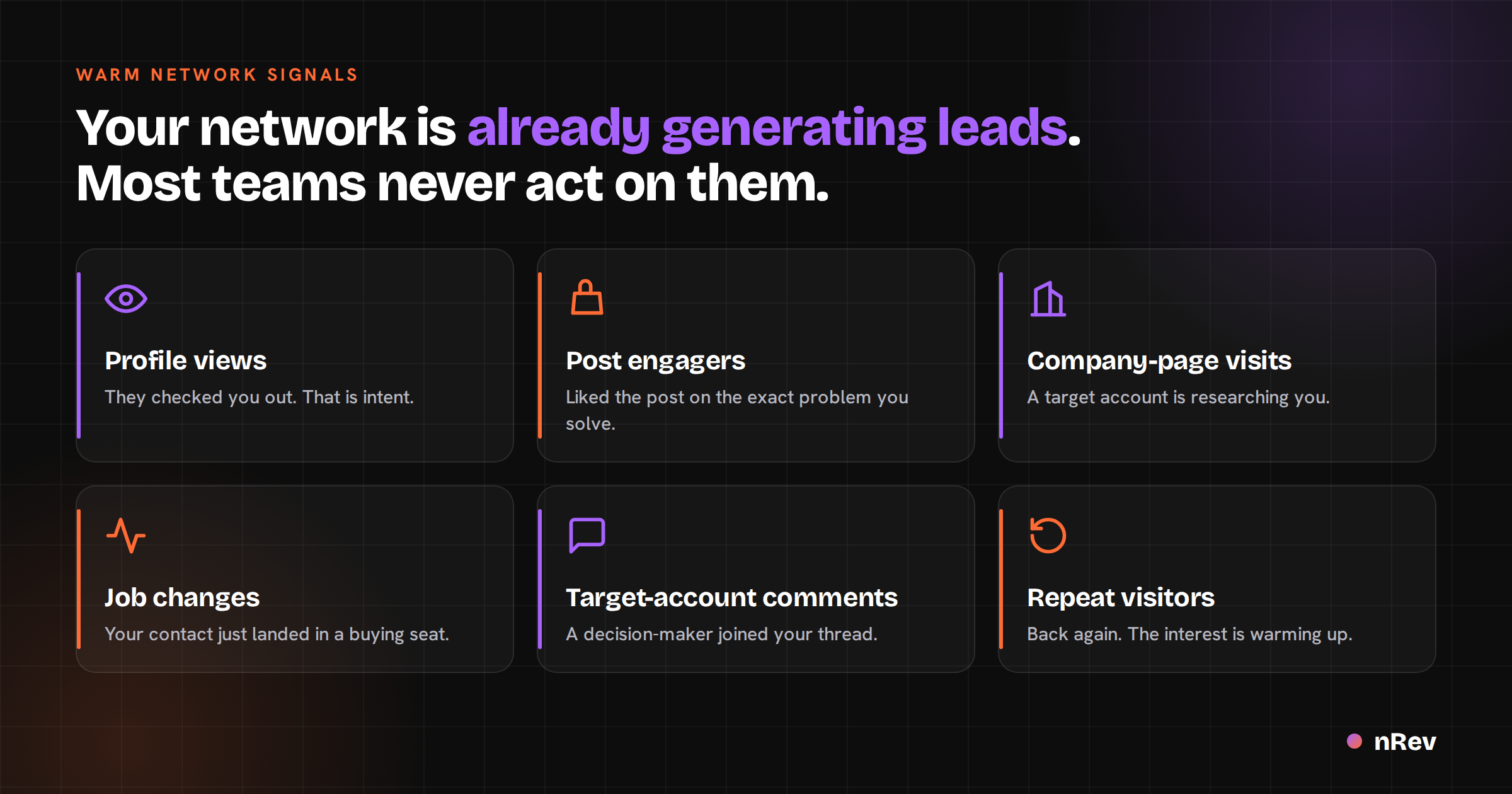
Here is what the ten-strategy listicles skip. While you are planning your next post, people in your network are already showing intent, and almost none of it gets acted on.
A social selling signal finder surfaces those people without you scrolling for them.
Someone viewed your profile twice this week. Someone liked the post where you described the exact problem you solve. Someone from a target account commented.
Someone you met at an event changed jobs and now sits in a buying seat at a bigger company. Every one of those is a buying signal, and every one of them is warmer than any cold prospect you will ever find in search. We cover the full taxonomy in our guide to B2B buying signals.
The problem is decay. A profile view is hot today and cold in a week. A job change is gold in the first month and noise after six. By the time these signals surface in a manual review, if they surface at all, the window has usually closed and a faster competitor has the conversation.
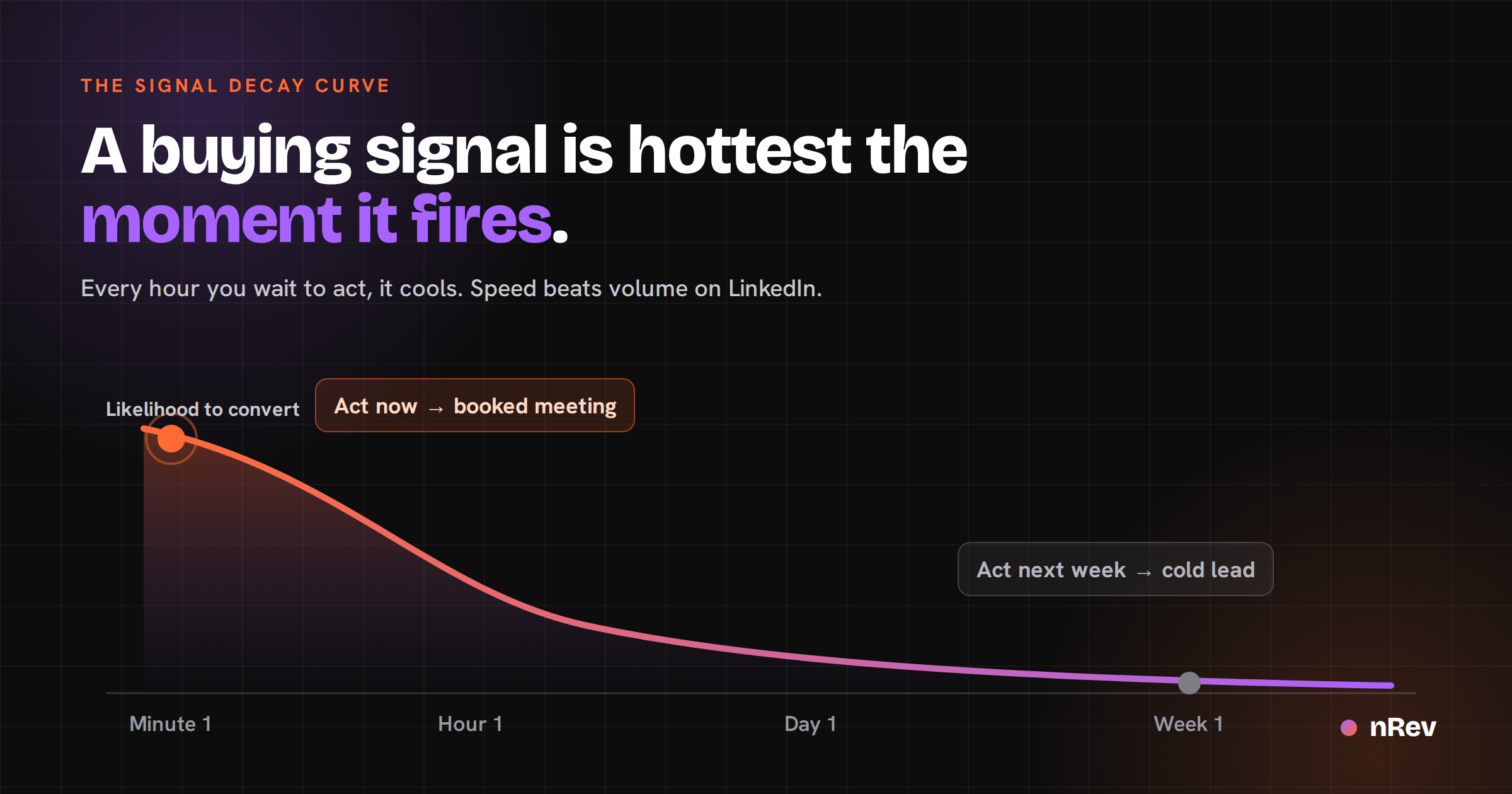
This is the real failure mode of LinkedIn lead generation. It is not that teams lack tactics. It is that the highest-intent leads they already have slip through because nobody is watching the signals in real time. We go deep on turning this into a system in our piece on LinkedIn warm network automation.
Manual vs Automated LinkedIn Lead Generation
Once you accept that speed beats volume, automation becomes the obvious question. The honest answer is that some of it helps and some of it gets your account restricted.
Aggressive automation that blasts connection requests and templated messages at scale is the fast lane to a flagged account and a burned domain.
LinkedIn watches for it, and prospects can smell it. That kind of automation optimizes for activity, which is the exact trap this guide is about.
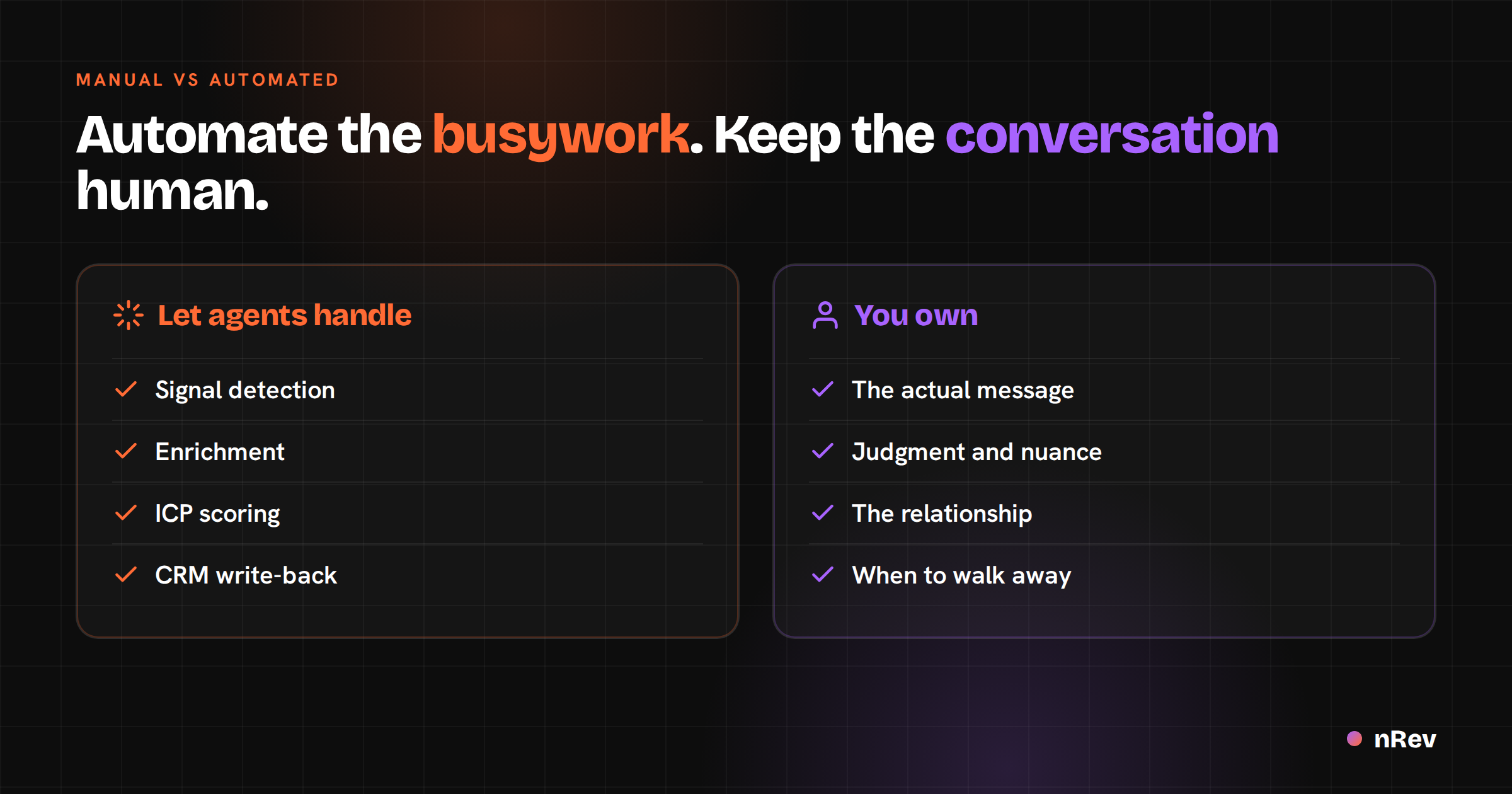
The automation that works is the kind that watches signals and surfaces the right person at the right moment, then helps you act with a genuinely personalized touch. It removes the manual data work, the list-building, the enrichment, and the CRM updates, without removing the human judgment in the actual conversation.
For a survey of the category, see our roundup of the best LinkedIn automation tools.
The line is simple. Automate the detection and the busywork. Keep the relationship human.
Common LinkedIn Lead Generation Mistakes
Most programs stall on the same handful of errors.
Pitching on the connection request, which tanks both accept and reply rates. Having no follow-up system, so warm replies die in the inbox. Ignoring the people who engage with your content, which is the warmest list you own.
Treating it as a pure numbers game and scaling spam instead of relevance. And running the whole thing with no CRM write-back, so every signal lives in someone's head and disappears when they get busy.
Fix those five and you are ahead of most teams on the platform.
How nRev Turns LinkedIn Signals Into Pipeline
Everything above is doable by hand. The reason it usually is not is that catching signals in real time, enriching and scoring them, drafting a personalized touch, and updating the CRM is a full-time job that no founder or lean GTM team has time for.
That is what nRev does. nRev is an Agent OS for GTM teams, not another LinkedIn automation tool. Instead of bolting together a scraper, an enrichment tool, a sequencer, and a CRM, you describe the motion you want and AI agents build and run it for you.
For LinkedIn specifically, an nRev agent watches your warm-network signals as they happen: profile views, post engagers, company-page visits, and job changes across your network.
The moment a signal fires, the agent enriches the person, scores them against your ideal customer profile, drafts a personalized message grounded in the actual context, and writes the lead and the activity straight into your CRM. No CSV exports.
No manual review. No leads decaying in a tab you forgot to open.
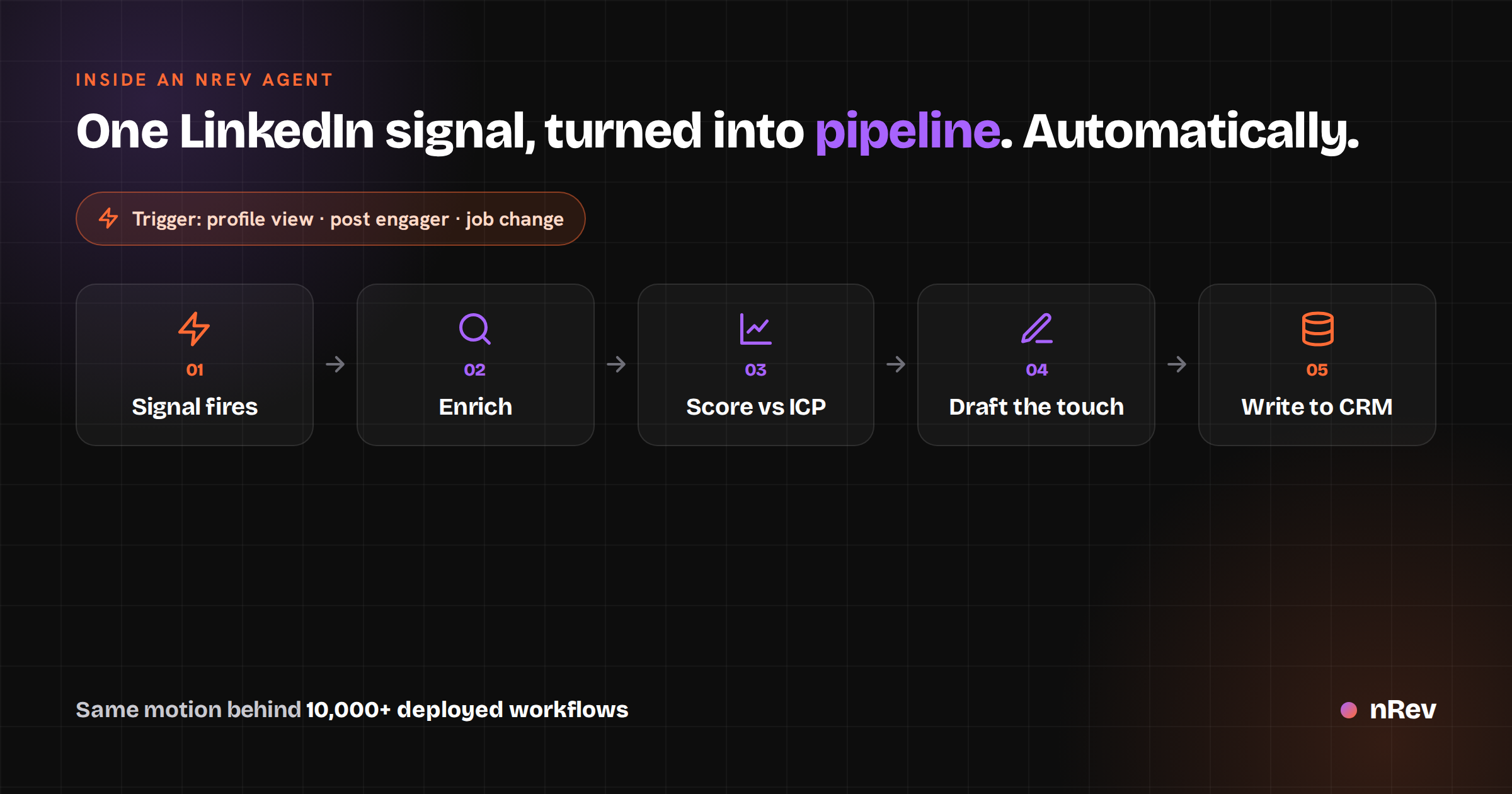
This is the same signal-driven motion the platform already powers across more than 10,000 deployed workflows.
You can see the LinkedIn version in our LinkedIn Growth Engine playbook and the broader pattern in Signal-Based Outbound.
If you want the agent to run the outreach end to end, that is what our AI SDR is built for.
The shift is the whole point of this guide. Stop generating more activity. Start executing on the intent you already have, faster than anyone else can.
Start free and turn your LinkedIn signals into pipeline
Frequently Asked Questions
What is LinkedIn lead generation?

LinkedIn lead generation is the process of finding, engaging, and converting professionals on LinkedIn into qualified leads for your business.
It combines inbound tactics like an optimized profile, content, and Lead Gen Forms with outbound tactics like targeted search and direct messaging, and increasingly with automation that acts on real-time buying signals.
How do I generate leads on LinkedIn without Sales Navigator?
You can generate leads on LinkedIn for free using standard search filters, by mining the people who engage with your content, and by working your second-degree connections through warm introductions.
It takes more manual organization than Sales Navigator, but the people engaging with your posts are often warmer than anyone you would find through paid search.
Is LinkedIn good for B2B lead generation?
Yes. LinkedIn is the strongest single channel for B2B lead generation because members self-report job title, company, seniority, and industry, and arrive in a professional buying mindset.
B2B marketers consistently rank it as their most productive social channel for leads.
What are the best LinkedIn lead generation tools?
The best tools fall into a few categories: targeting and search like Sales Navigator, content and engagement tools, enrichment providers, and signal-driven automation platforms that detect intent and route it to your CRM.
The right stack depends on whether your bottleneck is finding people, reaching them, or acting fast enough on the ones already interested.
How much does LinkedIn lead generation cost?
It ranges from free, using organic content and manual outreach, to paid, using Sales Navigator seats and LinkedIn Ads.
LinkedIn's cost per lead on ads tends to run higher than search, so paid LinkedIn lead generation earns its place when your deal size justifies the spend and your offer is strong.
Can you automate LinkedIn lead generation safely?
Partly. Mass-automating connection requests and templated messages risks account restrictions and reads as spam.
The safe and effective approach is to automate detection and the busywork, watching signals, enriching, scoring, and updating the CRM, while keeping the actual conversation human.