


Most LinkedIn advice tells you how to get more likes. This guide tells you something more useful: how to build a posting system that turns your content into an actual pipeline.
Likes are vanity. Comments are encouraging. But neither pays a bill or closes a deal. The teams winning on LinkedIn in 2026 are not the ones with the most followers. They are the ones who have figured out that every post is either building a warm audience of future buyers or disappearing into the feed with nothing to show for it.
LinkedIn posting best practices have changed significantly as the platform's algorithm shifted away from raw reach toward relevance and engagement quality. This guide covers exactly what the data says about formats, frequency, timing, hooks, and how to connect your content strategy directly to the outbound pipeline.
Why LinkedIn Posting Best Practices Changed in 2026
A post that got 5,000 impressions in 2024 using the same approach would get roughly 2,500 today. Organic reach dropped by approximately 50% year over year for most accounts, according to analysis by AuthoredUp across more than 621,000 tracked posts.
This sounds like bad news. It is not. Here is why.
While raw reach dropped, engagement per post actually went up by 12%. Fewer people are seeing each post, but those who do are engaging more meaningfully. The algorithm tightened distribution to make the content that does circulate genuinely worth seeing.
The shift also changed which signals matter most. LinkedIn moved away from counting fast likes as a sign of quality and toward deeper engagement indicators like saves, comments with substance, and dwell time. A post that gets saved tells the algorithm it has lasting value. A post that generates a brief scroll gets nothing.
For B2B teams, this is a significant opportunity. Most companies still post the same corporate updates and promotional announcements that the algorithm actively deprioritizes. The teams that adapt their LinkedIn post strategy now are building a reach advantage that compounds over time.
The Algorithm Signals That Actually Drive Distribution
Understanding what LinkedIn rewards in 2026 is the foundation of any effective posting strategy. These are the five signals the algorithm values most, based on research from Richard van der Blom's analysis of 1.8 million posts and AuthoredUp's analysis of 3 million posts.
Saves. This is the single strongest engagement signal in 2026. One save drives approximately five times more algorithmic reach than a like. When someone saves your post, it tells LinkedIn the content has reference value, exactly what the algorithm is built to surface. Structure your posts as frameworks, checklists, and step-by-step guides that people will want to return to.
Substantive comments. Comments of 15 words or more carry roughly 2.5 times more algorithmic weight than short responses. Generic comments like "Great post" are now classified as noise. Real responses to real content drive distribution. End your posts with a specific question that invites a thoughtful reply.
Dwell time. LinkedIn measures how long each person spends on your post. A quick scroll registers almost nothing. A post that makes someone pause and read registers as a positive quality signal. Carousels and document posts naturally generate high dwell time because people swipe through multiple slides.
Early engagement velocity. The first 60 to 90 minutes after posting are still critical. LinkedIn shows your content to a small test audience first and evaluates the response. If that group engages quickly, the algorithm expands distribution. Replying to every comment within this window compounds your reach significantly.
Profile credibility and topic consistency. LinkedIn reads your profile and posting history to understand your expertise. Posts that align with your established topics get distributed to a more relevant audience. Posting consistently on the same topics builds a credibility signal over time that individual posts cannot.
The Best Content Formats Ranked by Engagement
Not all LinkedIn post formats are equal. The data from Social Insider's 2026 LinkedIn Benchmarks Report (opens in new tab), which analyzed 1.3 million LinkedIn business posts, gives a clear picture of which formats produce the most engagement.
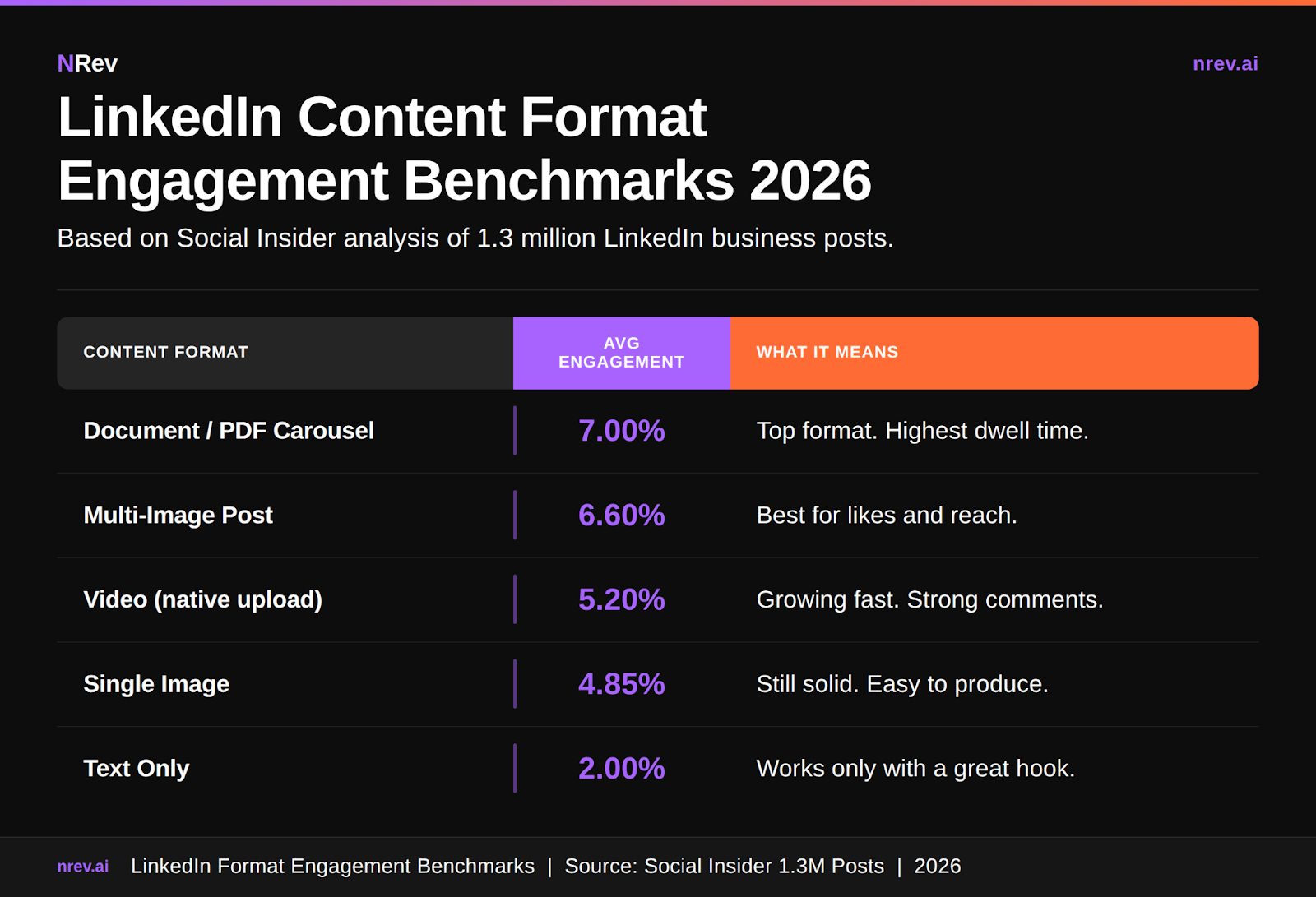
Document posts and PDF carousels: 7.00% average engagement rate. This is the top-performing format by a clear margin, with a 14% year over year increase. According to Social Insider's 2026 benchmarks (opens in new tab), native document posts earn 7.00% average engagement. The root source for this data is Social Insider's analysis of 1.3 million LinkedIn business posts collected from 16,645 active pages between January 2024 and December 2025.
Document posts work because they deliver what LinkedIn's audience genuinely wants: practical, downloadable value. Frameworks, checklists, step-by-step guides, and data reports all perform exceptionally well in this format. The swipe-through mechanic increases dwell time with every slide, which is exactly what the algorithm rewards.
Multi-image posts: 6.60% average engagement rate. The second highest format, particularly strong for generating likes and reach. Multi-image posts work well because they invite curiosity on each successive image.
Native video: 5.20% average engagement rate. Video views on LinkedIn grew 36% year over year according to Social Insider. Native video uploads significantly outperform links to external video platforms. Short, direct, camera-facing videos explaining a specific insight or process work best. Always upload video directly to LinkedIn rather than sharing a YouTube link.
Single images: 4.85% average engagement rate. A well-designed single image with a clear headline still performs reliably. It is the easiest format to produce consistently and works well as part of a varied content mix.
Text only: approximately 2.00% average engagement rate. Text-only posts are the weakest format by a significant margin. They can still perform when the hook and content quality are exceptionally strong, but they start at a structural disadvantage. If you use text-only posts, the first two lines need to do almost all the work.
How to Write a Hook That Stops the Scroll
LinkedIn truncates posts at approximately 210 characters before the "See more" button appears. The words before that button determine whether anyone reads the rest of your post.
If drafting is the bottleneck, a free LinkedIn post generator will give you three hooks to react to, which is easier than staring at an empty box.
This is where most LinkedIn content fails. Posts that open with "We are excited to announce..." or "I wanted to share some thoughts on..." give the reader no reason to click. They are predictable, low-energy openers that disappear into the feed.
A strong hook does one of three things.
It opens a knowledge gap. It implies there is something specific and valuable ahead that the reader does not have yet. "Most B2B teams are running outbound backwards. Here is the one thing they change when they fix it." The reader clicks to find out what that one thing is.
It makes a counterintuitive claim. It states something that challenges what the reader already believes. "More LinkedIn posts does not mean more reach. Here is what the data actually shows." The reader clicks because they want to verify or challenge the claim.
It speaks directly to a specific problem. It names a frustration or challenge so precisely that the target reader feels immediately recognized. "If your LinkedIn posts get likes but no DMs, here is why." This works because specificity creates relevance.
Keep your hook under 200 characters whenever possible. Every character before "See more" is premium real estate. Use it to create a reason to keep reading, not to introduce yourself or explain context.
How Often to Post on LinkedIn for Maximum Results
The question of how often to post on LinkedIn has a clear data-backed answer in 2026.
Buffer's analysis of over 2 million posts from 94,000 LinkedIn accounts (opens in new tab) is the most comprehensive published study on this question. The root source for this data is Buffer's internal data science team, led by Julian Winternheimer, analyzing posting frequency across real LinkedIn accounts.
The findings are clear:
Posting 2 to 5 times per week gives a modest but meaningful lift in reach and engagement rate per post compared to once a week. This is the range where most B2B professionals and teams can maintain quality without burning out.
Posting 6 to 10 times per week shows a stronger lift. Reach per post increases by an additional 5,001 impressions on average compared to the 2 to 5 range. This works well for dedicated content creators and teams with a content production system in place.
Posting 11 or more times per week produces the biggest gains, with accounts seeing nearly triple the engagements per post compared to once-a-week posters. However, this is only sustainable with a systematic content creation process.
The key takeaway from Buffer's analysis is that LinkedIn does not penalize you for posting often. The more you post, the more the algorithm has to distribute. Consistency builds compounding momentum that individual viral posts do not.
For most B2B teams, 3 to 5 quality posts per week is the practical sweet spot. Quality remains the prerequisite. High volume with weak content produces high volume with weak results.
The Best Times to Post on LinkedIn
Timing your posts to catch your audience when they are actively scrolling increases the early engagement velocity that the algorithm uses to determine distribution.
Based on aggregated benchmark data, the best windows for posting on LinkedIn are:
Tuesday, Wednesday, and Thursday between 7 and 9 AM in your audience's local time zone. This catches professionals before their first meetings of the day, when they are checking LinkedIn for industry news and updates.
Tuesday and Wednesday between 12 and 1 PM. The lunch scroll is real. This window catches people checking their feed between meetings or during a break.
Avoid posting on Friday afternoons and weekends unless your audience includes entrepreneurs and founders who work outside standard hours. Engagement during these windows is consistently lower, and lower early engagement means lower algorithmic distribution.
One important clarification: the best time for you specifically may vary from these general benchmarks. Your audience may be concentrated in different time zones or have different daily patterns. LinkedIn's analytics show you when your specific followers are most active, and that data should override general benchmarks.
Personal Profiles vs Company Pages: What the Data Shows
This is one of the most important distinctions in LinkedIn posting best practices, and most companies get it wrong.
Personal profiles significantly outperform company pages in organic reach and engagement. According to Refine Labs' published data study (opens in new tab), personal profiles generate 2.75 times more impressions and up to 5 times more engagement than company pages, despite having 46% fewer followers on average. Refine Labs reviewed 7 employee personal profiles against the Refine Labs company page over the same time period to produce this finding.
This happens because LinkedIn's algorithm trusts individual voices more than corporate publishing. A post from a real person signals an authentic perspective. A post from a company page signals marketing intent. The algorithm responds accordingly.
Employee posts achieve 561% greater reach than content published from company pages, according to the same Refine Labs LinkedIn employee vs brand research (opens in new tab). When a founder, sales leader, or subject matter expert posts from their personal profile, it travels further and earns more engagement than anything the company page publishes.
For B2B teams, the practical implication is clear. Your LinkedIn post strategy should be built primarily around personal profiles, not the company page. Founders, team leads, and domain experts should be posting regularly. The company page can serve as a credibility anchor for prospects who check it during their research process.
How to Convert Your Content Into Actual Pipeline
This is the section that most LinkedIn posting guides skip entirely. Getting engaged is not the goal. Converting that engagement into qualified conversations is.
Start by working out what already lands. You can analyze your post performance and see which posts pulled the audience you actually sell to.
Every post you publish on LinkedIn is either a warm-up for future outreach or a missed opportunity. When a target prospect engages with your content, that engagement is a buying signal. They liked your post about outbound strategy. They commented on your framework for qualifying leads. They saved your carousel about GTM team structure. Each of these is a signal that tells you something real about where they are in their thinking.
The connection between content and pipeline works in two directions.
Inbound - When your content is consistently valuable and targeted, prospects will reach out to you. They have seen your posts, recognized your expertise, and decided the conversation is worth starting. This is the highest-quality pipeline because the prospect has already self-qualified.
Outbound - When you monitor your target accounts for engagement signals and reach out based on what you observed, your outreach arrives with context. "I saw you engaged with my post about signal-based outreach last week" is a fundamentally different opening than a cold message to a stranger. It converts at a higher rate because it is not cold.
This is where a signal-based outbound workflow changes the economics of LinkedIn content. Instead of posting and hoping, you post with the intention of creating signals, then systematically act on those signals. Your content strategy and your outreach strategy become the same system.
When you pair consistent posting with a LinkedIn lead generation process that monitors who is engaging with your content and when, every post becomes a source of qualified pipeline data, not just a metric on a dashboard.
Four LinkedIn Posting Best Practices That Drive Real Results
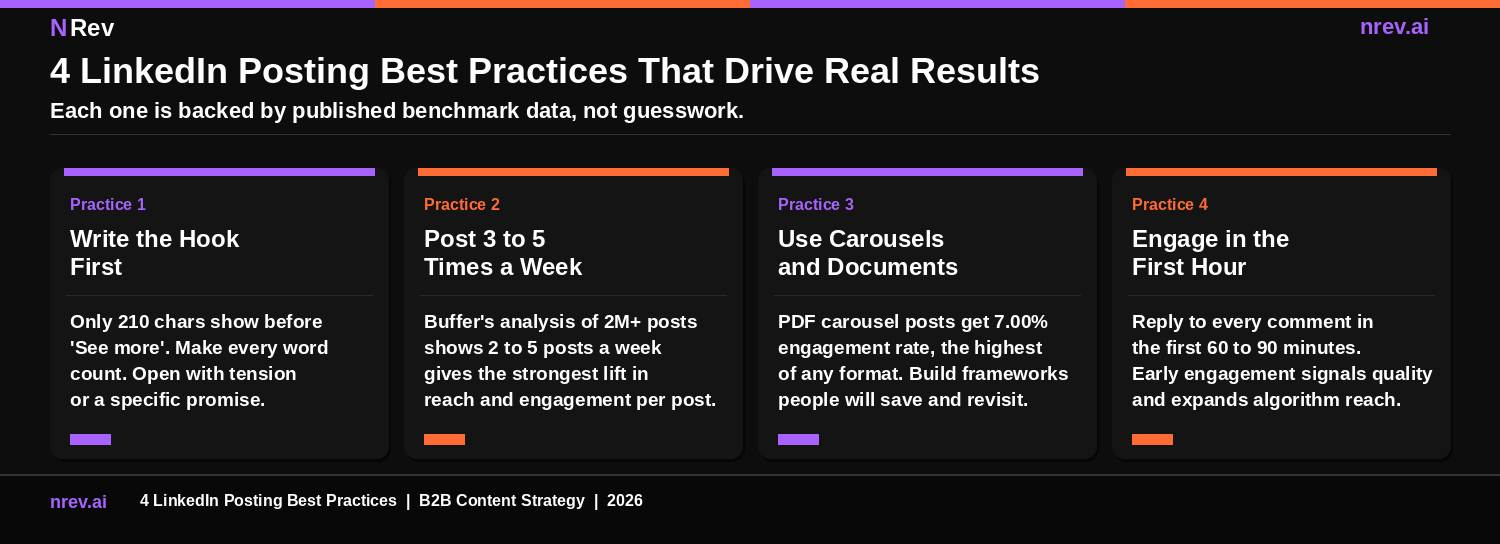
These four practices summarize the most impactful changes you can make to your LinkedIn posting strategy today, each grounded in the data covered throughout this guide.
Practice 1: Write the hook before anything else. The first 210 characters determine whether your post gets read. Draft your hook first, not last. Test two or three variations before you publish. The best hooks open a knowledge gap, make a counterintuitive claim, or speak directly to a specific frustration your target audience experiences. Never open with your name, your company, or "I am excited to share."
Practice 2: Post 3 to 5 times per week, consistently. Based on Buffer's analysis of more than 2 million LinkedIn posts, moving from once a week to 2 to 5 posts a week is where performance begins to compound. Consistency over time matters more than any individual post. A reliable publishing cadence builds audience familiarity and algorithmic priority simultaneously.
Practice 3: Use document and carousel posts as your primary format. PDF carousel posts earn 7.00% average engagement, the highest of any format according to Social Insider's 2026 benchmark data. Build frameworks, checklists, and step-by-step guides in this format. Make them genuinely useful enough that people save them for future reference, because saves are the most powerful distribution signal on the platform.
Practice 4: Engage in the first hour after every post. Reply to every comment within the first 60 to 90 minutes. Ask a follow-up question. Extend the conversation. This early engagement signals quality to the algorithm and drives wider distribution. Posts that go quiet immediately after publishing receive far less distribution than posts with active early conversations.
Turn LinkedIn Content Into Booked Meetings With nRev AI
Your LinkedIn posts are creating buying signals every day. Prospects are saving your frameworks, commenting on your insights, and engaging with your content before they ever reach out.
Most teams post and walk away. They never connect the engagement data back to their outreach workflow. nRev AI monitors your target accounts for engagement signals in real time, surfaces the right prospects at the right moment, and gives your team the context to reach out when it will actually land.
You describe the workflow you want. nRev builds it. No engineering. No manual tracking. Just a system that turns your content engagement into a real pipeline.
Build your first LinkedIn content-to-pipeline workflow on nRev AI and start converting engagement into conversations.
Frequently Asked Questions
What are the best practices for posting on LinkedIn?

The most impactful LinkedIn posting best practices in 2026 are: write a strong hook in the first 210 characters, post 3 to 5 times per week consistently, prioritize document and carousel formats which earn the highest engagement rates, engage with every comment within the first 90 minutes of posting, and post from personal profiles rather than company pages.
Personal profiles generate up to 5 times more engagement than company pages according to Refine Labs research. Every practice should connect back to a clear goal: building a warm audience of future buyers who will respond to your outreach.
What is a good LinkedIn post strategy for B2B?
A good LinkedIn post strategy for B2B teams starts with a clear content focus aligned to your ICP's problems and interests. Post 3 to 5 times per week using a mix of document posts, single images, and text posts. Lead every post with a hook that opens a knowledge gap or names a specific problem.
Track which posts generate saves and substantive comments, because those are the highest-quality engagement signals. Connect your posting activity to your outreach workflow by monitoring who engages with your content and using that engagement as a trigger for personalized outreach. Content and outbound should not be separate tracks.
What are the best LinkedIn best practices in 2026?
The key LinkedIn best practices in 2026 center on one fundamental shift: the platform now rewards depth of engagement over breadth of reach. Saves carry five times more algorithmic weight than likes. Comments of substance carry 2.5 times more weight than short reactions.
Document posts earn 7.00% average engagement, the highest of any format according to Social Insider's analysis of 1.3 million posts. Post from personal profiles, not company pages. Write hooks that stop the scroll. Engage actively in the first 90 minutes after publishing. And connect your content activity to your outbound pipeline so every post generates not just impressions but actual qualified conversations.