

Go to linkedin.com/sales/ssi right now. Write down the number you see.
Most people who check their social selling index score for the first time feel one of two things. Either they're pleasantly surprised and have no idea how they got there. Or they see a number in the 20s and feel vaguely embarrassed without knowing what to fix.
This guide is for both types. It explains what your LinkedIn SSI score actually measures, what a good score looks like depending on your industry, how to improve each of the four pillars without gaming the system, and most importantly, how to connect your SSI activity to real pipeline. Because the score by itself means nothing. The behaviors behind it are what actually close deals.
What My Social Selling Index Actually Measures
Your social selling index score is LinkedIn's way of measuring how well you use the platform for B2B sales. It runs from 0 to 100, updates every day, and reflects your activity over the last 90 days, not your lifetime history. That means a dormant account can recover in 30 to 60 days if you start showing up consistently.
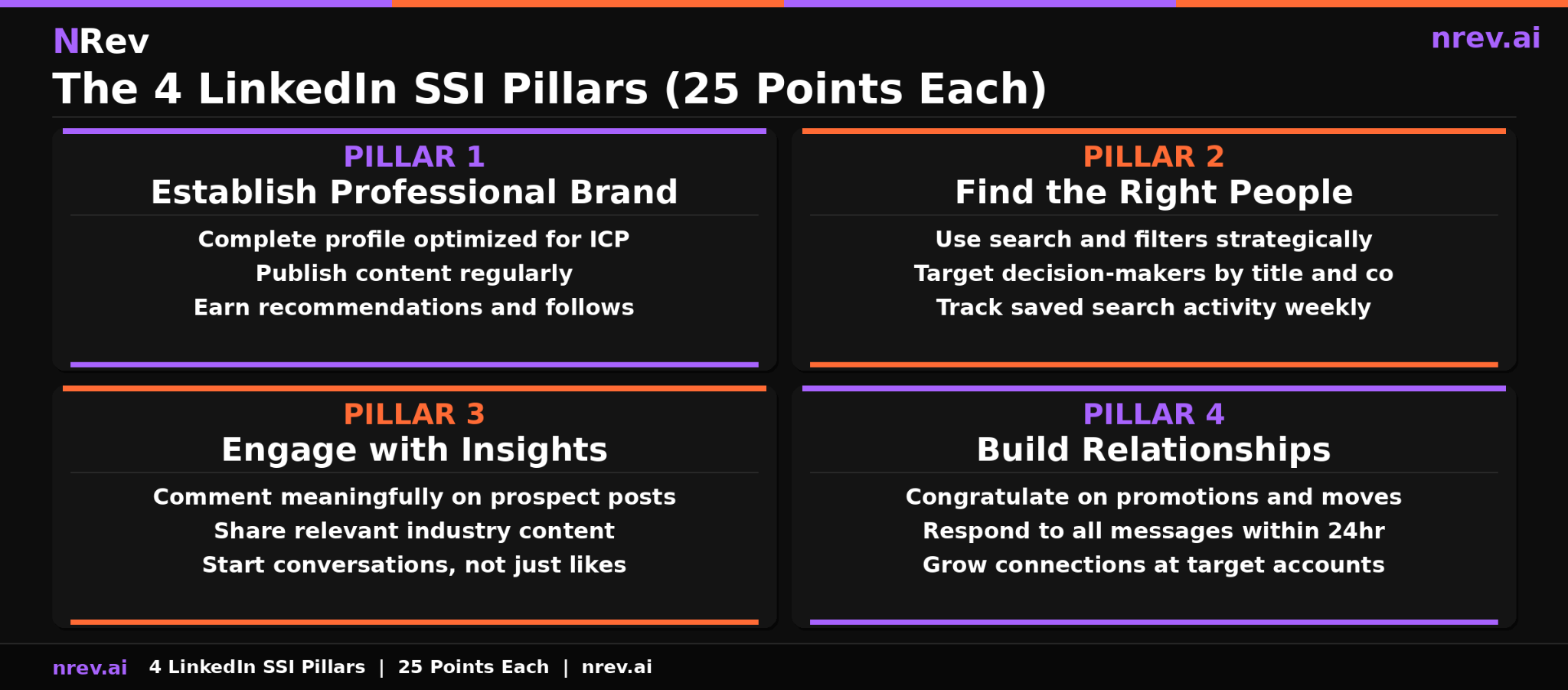
LinkedIn built the SSI in 2014 originally to justify Sales Navigator subscriptions. Over time it became the standard benchmark for LinkedIn selling activity. The score is built on four equally weighted pillars, each worth up to 25 points:
- Establish Professional Brand
- Find the Right People
- Engage with Insights
- Build Relationships
The score doesn't measure whether you're closing deals. It measures whether you're doing the LinkedIn behaviors that correlate with closing deals. That distinction matters a lot, and we'll come back to it.
According to LinkedIn's own research on social selling leaders, sellers with high SSI scores create 45% more opportunities than peers with lower scores and are 51% more likely to hit quota. Root source: LinkedIn Sales Solutions primary research. But LinkedIn's own Sales Navigator page also says the SSI "no longer accurately reflects the modern sales environment" and is pushing AI tools as the next chapter. Both things are true. The score still works as a diagnostic. It just shouldn't be the only thing you're measuring.
How to Check Your LinkedIn SSI Score Right Now
Go to linkedin.com/sales/ssi and log in with your LinkedIn account. You don't need a Sales Navigator for this. The SSI dashboard is free for every LinkedIn member.
You'll see four things:
Your overall score from 0 to 100 at the top. This is the headline number.
Your four pillar scores, each out of 25. This is where the real information lives. Most people have at least one pillar significantly weaker than the others, and that's where your next gains are.
Your industry rank, showing how you compare to others in your field. A 65 in an active B2B tech space might put you in the top 25%. The same 65 in a quieter industry might put you in the top 10%.
Your network rank, showing how you compare to your direct connections. If everyone in your network has a strong SSI, your network rank will be lower even with a good absolute score.
Check this monthly and screenshot it on the same date each month. The trends matter more than any single number.
What Your SSI Score Actually Means: The Benchmarks
Here's where most guides get vague. Let's be direct about what each range actually means.
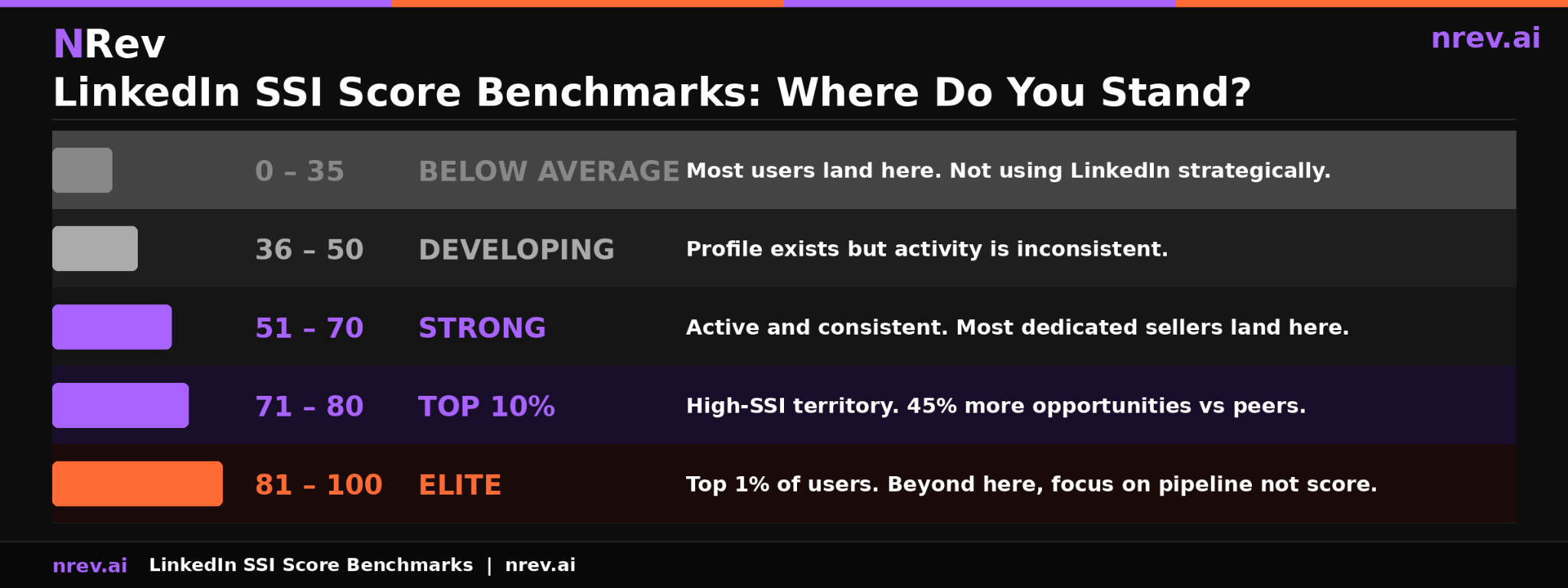
0 to 35: Below Average
This is where most LinkedIn users sit. It usually means the profile isn't complete, there's no posting activity, and search is used rarely or never. The good news: this range responds fastest to basic fixes. Getting from 25 to 45 is easier than getting from 60 to 70.
36 to 50: Developing
You're showing up, but not consistently. Maybe you post occasionally, respond to comments when they come in, but aren't systematically using LinkedIn for prospecting. Sellers at this level are on the platform but not treating it as a pipeline channel.
51 to 70: Strong
This is where dedicated social sellers live. You're posting regularly, using search to find and connect with prospects, engaging meaningfully with content, and maintaining active conversations. This range is achievable within 60 days for most people who commit to a daily LinkedIn routine.
71 to 80: Top 10%
High-SSI territory. This is where LinkedIn's data on the 45% more opportunities figure applies. You're in a small group of consistently active, targeted LinkedIn users. Most serious enterprise sellers and founders with strong personal brands sit here.
81 to 100: Elite
Top 1% of users globally. The gains from getting above 80 are marginal in terms of pipeline. If you're here, the SSI has done its job. Focus on whether your LinkedIn activity is actually generating conversations, not on pushing the score higher.
One important note: an industry average score for B2B sales professionals sits around 35. If you're reading this guide, you're probably already thinking more deliberately about LinkedIn than most of your competitors.
The 4 LinkedIn SSI Pillars Explained
Each pillar is worth up to 25 points. The fastest way to improve your overall SSI score is to identify your weakest pillar and focus there first, not try to improve all four simultaneously.
Pillar 1: Establish Professional Brand
This pillar measures two things: how complete and credible your profile is, and whether you're publishing content that builds authority.
Before you change anything, check how your posts actually perform, because SSI moves with output quality and not with posting frequency.
Your headline is the most important single field. It should describe what you do for your buyer, not your job title. "Helping B2B SaaS teams build signal-based outbound at nRev" will outperform "Co-Founder at nRev AI" every time. Your About section should read like a pitch to your ICP, with real proof points: outcomes, clients, results.
On the content side, consistency beats quality at first. One post per week from a profile that's never posted before will move this pillar. As you build momentum, aim for two to three posts per week. Original perspectives based on your actual experience move this pillar faster than shared articles.
Pillar 2: Find the Right People
This pillar tracks how strategically you're using LinkedIn's search and targeting tools to reach the right prospects.
Use the People search with filters for industry, title, company size, and location. Save searches and revisit them weekly. LinkedIn tracks your search activity and rewards purposeful, repeatable prospecting behavior over random browsing.
If you have Sales Navigator, the advanced filters here are significantly more powerful. You can filter for people who've posted on LinkedIn in the last 30 days, which means you're finding active prospects rather than dormant profiles. Activity matching activity is how the best conversations on LinkedIn start.
If you don't have Sales Navigator, the free LinkedIn search with careful Boolean queries covers a lot of ground. The key is to do it deliberately and consistently, not occasionally.
Pillar 3: Engage with Insights
This is the pillar most people undervalue. It measures whether you're engaging with content in a way that starts conversations, not just broadcasts.
A social selling signal finder makes this pillar practical by showing which conversations in your network are worth a comment this week.
Meaningful comments of 20 words or more on posts from people in your ICP do two things: they move this pillar, and they put your name in front of the right people in a context where you've already demonstrated that you have something useful to say.
The mindset shift is from "I need to post more" to "I need to show up in the right conversations more." Commenting on a prospect's post with a genuinely useful observation is often a better first touch than a connection request.
Sharing content from industry conversations you're genuinely tracking also moves this pillar, and creates a record of what you care about that prospects can see when they visit your profile.
Pillar 4: Build Relationships
This is the relationship depth pillar. It rewards growing your network with the right people at target accounts, maintaining active conversations, and engaging with your connections over time.
Congratulating connections when they announce a promotion is one of the simplest and most underused tactics for this pillar. When someone gets promoted, they post about it. LinkedIn surfaces it. You see it. A brief, genuine note takes 20 seconds to write and keeps the relationship warm with zero friction.
This matters beyond just SSI score mechanics. A promotion is one of the most reliable buying signals in B2B. Someone in a new role is evaluating their inherited tools, looking for ways to make an impact, and often open to conversations that a comfortable incumbent wouldn't be. The promotion congratulation opens a natural conversation.
Responding to messages within 24 hours also moves this pillar. LinkedIn tracks responsiveness as a relationship signal. More practically, slow responses kill momentum in conversations that started well.
The One Thing LinkedIn Won't Tell You About Your SSI
Here's the honest part that most SSI guides skip.
LinkedIn now says the SSI "no longer accurately reflects the modern sales environment." That's on their own Sales Navigator page, right now. They're pushing AI tools as the replacement.
They're not wrong about the limitation. A high SSI score doesn't guarantee pipeline. Someone could post daily, comment on everything, and have a score of 78 while booking zero meetings. The score measures activity. It doesn't measure whether that activity is targeted, strategic, or producing conversations that matter.
It also benchmarks you against peers in your industry, which means your score is partly a function of how active everyone else in your space is. A 60 in a highly active tech vertical might put you in the bottom half. A 60 in a quieter vertical might put you in the top 10%.
None of that means the SSI is useless. It means you should use it for what it's actually good at: identifying which LinkedIn behaviors you're underusing, and giving you a rough weekly pulse on whether you're showing up consistently enough to have a presence.
The sellers who use SSI well treat it as a diagnostic check, not a KPI. They look at their weakest pillar, fix it, and then ask whether their LinkedIn activity is generating the conversations that matter. The score follows the right behaviors. It's not a substitute for measuring whether those behaviors are producing pipeline.
How to Use SSI Signals as Pipeline Triggers
Here's where SSI goes from a LinkedIn metric to a sales workflow.
Every behavior that moves your social selling index score is also a signal about what's happening in your network. The Pillar 4 signals, specifically, are the richest source of real-time pipeline intelligence hiding in plain sight.
When someone in your target account network announces a promotion, that's a buying signal. New titles mean new budgets, new vendor decisions, new opportunities to displace incumbents. Congratulations to them. Note the account. Follow up in a week with something relevant to their new role.
When someone at a target account starts engaging heavily with content in a topic area your product addresses, they're broadcasting their priorities. Comment on that content. You're now in their peripheral vision with context before you ever send a connection request.
When a decision-maker at a prospecting target accepts your connection and starts viewing your content, that's a warm signal. It's not a pipeline opportunity yet, but it's someone who has opted into seeing what you share. What you post next matters.
None of these are about gaming your SSI score. They're about treating the LinkedIn activity that happens to move your score as intelligence about what's happening at your target accounts right now.
That shift, from "I'm doing this to improve my score" to "I'm doing this because it surfaces real buying signals," is what separates sellers who build a pipeline from LinkedIn from sellers who just build a larger audience.
How nRev AI Connects Your SSI Activity to Outbound Timing
The signals in Pillar 4, specifically promotions, job changes, and engagement patterns at target accounts, are exactly what nRev AI monitors at scale.
Rather than manually checking LinkedIn for who at your target accounts got promoted, what companies are showing engagement signals, or which accounts are actively researching solutions in your space, nRev watches those accounts continuously and surfaces the moments when outreach is most likely to land.
When a VP at a target account announces a promotion, nRev flags it, surfaces the account context, and can trigger the outreach sequence that treats this as the buying signal it is. The message that arrives references something real and current rather than leading with a generic pitch.
This is how your social selling index score connects to your outbound sales automation workflow. The SSI behaviors you build on LinkedIn, showing up in the right conversations, engaging with prospects before you pitch them, tracking who's moving into new roles at target accounts, generate the signals that nRev converts into timed, specific outreach.
Combined with the b2b buying signals layer that monitors beyond LinkedIn, across job postings, intent data, and competitive signals, the result is an outbound motion that reaches prospects at the moment they're most open. Not cold. Not generic. Timed to what's actually happening at their company right now.
Your SSI Score Is Telling You Something. Go Find Out What.
Check your score. Screenshot it. Look at your lowest pillar. Spend two focused weeks on that one area and nothing else. Then check again.
The score will move. But more importantly, the habits you build fixing a weak pillar are the same habits that generate the conversations that close deals. That's the real return on improving your social selling index score.
nRev AI turns the account signals from your LinkedIn activity into timed outbound workflows so your SSI work compounds into a pipeline, not just profile views.
See how nRev connects LinkedIn signals to your outbound workflow and start turning social selling activity into real conversations.
Frequently Asked Questions
Q1. What is the social selling index on LinkedIn?

Q2. What is a good LinkedIn SSI score?
Q3. How do I improve my LinkedIn SSI score fast?