

You already know LinkedIn is a powerful channel. The frustrating part is watching your messages get ignored while your connection requests pile up unanswered.
The problem is rarely your product. It is almost always the approach. Most LinkedIn outreach in 2026 still follows the same playbook that stopped working years ago: generic connection requests, copy-paste messages, and immediate pitches to cold strangers.
This guide gives you a different system. You will learn how to build a signal-based prospect list, warm up your targets before reaching out, write messages that actually get replies, and follow up without being annoying. Every step is built for B2B teams who want a consistent pipeline, not random conversations.
What Is LinkedIn Outreach and Why It Still Works
LinkedIn outreach is the process of identifying potential customers on LinkedIn and starting conversations with them through personalized messages, connection requests, or InMail.
It is different from cold email because it happens in a professional context where people expect business conversations. Your message arrives with a profile, a face, and a network of shared connections attached to it. That context changes how it lands.
The data confirms LinkedIn's dominance for B2B.
According to a study by HubSpot across 5,198 businesses, LinkedIn traffic converts to leads at 2.74%, which is 277% higher than Facebook at 0.77% and Twitter at 0.69%. This is the original published source for a statistic that is widely cited across the industry.
LinkedIn's own marketing data, published on their Lead Generation solutions page, confirms that 80% of B2B social media leads come through LinkedIn, with all other platforms combined accounting for the remaining 20%.
LinkedIn outreach works because the audience is there, they are receptive to professional conversations, and the platform gives you rich profile data that makes personalization genuinely possible at scale.
2. Why Most LinkedIn Outreach Fails
Before covering what works, it helps to understand exactly why most outreach fails. The same mistakes repeat across thousands of campaigns.
The pitch-first message. Sending a sales pitch in the first message is the single most common mistake. The recipient does not know you yet. There is no trust. A pitch before trust feels like a cold call, and people ignore it the same way.
The generic template. A message that could have been sent to a thousand people signals to the reader that it was.
Anything that starts with "Hi [Name], I came across your profile and thought..." has been seen so many times that it triggers an immediate skip. Your prospect needs to feel that the message was written specifically for them after you actually looked at their situation.
No reason for the outreach. Every message needs a reason why you are reaching out to this specific person right now. Without that, the message feels random and unwanted. A clear trigger, such as a job change, a funding announcement, or a piece of content they published, gives the message immediate context and relevance.
Asking for too much too soon. Requesting a 30-minute call in the first message creates friction. The prospect has to make a commitment before they know whether talking to you is worth their time. A question that is easy to answer creates no friction and keeps the conversation moving.
No follow-up system. Most people send one message, get no reply, and move on. A structured follow-up sequence with new value in each message is the difference between a 5% and a 15% reply rate.
Step 1: Optimize Your Profile Before You Send Anything
Your LinkedIn profile is the first thing a prospect checks when they get your message. If it does not immediately communicate who you help and how, your reply rate will suffer regardless of how good your messages are.
Think of your profile as a landing page, not a resume. A resume lists what you have done. A landing page answers one question: what is in it for the person reading this?
Three things to fix before you start any outreach campaign.
Your headline. Do not write your job title. Write the outcome you create for your customers. "GTM Engineer at Acme" tells the reader nothing useful. "I help B2B SaaS teams build outbound workflows that book 3x more meetings" tells them exactly whether they should care.
Your About section. Write it for the reader, not about yourself. Open with the problem you solve, then explain who you help, and close with a clear call to action that tells them what to do next. Keep it under 200 words.
Your recent activity. Before running outreach, make sure your feed shows recent posts or comments from you. A prospect who checks your profile and sees no activity in six months will question your credibility. Even two or three recent comments on relevant posts makes a significant difference.
Step 2: Build a Signal-Based Prospect List
The biggest leverage point in any LinkedIn outreach strategy is targeting people who are already showing intent signals, not just people who fit your ideal customer profile on paper.
A buying signal is an observable action that tells you someone is actively thinking about a problem you solve. The strongest signals on LinkedIn are:
Job changes. When a decision-maker moves into a new role, they are building their stack from scratch. They have budget authority and vendor choices to make. They are far more open to conversations than someone settled into a two-year-old setup.
Funding announcements. A company that just raised a round is actively hiring, buying tools, and investing in growth. Outreach within the first week of a funding announcement consistently outperforms cold list outreach.
Competitor engagement. When someone follows a competitor's LinkedIn page or engages with competitor content, they are actively researching solutions in your category. That is an in-market signal worth acting on immediately.
Content engagement on your topics. When someone repeatedly engages with content about a problem you solve, they are in research mode. They will be ready to buy soon.
Building this list manually is slow and does not scale. The more effective approach is to use a system that monitors your target accounts for these signals automatically and surfaces the right names at the right time. This is what a signal-based outbound workflow does in practice.
Step 3: Warm Up Before You Reach Out
The connection acceptance rate for a cold request from someone a prospect has never heard of is around 25 to 30%. The same request from someone whose name they recognize from their LinkedIn feed is significantly higher.
Warming up is simple. For two weeks before you send a connection request to a target, engage with their content. Leave a thoughtful comment on one of their posts. Like a post that is genuinely useful. The goal is not to flatter them. The goal is to appear in their notifications enough times that when your connection request arrives, your name feels familiar.
This approach also serves a second purpose: it tells you which targets are actually active on LinkedIn. Someone who posts regularly and gets engagement is far more likely to see and reply to your message than someone who last posted eight months ago.
Two weeks of engagement before a connection request is the standard for LinkedIn warm network outreach. Teams that skip this step consistently see lower acceptance and reply rates.
Step 4: Write a LinkedIn Outreach Message That Gets Replies
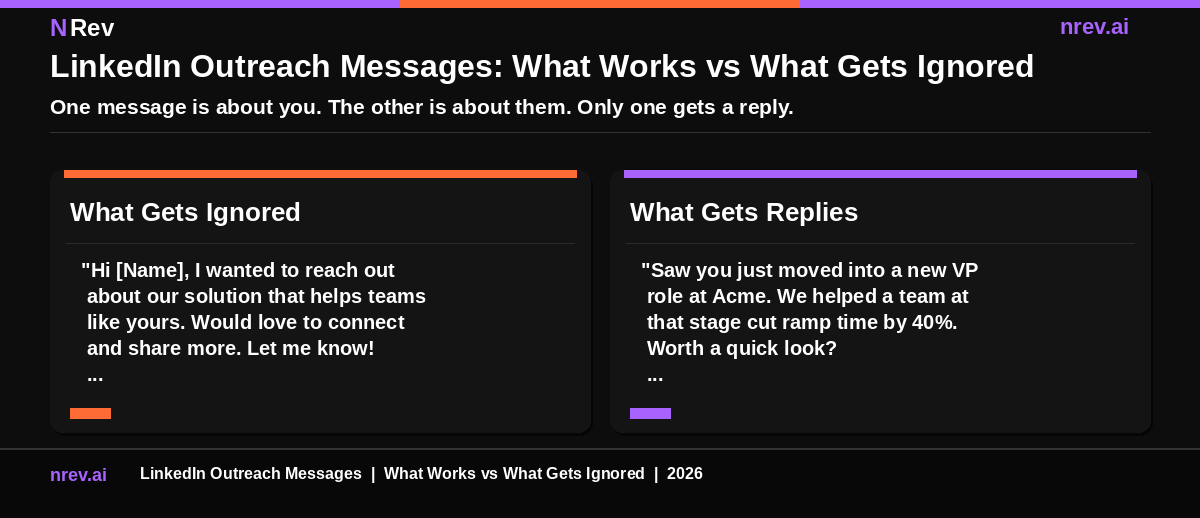
The best LinkedIn outreach messages follow a consistent structure. Three parts, in this exact order.
If you want a starting point rather than a blank box, you can generate the message from the prospect’s profile and edit from there.
Part 1: The trigger. State the specific signal or event that made you reach out. Not a generic compliment. A real, specific thing you noticed. "Saw you just joined Acme as VP of Sales." "Noticed your team just raised a Series B." "Saw your comment on the post about scaling SDR teams last week." One sentence. Specific. Real.
Part 2: The proof. State one concrete result you achieved for someone in a comparable situation. Not a feature list. Not your company mission. One outcome with a number. "We helped a team at the same stage reduce their ramp time by 40% in the first quarter." "One of our clients went from 6 to 22 booked meetings a month without adding headcount."
Part 3: The Ask. One easy question. Not a demo request. Not a calendar link. A question that the prospect can answer in one sentence. "Worth sharing the playbook?" "Curious if you've run into this?" "Would that be useful to see?"
Keep the entire message under 100 words. LinkedIn research consistently shows that shorter messages outperform longer ones in both reply rate and meeting conversion. The reader is busy. A short, specific message signals that you respect their time.
What to avoid:
Do not use "I wanted to reach out" as an opener. Do not ask for a 30-minute call in the first message. Do not include links in the first message. Do not add a PS with a soft pitch. Each of these patterns is immediately recognizable as a template and triggers an instant skip.
Step 5: Follow Up the Right Way
Most deals on LinkedIn do not come from the first message. They come from the follow-up. But the way most teams follow up destroys the relationship before it starts.
Following up with a variation of the same pitch signals that you ran out of ideas. Following up with something genuinely new signals that you are worth talking to.
The rule is one follow-up only, and it must bring something the prospect did not have before. A relevant case study. A specific data point about their industry. A piece of content that directly addresses a problem you know they are dealing with. "Just following up" is never acceptable.
Wait at least five business days before following up. If you still get no reply after one follow-up, move the contact to a lower-priority list and focus your energy on active conversations. Sending a third or fourth message without any engagement signal is not persistence. It is spam.
LinkedIn Outreach Metrics Worth Tracking
Tracking the right numbers tells you exactly where your LinkedIn outreach is breaking down.
Connection acceptance rate. A healthy rate is 25 to 35% for cold outreach. Below 20% means your targeting is too broad or your profile is not buyer-ready. Above 40% on cold outreach typically means your signal targeting is tight and your warm-up is working.
Positive reply rate. Of all first messages sent, what percentage receive a genuine positive response? A healthy benchmark for well-targeted personalized outreach is 10 to 20%. Below 5% indicates a problem with your message quality or targeting.
Meetings booked per 100 first messages. This is the clearest conversion metric. If 100 well-targeted personalized messages produce fewer than 3 booked meetings, the issue is in the message or the signal quality, not the volume.
Meeting the opportunity rate. Of the meetings LinkedIn outreach generates, how many turn into active pipelines? A low rate here signals that your targeting is attracting the wrong type of conversation, which means your ICP definition needs tightening.
Review all four metrics weekly. When one drops, you will know immediately which part of the process to adjust.
How to Scale LinkedIn Outreach Without Getting Banned
LinkedIn enforces activity limits on all accounts. Violating those limits results in warnings, restrictions, or permanent suspension. Here is how to scale responsibly.
Keep connection requests to a maximum of 100 per week. This is the widely accepted safe threshold across the LinkedIn automation community. Above that number, the risk of triggering LinkedIn's spam detection increases significantly.
Never automate the actual message content. Signal detection, prospect list building, and CRM updates can all be automated safely. But every message that goes out should be reviewed by a human before it sends. Automated messages sent at high volume with no human review are the fastest route to account restrictions.
Vary your activity timing. Tools that send at exactly the same hour every day create detectable patterns. Spreading activity across business hours within your target time zone looks more natural to LinkedIn's detection systems.
Always stop sequences when a prospect replies. One of the most damaging automation errors is sending a follow-up to someone who already responded. Enable auto-pause on reply in whatever tool you use.
For teams building systematic outbound automation workflows, the safest model is to use AI to surface signals and prepare personalized message drafts, and then let humans review and send each one.
How nRev AI Automates the Hard Parts
The most time-consuming parts of LinkedIn outreach are the parts that happen before you ever send a message: monitoring target accounts for buying signals, researching prospects, and building personalized message drafts at scale.
This is exactly what nRev AI is built for. nRev is an Agent OS for GTM teams. It monitors your target accounts for buying signals in real time, surfaces the right prospects at the right moment, and generates personalized outreach drafts based on the signal it detected.
Your team focuses on the conversations. The system handles the detection, the research, and the timing.
You describe the LinkedIn outreach workflow you want in plain language. nRev's AI builds it. No engineering. No automation setup. Just a workflow that works.
Frequently Asked Questions
What is LinkedIn outreach?

What is a good LinkedIn outreach strategy?
How do I write a LinkedIn outreach message?