


Best Outbound Sales Software for B2B Teams in 2026
Most B2B sales teams are running too many tools and getting too little pipeline from them. The average sales rep uses eight different tools to close a single deal, yet still spends only 28 to 30 percent of their week actually selling.
The problem is not a shortage of outbound sales software options. There are thousands of them. The problem is that most teams buy tools reactively, one to solve data, one to send emails, one to track calls, one to manage sequences, until the stack becomes the obstacle rather than the solution.
This guide breaks down the five categories of outbound sales software every B2B team needs to understand, what each category does, which tools lead each one, and how to choose a stack that creates a real outbound system rather than a collection of disconnected tools.
Why Outbound Sales Software Actually Matters
Outbound sales is a repeatable system problem, not a people problem. When the system is broken, the most talented reps in the world produce inconsistent results. When the system works, even average reps produce predictable pipelines.
The right outbound sales software is the infrastructure that makes the system work. It determines who gets contacted, when, through what channel, with what message, and with what follow-up cadence. Software does not replace the human judgment required to close a deal. It eliminates the manual work that prevents reps from applying that judgment consistently.
According to Salesforce's 6th State of Sales Report, a survey of 5,500 sales professionals across 27 countries, sales reps spend 70 percent of their time on non-selling tasks. These include administrative work, CRM updates, manual research, and meeting preparation. The remaining 30 percent is the only time reps are actually doing the job they were hired to do.
The right outbound sales software reclaims that time. Not by eliminating the need for human effort, but by automating the work that does not require human judgment: finding contacts, monitoring signals, building lists, scheduling follow-ups, and logging activity.
The Tool Overload Problem Most Teams Ignore
Before adding another piece of outbound sales software to your stack, it is worth understanding the most common failure mode in B2B sales tech: too many tools solving overlapping problems, creating more complexity than they remove.
According to Salesforce's statistics page, which draws from the Gartner Sales Survey of 1,026 sellers conducted in September 2024, sellers use an average of 8 tools to close deals. That same Gartner survey found that 72 percent of sellers feel overwhelmed by the number of tools they are expected to use.
The performance impact is significant. Sellers who feel overwhelmed by their tools are 45 percent less likely to hit quota, according to the same Gartner survey cited by Salesforce. More tools does not mean more pipeline. It often means more drag.
The practical implication before evaluating any software: identify the specific gap in your current outbound process, then choose the tool that addresses that gap with the least additional complexity. One tool that gets used consistently beats three tools that get used inconsistently.
The 5 Categories of Outbound Sales Software
Every piece of outbound sales software fits into one of five functional categories. Understanding the categories before evaluating specific tools prevents the most common buying mistake: purchasing a tool from one category when the real problem is in a different category.
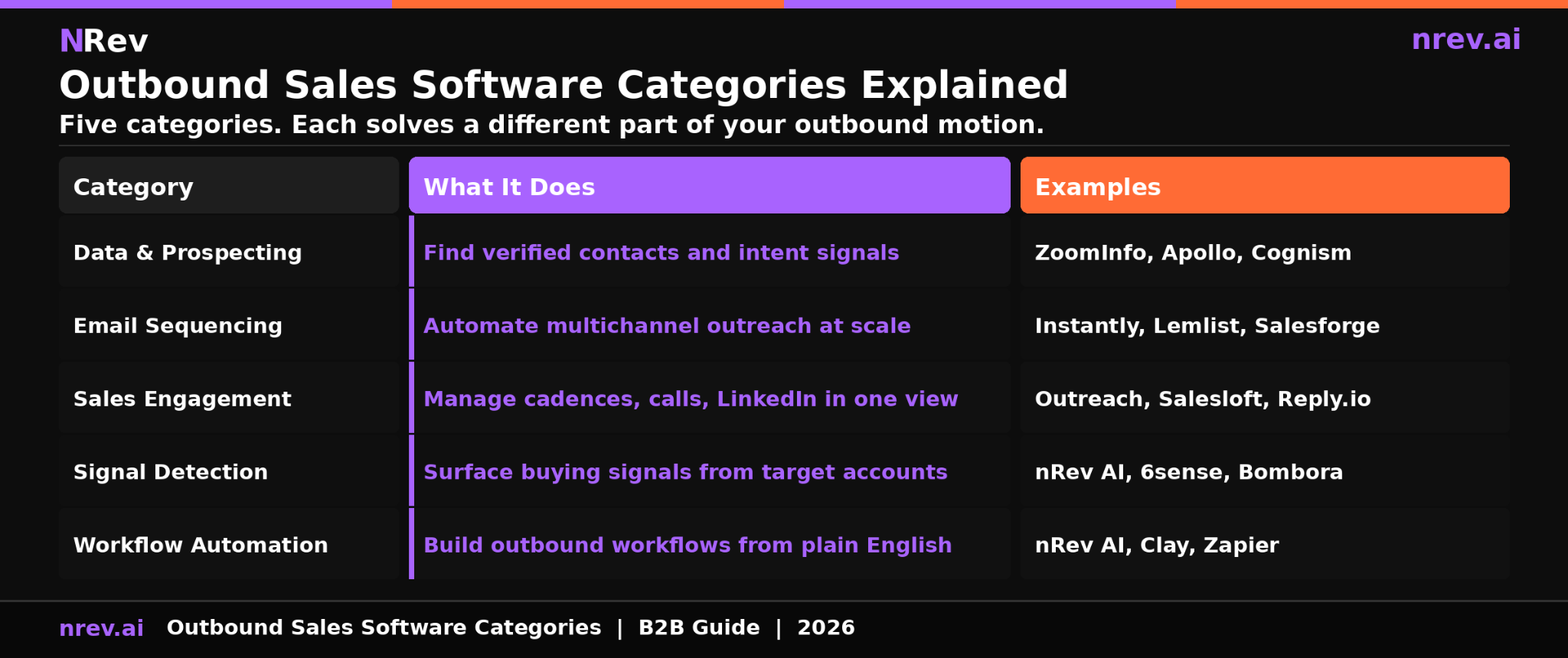
The five categories are:
Data and Prospecting. Tools that help you find verified contacts and surface intent signals across your target accounts.
Email Sequencing and Outreach. Tools that automate multichannel outreach across email, LinkedIn, and phone in coordinated sequences.
Sales Engagement Platforms. Tools that give reps a single workspace to manage all outbound activity, track performance, and run cadences.
Signal Detection and Intent. Tools that monitor your target accounts for buying signals and alert you when the right moment to reach out has arrived.
Workflow Automation and AI Systems. Tools that connect the other categories into a unified system, automating research, routing, and personalized outreach at scale.
Most teams have at least one tool in categories 1, 2, and 3. Very few have a real solution for categories 4 and 5. That gap is where most outbound pipelines are lost.
Category 1: Data and Prospecting Tools
Data tools are the foundation of any outbound motion. You cannot send a relevant message to the right person at the right time if your contact data is wrong, outdated, or incomplete.
B2B contact data decays fast. People change jobs, get promoted, leave companies, and change email addresses constantly. A list that was accurate six months ago could have 20 percent or more of its contacts in the wrong role or at the wrong company by the time you reach out.
The most important features to evaluate in a data tool are email verification accuracy, refresh frequency, mobile number coverage for cold calling, and the depth of intent signal data available.
ZoomInfo is the largest B2B database on the market with over 320 million contacts and 120 million company profiles. It includes buyer intent signals, website visitor identification, and deep CRM integrations. It is the default choice for enterprise teams and comes with enterprise pricing to match.
Apollo.io combines a 275 million contact database with built-in email sequencing and a dialer at a significantly lower price point. It is the most common starting tool for startups and small sales teams. The trade-off is data quality: Apollo lists can bounce at higher rates than dedicated data providers, particularly outside the United States.
Cognism specializes in verified mobile numbers and GDPR-compliant international data, making it the strongest choice for teams running heavy cold-calling programs in Europe.
What to look for: Prioritize email verification accuracy and refresh frequency over raw database size. A smaller, cleaner list outperforms a massive, stale one every time.
Category 2: Email Sequencing and Outreach Tools
Once you have verified contact data, you need a way to reach those contacts systematically across multiple channels. Email sequencing tools automate the delivery of coordinated outreach across email, LinkedIn, and phone.
The key distinction in this category is single-channel versus multichannel. Email-only tools are increasingly limited because email alone is not enough to break through. Sales sequences using three or more channels see 287 percent higher response rates than single-channel outreach, according to research aggregated by Martal Group's 2026 sales statistics report.
Instantly is the leading high-volume cold email platform, built specifically for teams running large outreach campaigns. Its infrastructure handles domain warm-up, rotation, and deliverability management. It is the strongest option for teams prioritizing email volume with solid deliverability.
Lemlist offers multichannel outreach combining email, LinkedIn automation, and cold calling in a single sequence. It also includes dynamic personalization features that let you insert personalized images and variables beyond simple first name tokens.
Salesforge is an AI-powered outbound platform that generates personalized email sequences automatically based on prospect data. It focuses on quality over volume and is well-suited to teams that want AI to handle first-draft personalization.
What to look for: Multichannel capability is now a baseline requirement. A sequencing tool that only handles email will underperform tools that coordinate email, LinkedIn, and phone in a single cadence.
Category 3: Sales Engagement Platforms
Sales engagement platforms (SEPs) are the operational layer that gives reps a single place to manage all their outbound activity. They combine sequencing, task management, call logging, analytics, and CRM sync into one workspace.
The primary problem these tools solve is context switching. When reps need to check their CRM, their email platform, their dialer, and their LinkedIn messages separately to understand where a prospect is and what to do next, they lose hours to tool-switching every week. A sales engagement platform consolidates all of this into one view.
Outreach is the leading enterprise sales engagement platform. It offers sophisticated multichannel sequencing, AI-powered analytics, A/B testing, and deep Salesforce integration. It is built for teams with structured sales processes and 25 or more SDRs.
Salesloft focuses on sales cadence management combined with conversation intelligence. It records and analyzes sales calls, surfaces coaching opportunities, and gives sales leaders visibility into which activities and messaging patterns are driving results.
Reply.io is a more accessible option for smaller teams, offering multichannel sequences, an AI SDR feature, and a built-in contact database. It sits between the enterprise SEPs and the pure sequencing tools in both capability and cost.
What to look for: Native CRM integration is non-negotiable. A sales engagement platform that requires manual data transfer between itself and your CRM creates more administrative work, not less.
Category 4: Signal Detection and Intent Tools
This is the category that separates good outbound from great outbound. Most teams invest heavily in categories 1 through 3 and almost nothing in category 4. That gap is the reason so much outbound feels cold.
Signal detection tools monitor your target accounts for observable events that indicate buying intent: a new funding announcement, a VP of Sales joining, a company expanding into a new market, a competitor review surge on G2, or a hiring spike in a function that relates to what you sell.
When your team reaches out because of a real, specific, timely signal, the message stops being cold. It becomes relevant. And relevance is the only thing that consistently improves reply rates in outbound.
6sense is the leading account-level intent platform. It aggregates buyer intent signals from millions of data sources and predicts which accounts are in an active buying cycle, allowing teams to prioritize outreach to the right accounts at the right time.
Bombora provides intent data based on B2B content consumption patterns. It tracks which topics companies are actively researching across thousands of websites and surfaces accounts showing intent in your category.
nRev AI takes a different approach to signal detection. Rather than aggregating third-party intent data, nRev monitors your specific target accounts for real observable events and surfaces them the moment they appear. Your team gets an alert when a target account hires a new VP of Sales, raises a funding round, or engages with competitor content, along with the context to reach out immediately.
What to look for: Signal detection should tell you not just who to contact but why to contact them right now. A tool that gives you a list of in-market companies without the specific trigger is not fully solving the timing problem.
Category 5: Workflow Automation and AI Systems
This category represents the biggest shift in outbound sales software in 2026. Workflow automation tools connect the other four categories into a unified system. They take signals, match them to the right contacts, trigger the appropriate outreach, and handle follow-up, all without manual intervention at each step.
According to Salesforce's 6th State of Sales Report, 83 percent of sales teams using AI-powered tools reported revenue growth in the year covered by the survey, compared to 66 percent for teams without AI. The same report, drawing on research by Gartner, found that sellers who use AI tools effectively are 3.7 times more likely to hit quota than those who do not.
The key insight: AI in outbound sales is not about generating email copy. It is about automating the research, routing, and timing decisions that currently consume the 70 percent of rep time that is lost to non-selling tasks.
nRev AI is purpose-built for this category. It is an Agent OS for GTM teams that monitors target accounts, surfaces buying signals, and builds complete outbound workflows from a plain English description. A sales or RevOps leader describes the workflow they want: when a target account hires a VP of Sales, find the contact, draft a personalized first-touch email referencing the hire, and queue a LinkedIn connection request for the next day. nRev builds and runs that workflow automatically.
This is what replaces the combination of Clay, n8n, and Zapier for teams that want an AI-powered outbound system without writing any code or managing complex automation logic.
Clay is a data enrichment and workflow platform that connects to 75 or more data providers. It is extremely powerful for teams with RevOps resources to build and maintain custom workflows, but requires technical expertise to use effectively.
What to look for: Ease of workflow creation matters as much as power. A platform that requires engineering support to update workflows will become outdated as your outbound strategy evolves. Prioritize tools where sales and RevOps leaders can make changes without involving a developer.
How to Choose the Right Outbound Sales Software Stack
Choosing outbound sales tools is not about buying the most powerful option in each category. It is about matching the right tool to your team's current stage, headcount, and specific execution gaps.
Before you buy anything, a set of free outbound tools will tell you which category you actually need.
For teams with 1 to 10 reps: Start with one data tool and one sequencing tool. Apollo covers both for early-stage teams. Add a signal detection tool before you add a third point solution. Your bottleneck at this stage is usually list quality and message relevance, not sequence volume.
For teams with 10 to 25 reps: Add a sales engagement platform to give reps a unified workspace. Outreach or Salesloft at the lower end, or Reply.io as a more accessible alternative. Build a formal signal detection process, either through a dedicated tool or by using nRev AI to monitor your target account list automatically.
For teams with 25 or more reps: At this scale, the workflow automation layer becomes critical. Manual processes that work for a 10-person team break down at 25 or more. Invest in connecting your stack: data feeds into sequencing, signal detection triggers personalized outreach, and everything syncs back to your CRM automatically.
Regardless of team size, the same selection principle applies: identify your single biggest execution gap, then choose the tool that closes it with the least added complexity. A focused stack with high adoption beats a comprehensive stack with low adoption every time.
Why Most Teams Get the Stack Wrong
The most common stack mistake is buying category 1, 2, and 3 tools while skipping categories 4 and 5 entirely. Teams invest in finding contacts and sending messages but never build the signal detection or automation layer that makes the outreach timely and relevant.
The result is high-volume, low-relevance outreach. Messages go out consistently. Reply rates stay low. Reps start blaming the channel or the product, when the real problem is timing and targeting.
The second most common mistake is buying before auditing. Teams add new tools to solve problems created by existing tools, rather than asking whether the existing tools could be configured differently or whether a different workflow would solve the problem without a new platform.
Before your next software purchase, run this four-question audit.
What is the actual gap in your current outbound results? Not "we want more pipeline" but a specific stage that underperforms: too few people responding, too few meetings converting, too many follow-ups going unanswered.
Which category of tool addresses that specific gap? If your reply rate is low, you likely need better signal detection or better personalization, not a faster sequencing tool.
Do you already have a tool in that category that is underused? Seventy-two percent of sellers feel overwhelmed by their tools, according to the Gartner data cited above. The answer is often better adoption of existing tools, not a new purchase.
Will a new tool create integration work? If the answer is yes, budget for that work explicitly or reconsider the purchase.
When these questions consistently lead to the answer that your team needs a more connected, automated outbound workflow rather than another point solution, that is when outbound automation becomes the right investment rather than another sequencing tool.
Pairing signal detection with a strong LinkedIn lead generation approach creates the warmest possible outbound motion: you know which prospects are worth reaching out to, you have context for why, and you can meet them on the platform where they are most active.
Build Your Outbound System on nRev AI
Most outbound sales software stacks are a collection of tools looking for a workflow. nRev AI is the workflow that connects them.
nRev monitors your target accounts for buying signals, surfaces the right prospects at the right moment, and builds complete outbound sequences automatically. You describe what you want in plain English. nRev builds the workflow and runs it. No code. No complex automation logic. No engineering dependency.
For B2B teams that are ready to replace their disconnected outbound stack with a system that actually works together, nRev is the Agent OS that makes that possible.
Build your first signal-based outbound workflow on nRev AI and start converting buying signals into booked meetings.
Frequently Asked Questions
What is outbound sales software?

What are the best outbound sales tools for small B2B teams?
How do outbound sales tools and sales communication tools differ?