

Outbound Sales: A Complete Guide for B2B Teams
Outbound sales is how B2B teams build pipelines on their own schedule, without waiting for a prospect to find them first.
Every company that wants predictable revenue needs a working outbound motion. Inbound brings leads when content ranks and algorithms cooperate. Outbound brings leads when your team decides to go get them. The best B2B teams run both, but outbound is the one you can control and scale directly.
This guide covers exactly what outbound sales is, how it works, which techniques and outbound sales channels produce results in 2026, and how to build a system that creates a consistent pipeline from your most important target accounts

What Is Outbound Sales? The Clear Definition
Outbound sales meaning, in the simplest possible terms: your team reaches out to potential customers first, before they have expressed interest in your product.
The sales rep, SDR, or founder identifies a target prospect, researches them, and initiates contact through email, phone, LinkedIn, or another channel. The prospect has not raised their hand. The outreach is proactive.
This is the direct opposite of inbound sales, where a prospect finds your content, fills out a form, or books a demo on their own. In outbound, your team controls when and who gets contacted. That control is the core value of outbound motion.
Outbound sales includes a wide range of activities. Cold email sequences, cold calling, LinkedIn prospecting, direct mail, and event-based outreach are all forms of outbound. What they share is that the sales team initiates every conversation.
Modern outbound in 2026 looks different from the mass-blast cold emailing of five years ago. The shift is toward signal-based outreach: contacting the right person at the right moment because a real observable event, such as a new job, a funding announcement, or a competitor research activity, tells you this person has a reason to have a conversation right now.
Outbound Sales vs Inbound Sales: Key Differences
Understanding the distinction matters because the two motions require different teams, different tools, and different success metrics.
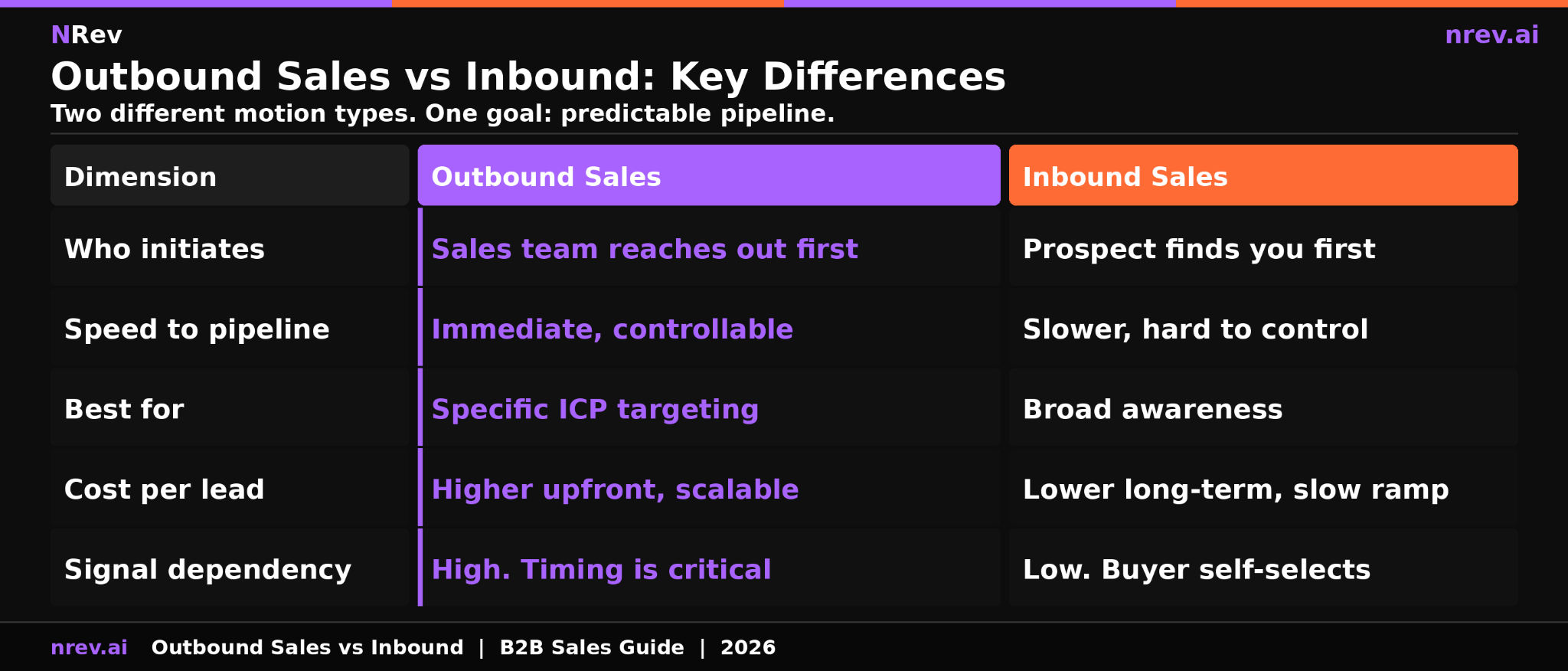
Outbound sales means your team initiates every conversation. You choose who to contact, when to contact them, and what message they receive. The pipeline you generate is a direct result of the effort and targeting quality your team puts in. When outbound slows down, you can diagnose and fix it. You can add volume, change messaging, or adjust targeting. You are in control.
Inbound sales means the prospect initiates the conversation. Your content, SEO, advertising, or referrals bring people to you, and your team responds to inbound interest. The quality of inbound leads is often higher because the prospect self-selected. The challenge is that inbound is slower to build, harder to control, and dependent on external factors like search rankings and platform algorithms.
Most high-growth B2B teams run both. Inbound builds awareness and generates leads passively over time. Outbound fills the pipeline immediately and targets the exact accounts you want to win. Each motion makes the other more effective. Inbound content warms up prospects who later receive outbound messages, and outbound conversations surface content that resonates better with the market.
The clearest reason to invest in outbound: it is the only motion you can turn on and measure results from within days, not months.
Why Outbound Sales Still Works in 2026
A common misconception is that outbound is dead because buyers ignore cold messages. The data tells a different story.
According to SPOTIO's 2026 sales statistics compilation, 69% of buyers have accepted cold calls from new providers in the past year. The source cited for this figure is the Demand Gen Report 2024, which surveyed B2B buyers about their receptiveness to outbound contact.
The problem is not the outbound channel. The problem is the execution. Generic messages sent to poorly targeted lists at the wrong time produce bad results. Personalized messages sent to the right person at the right moment produce conversations.
Martal Group's 2026 sales statistics report, which aggregates data from multiple B2B research sources, shows that personalized cold emails have a 32% higher response rate compared to generic ones. The original source cited for this figure is Salesloft's 2024 research on email personalization.
The same report shows that companies with strong sales enablement programs achieve a 49% higher win rate on forecasted deals. The root source for this finding is a Marketo 2024 study on sales and marketing alignment.
Outbound works when three conditions are met: the target is the right person, the timing aligns with a real signal or need, and the message references something specific enough to feel personal. When all three are true, outbound consistently produces qualified pipelines.
The 5-Step Outbound Sales Process
These are the five steps every effective outbound motion follows, in this exact order.
Step 1: Define your ICP precisely.
Your Ideal Customer Profile is the foundation of all outbound results. Without a specific ICP, every other step in the process is less effective. Define the job titles you target, the company sizes, the industries, the tech stack indicators, and the pain points that make your solution relevant. The sharper your ICP, the higher your conversion rate at every stage.
A weak ICP means your list is full of wrong-fit contacts. You spend the same effort sending messages to people who will never buy as to people who are perfect fits. Tightening your ICP is the single highest-leverage improvement available to most outbound teams.
Step 2: Build a signal-based prospect list.
A static list of names that match your ICP is the starting point, not the finish line. The modern approach is to layer buying signals on top of ICP criteria. A buying signal is an observable event that indicates a prospect has a reason to have a conversation with you right now.
The most powerful signals for B2B outbound are job changes at target accounts, funding announcements, hiring patterns that suggest growth in a relevant function, competitor engagement, and content activity on the problems your product solves. Prioritize prospects who show these signals over those who are just a demographic match.
This is exactly what a signal-based outbound workflow automates. Instead of manually scanning LinkedIn and news sites every day, a system surfaces the right names at the right moment.
Step 3: Write personalized messages built around the signal.
Every outbound message should reference the specific signal that made you decide to reach out to this person today. Not a generic mention of their industry or job title. A specific, real observation: their company just raised a Series B, they just moved into a new VP role, they commented on a post about the exact problem you solve.
Personalized emails consistently outperform templates across every benchmark dataset. According to Martal Group's cold email statistics report, which cites data from Instantly's 2026 Benchmark Report analyzing billions of cold email interactions, the platform-wide average cold email reply rate is 3.43%. Campaigns with advanced personalization beyond first name saw reply rates up to 18%, more than five times the average.
Step 4: Run multichannel sequences.
No single channel wins alone. Email sequences get ignored. Cold calls rarely connect on the first try. LinkedIn messages get lost in notification noise.
The teams that see the strongest outbound results combine all three in a coordinated sequence. According to data cited in Martal Group's sales statistics report, sales sequences using three or more channels see a 287% higher response rate than single-channel outreach. The root source for this figure is research published by sales technology platforms tracking multichannel sequence performance across B2B campaigns.
A practical multichannel sequence might look like: Day 1, personalized email. Day 3, LinkedIn connection request referencing the email. Day 5, follow-up email with a new data point or insight. Day 7, phone call or voicemail. Day 10, second LinkedIn message. Each touch reinforces the previous one and adds a new reason to respond.
Step 5: Follow up with persistence and value.
Most outbound deals are lost not because of a bad first message, but because of no follow-up. According to SPOTIO's 2026 sales statistics page , which cites data from RAIN Group's 2024 research, 80% of sales require five or more follow-ups after the initial contact. Yet 44% of salespeople give up after just one attempt.
That gap is one of the most actionable opportunities in outbound. Simply being more persistent than the average rep, while bringing new value in each follow-up instead of repeating the same pitch, captures a significant portion of deals that others abandon.
Each follow-up should bring something new. A relevant insight. A case study from a similar company. A stat about the problem you solve. Never send a follow-up that just says "following up." That signals you have nothing new to add.
Outbound Sales Techniques That Work
These are the specific outbound sales techniques that produce results in the current environment, based on what the data shows and what top-performing B2B teams consistently do.
Signal-triggered outreach. The most effective outbound technique in 2026 is reaching out immediately after a relevant buying signal. A new hire in the role you target. A funding announcement. A competitor contract renewal cycle. Outreach tied to recent activity boosts response rates by 32% compared to generic outreach, according to data from LinkedIn Sales Navigator benchmarks cited by Martal Group's outreach statistics report.
The insight-first email. Rather than opening with what you sell, open with a specific finding about the prospect's company, industry, or situation. "Your team just expanded into enterprise accounts. One thing we consistently see at that stage is X." The prospect reads a message about their reality, not about your product. This framing produces significantly higher reply rates than feature-led messaging.
Social proof sequencing. Include a short, specific proof point from a comparable company in your follow-up sequence. Not "we work with 500 customers." A specific outcome: "A team at the same growth stage reduced their ramp time by 40% in the first quarter using our approach." Specificity makes the proof credible and the claim memorable.
Warm calling with a context hook. Cold calling produces a 2.3% average success rate, but callers who reference a recent event, a piece of content the prospect published, or a shared connection at the start of the call see significantly higher connection rates. Always begin with a context hook before any pitch. "I saw your post last week about scaling SDR teams. I have a relevant data point for that. Worth 90 seconds?"
Account-based sequencing. Instead of reaching out to one contact at a target account, build sequences that touch multiple stakeholders simultaneously. According to Martal Group's cold email statistics report, which cites research on multi-contact outreach strategies, emailing multiple contacts at the same company increases response rates by 93% compared to single-contact outreach.
Outbound Sales Channels: Cold Email, Calling, and LinkedIn
Each channel serves a specific function in an effective outbound motion.
Cold email remains the highest-volume outbound channel and the most measurable. According to Martal Group's cold email statistics report, which draws on data from Instantly's 2026 Benchmark Report analyzing billions of cold email interactions, the average cold email reply rate is 3.43% platform-wide, with top performers achieving above 10%. Top-performing campaigns that use advanced personalization see reply rates as high as 18%.
Keep cold emails short, specific, and low-commitment. The ideal length according to benchmark data is 50 to 125 words, with the specific ask being easy to answer without a major commitment. Never include a link in the first cold email. Never open with your company name or product description.
Cold calling is the highest-friction channel but the highest-conversion when it connects. According to SPOTIO's 2026 sales statistics, which cites Demand Gen Report 2024 data, 69% of B2B buyers have accepted cold calls from new providers in the past year. The average cold call conversion rate to a qualified meeting sits at approximately 2.3%. Calling works best as part of a sequence, not as a standalone channel, because a prospect who has already seen your email is more receptive to a follow-up call.
LinkedIn outreach is the fastest-growing outbound channel and the one where warm outreach produces the strongest results. LinkedIn delivers the highest engagement when the prospect has already seen your content, engaged with a post, or received prior contact through another channel. LinkedIn connections combined with email and phone in a coordinated sequence produce dramatically higher results than any single channel alone.
How to Write Outbound Messages That Get Replies
Every outbound message needs to answer one question from the prospect's perspective: why should I respond to this specific message from this specific person right now?
The answer to that question is always the same: because the message is clearly about their situation, not yours.
The structure that works consistently across cold email, LinkedIn, and even voicemail is:
Line 1: The trigger. One sentence referencing the specific event or signal that made you reach out. This is not a generic opener. It is a real, specific observation about them.
Line 2: The connection. One brief line explaining why that trigger made you think of reaching out. Not a pitch. A logical connection between their situation and something you know or do.
Line 3: The proof. One concrete result delivered for someone in a comparable situation. A number. A specific company stage. Something real that makes the claim credible.
Line 4: The ask. One easy question. Not a meeting request. Not a demo link. Something that requires minimal commitment to answer.
Keep the total message under 100 words whenever possible. The temptation is to include more context, more social proof, and a clearer description of your product. Resist it. More words means less time for the prospect to give you.
Outbound Sales Metrics You Must Track
These are the four metrics that tell you whether your outbound motion is working at each stage.
Connection or acceptance rate. For cold email, this is your open rate. For LinkedIn, this is your connection acceptance rate. A healthy range for cold email open rates is 25 to 35% for a well-warmed sending domain reaching a relevant audience. For LinkedIn, a personalized request should see 25 to 35% acceptance.
Reply rate. This is the most important outbound metric. The Instantly 2026 Benchmark Report, cited in Martal Group's cold email statistics report, puts the platform-wide average cold email reply rate at 3.43%. A reply rate above 5% indicates good targeting and message quality. Above 10% is strong performance and usually the result of tight ICP targeting combined with genuine signal-based personalization.
Meeting rate. Of all first messages sent, what percentage convert into a booked meeting? This metric combines targeting quality, message quality, and follow-up persistence. A healthy benchmark is 1 to 3 meetings booked per 100 first messages for broad outbound. Signal-based, highly targeted outbound consistently produces 5 to 10 meetings per 100 first messages.
Pipeline-to-effort ratio. How much pipeline value is your outbound motion generating per hour of SDR or sales rep time spent? This is the ultimate measure of efficiency. Improving this ratio is the primary reason to invest in automation and better signal detection rather than simply hiring more people to do the same process.
Review all four metrics weekly. When one metric drops, you can pinpoint exactly which stage of the process needs adjustment.
How nRev AI Automates the Hard Parts of Outbound
The most time-consuming parts of outbound sales are the parts that happen before anyone sends a message: monitoring target accounts for buying signals, researching each prospect to personalize outreach, and building the list of people worth contacting right now.
These are also the parts where AI creates the most leverage. Signal detection, prospect research, and list building can all be automated without sacrificing the human judgment that makes outbound messages worth reading.
nRev AI is an Agent OS for GTM teams. It monitors your target accounts in real time, surfaces the right prospects the moment they show a buying signal, and generates personalized outreach drafts based on what it detected. Your team focuses on the conversations. The system handles the detection, the research, and the timing.
When you combine a well-built outbound automation workflow with a clear ICP and a solid sequence, outbound stops being a volume game and becomes a precision motion. Every message arrives with context. Every follow-up adds something new. Every conversation starts from a place of relevance.
For teams building or rebuilding their LinkedIn lead generation motion as part of a broader outbound system, nRev connects the two so that content engagement, profile activity, and connection events all feed into the same outbound workflow automatically.
Turn Outbound Into a Predictable Pipeline System With nRev AI
Outbound sales works when the right message reaches the right person at exactly the right moment. Most teams miss that moment because they are not watching for it.
nRev AI monitors your target accounts continuously, surfaces buying signals the instant they appear, and helps your team reach out with context before any competitor does. You describe the workflow you want. nRev builds it. No engineering. No manual prospecting. Just a system that creates a consistent pipeline from your most important accounts.
Build your first outbound sales workflow on nRev AI and start turning signals into booked meetings.
Frequently Asked Questions
What does outbound sales mean?

What are the most effective outbound sales techniques?
How many follow-ups should you send in outbound sales?