


What Is Outbound Sales and Why Most Teams Get It Wrong
Most B2B teams think they understand outbound sales. They set up sequences, hire SDRs, and start sending emails. Then they wonder why the pipeline stays thin.
What is outbound sales, really? It is the motion where your team proactively reaches out to people who have not yet asked to hear from you. You make the first move. You choose who to contact, when to contact them, and what to say. The results are entirely within your control.
That control is exactly why outbound prospecting is the fastest way to build pipeline when done right, and one of the biggest sources of wasted effort when done wrong. This guide covers the clear definition, the most common mistakes B2B teams make, and the outbound sales strategy that actually produces consistent results in 2026.
What Is Outbound Sales: The Clear Definition
Outbound sales is the process of your sales team proactively reaching out to potential customers who have not expressed prior interest in your product or service.
Your team identifies prospects, researches them, and initiates contact. The prospect did not ask for the outreach. Your team made the first move. Every channel you use to do this, cold email, cold calling, LinkedIn messages, direct mail, event outreach, counts as outbound.
This is the direct opposite of inbound sales, where the prospect finds you through search, content, or referrals and initiates the conversation themselves.
The word "cold" gets attached to outbound because historically the contact was a stranger with no prior relationship. In modern B2B outbound sales, the best teams minimize how cold that contact feels by using buying signals to reach out at the exact moment when the prospect has a real reason to respond. A job change. A funding announcement. A piece of content they published. A competitor evaluation.
When you reach out because of a real signal, outbound stops feeling cold and starts feeling relevant. That difference in execution is what separates a 3% reply rate from a 15% reply rate.
Outbound Sales vs Inbound Sales: The Key Difference
Both motions exist to generate pipelines. They differ on who initiates the conversation and how much control your team has over timing.
Outbound sales: Your team reaches out first. You choose the target, the timing, and the message. You can adjust and optimize results directly because every variable is in your control. Pipeline growth is a direct function of the effort and targeting quality your team brings.
Inbound sales: The prospect reaches out first, after finding your content, your website, or a referral. Inbound leads are often higher quality because the prospect is self-selected. The challenge is that inbound is slower to build, depends heavily on SEO and content, and cannot be turned on immediately.
The clearest case for outbound: it is the only motion you can activate and see results from within days. Inbound takes months to compound. Outbound takes hours to start.
Most high-performing B2B teams run both together. Inbound warms up the audience over time. Outbound targets specific accounts immediately. Each makes the other more effective. Inbound content gives your outbound reps something credible to reference. Outbound conversations surface exactly which topics your content should cover next.
What Outbound Prospecting Actually Involves
Outbound prospecting is the front end of the outbound motion. It is the process of identifying, researching, and prioritizing the right people to contact before any message goes out.
Most teams treat prospecting as list-building: download a CSV, load it into a sequence, start sending. This is the fastest way to waste the budget on outreach that lands cold.
Modern outbound prospecting has three distinct components.
ICP definition. Before building any list, you need to define exactly who you are targeting. Job title, seniority level, company size, industry, tech stack, stage of growth. The sharper your Ideal Customer Profile, the higher every downstream metric will be, including reply rate, meeting rate, and close rate.
Signal detection. A static list of ICP-matched contacts is the starting point, not the finish line. Buying signals are the filter that tells you which contacts on that list are worth reaching out to right now. A recent funding round means a company has budget to spend. A new VP of Sales joining means priorities are being reset. A company posting jobs in a function that relates to what you solve means they are actively investing there. These signals change who is worth contacting today versus next quarter.
Prioritization and sequencing. Not every prospect deserves the same depth of personalization. Signal-rich prospects get fully customized outreach referencing the specific trigger. Warm ICP matches get lighter personalization. Broad ICP matches without signals get templated sequences. The smart allocation of personalization effort is what separates efficient outbound from overwhelmed teams trying to custom-write every message.
Why Most Teams Get Outbound Sales Wrong
The core reason most outbound programs underperform is a mismatch between what teams measure and what actually drives results.
Teams measure activity: emails sent, calls made, sequences launched. But buyers respond to relevance, not volume. When a team optimizes for activity, they send more messages that are less targeted, which produces worse results, which pushes them to send even more messages to compensate. The cycle compounds.
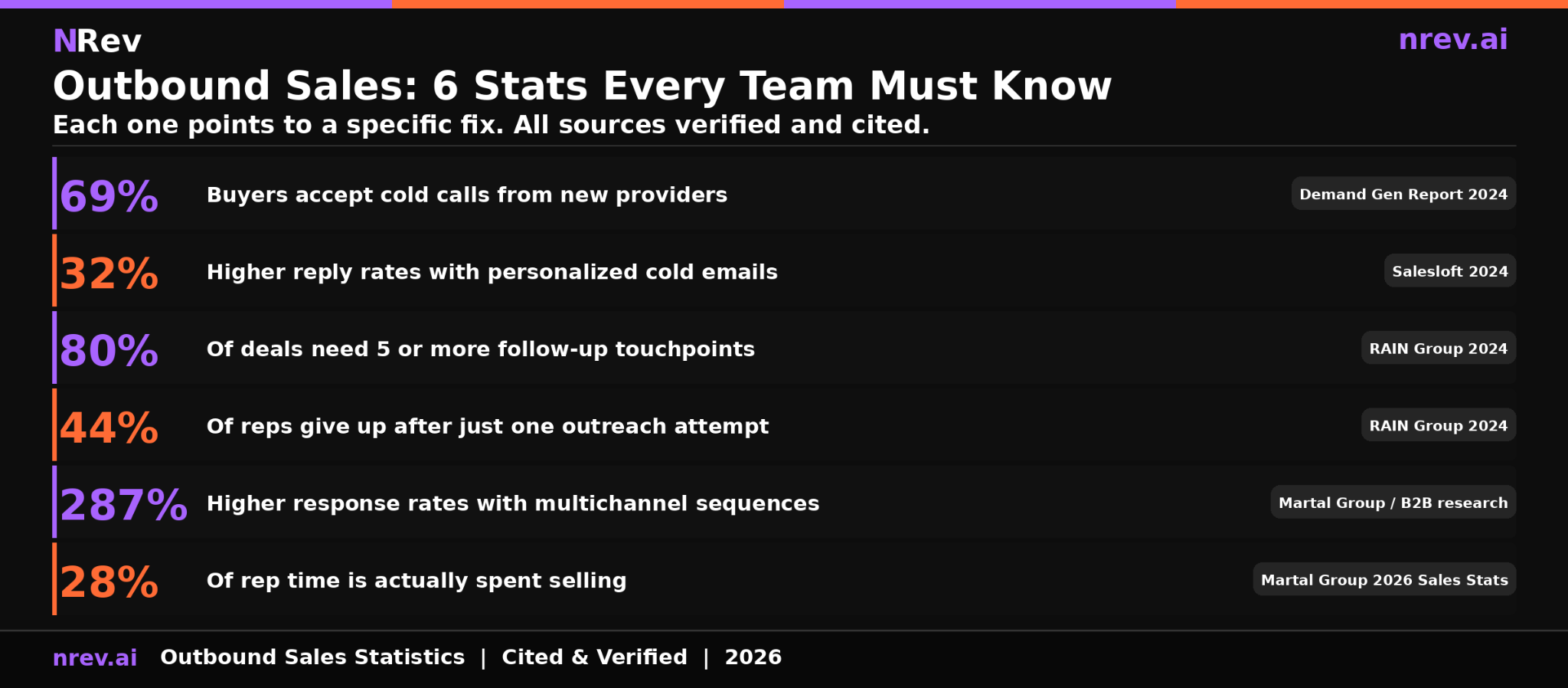
The data is clear. According to SPOTIO's 2026 sales statistics page, which cites Demand Gen Report 2024, 69% of buyers have accepted a cold call from a new provider in the past year. Buyers are not ignoring outbound because it does not work. They are ignoring it because most of it is irrelevant to them.
The same source reports, citing Salesloft's 2024 research, that personalized cold emails produce a 32% higher response rate compared to generic ones. The difference between a bad outbound program and a good one is rarely the channel. It is the targeting, the timing, and the message quality.
Sales reps also spend far less time actually selling than most leaders realize. According to Martal Group's 2026 sales statistics report, which aggregates data across multiple B2B research sources, reps spend only 28% of their time on actual selling activity. The rest goes to admin work, CRM updates, and manual research. This means the outbound problem is often not a people problem but a systems problem.
Six Outbound Sales Mistakes That Kill Your Pipeline
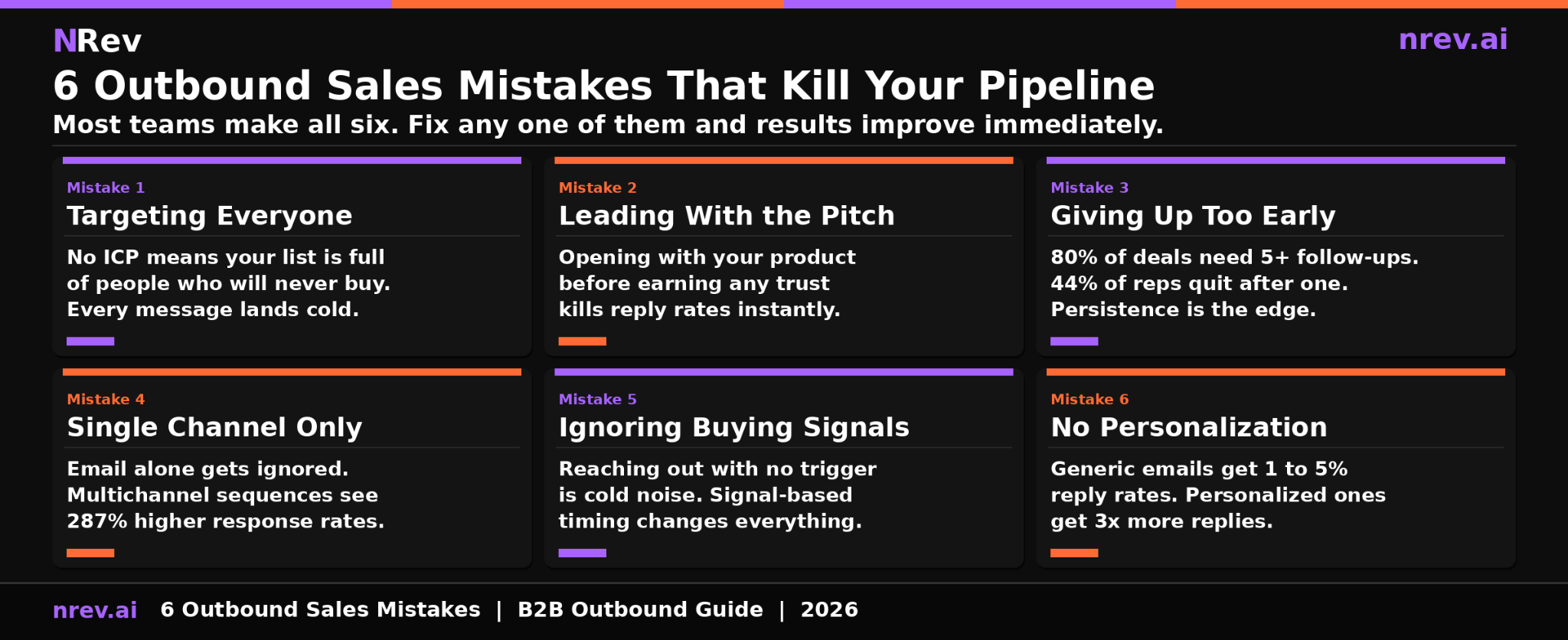
Mistake 1: Targeting everyone who fits the demographic.
A list of people with the right job title is not an ICP. It is a demographic filter. The teams that get outbound right narrow further: they layer in company size, tech stack, growth signals, and buying intent before any message goes out. A sharper list with 100 names consistently outperforms a broad list with 10,000 names.
Mistake 2: Opening with the product pitch.
The first message in any outbound sequence is the worst possible moment to pitch. The prospect does not know you yet. They have no context for why your product would be relevant to them. A message that opens with "Hi, I work at Company X and we help teams like yours with Y" gets ignored instantly, because it talks about you when the prospect only cares about themselves.
The message that works opens with a specific observation about the prospect's situation and connects it to a relevant outcome, without mentioning the product at all.
Mistake 3: Stopping after one or two touches.
According to SPOTIO's sales statistics, which cites RAIN Group 2024 research, 80% of deals require five or more follow-up touchpoints after the initial contact. Yet 44% of salespeople give up after just one attempt. The math on this is striking: nearly half of all sales reps are walking away from 80% of their potential deals by stopping too soon. Persistence, with new value in every follow-up, is one of the most consistent edges in outbound.
Mistake 4: Using only one channel.
Email sequences that go unanswered, calling without any prior context, or LinkedIn messages without email follow-up all underperform compared to coordinated multichannel sequences. According to data cited in Martal Group's sales statistics report, sales sequences using three or more channels see 287% higher response rates than single-channel outreach. Using one channel is leaving most of your potential responses on the table.
Mistake 5: Ignoring buying signals.
Reaching out to a cold prospect with no trigger other than their job title puts you in the same category as every other SDR who sent them a message that day. Reaching out because their company just announced a funding round, their VP of Sales just joined, or they are actively comparing tools gives you something real to reference. That specificity is what earns a response.
Mistake 6: No personalization at any level.
Generic templates get generic results. The average cold email reply rate sits between 1% and 5% for mass outreach, according to benchmark data cited in Martal Group's cold email statistics report, which draws from Instantly's 2026 Benchmark Report analyzing billions of cold email interactions. Campaigns with advanced personalization beyond the first name see reply rates as high as 18%. The gap between personalized and generic outreach is not marginal. It is five times the result from the same effort.
Outbound Sales Strategy: What the Best Teams Do Differently
The teams that consistently produce pipeline from outbound are not working harder than average teams. They have built a system where every outreach decision is driven by data rather than guesswork.
They start with a tight ICP and update it regularly. Top outbound teams review their ICP quarterly. They look at which deals closed fastest, which had the highest contract values, and which customers renewed. Then they rebuild their targeting criteria around those patterns. The ICP is never finished.
They build a signal detection system. Instead of manually checking LinkedIn for job changes and news feeds for funding announcements, they set up automated monitoring that surfaces the right accounts at the right moment. When a target account shows a buying signal, the sequence starts immediately. Timing is the variable that turns a cold message into a relevant one.
They run multichannel sequences with deliberate spacing. A strong sequence in 2026 looks something like: Day 1, personalized email referencing the signal. Day 3, LinkedIn connection request mentioning the email. Day 5, follow-up email with a new data point. Day 7, phone call. Day 10, LinkedIn message. Each touch builds on the previous one and adds something new.
They track reply rate as the primary outbound metric. Not emails sent. Not calls made. Not sequences launched. Reply rate tells you whether your targeting and messaging are working. A team with a 10% reply rate on 200 first messages is dramatically more efficient than a team with a 2% reply rate on 1,000 first messages. Fewer messages, more conversations, more pipeline.
They automate the research, not the judgment. The research that goes into every outreach message, finding the signal, understanding the company, identifying the right person, is where AI creates the most leverage. The judgment about what to say and how to position the message stays with the human rep. This combination of automated research and human crafted messages is what produces outbound at scale without losing relevance.
When you combine these five elements into a repeatable system, outbound stops being a volume game and becomes a precision motion. Every sequence starts with a real reason to reach out. Every follow-up adds value. Every conversation starts from a position of demonstrated relevance.
This is exactly what a signal-based outbound workflow automates. Instead of manually hunting for triggers, the system surfaces them and gives your team the context to act immediately.
Outbound Sales Tips You Can Apply This Week
These four outbound sales tips do not require new tools or a team rebuild. Each one addresses a specific execution gap that most B2B teams have.
Tip 1: Audit your ICP before your next sequence launch. Pull your last 10 closed deals and identify the two or three firmographic signals they share that are not currently in your targeting criteria. Update your list criteria before you build the next sequence.
Tip 2: Add one signal-based trigger to your prospecting. Pick one buying signal that is relevant to what you sell: a specific job title change at a target account, a funding event, or a technology adoption signal. Monitor that signal for one week and prioritize those contacts in your next outreach batch.
Tip 3: Rewrite your first email to remove the pitch entirely. Take your current first-touch email and delete every sentence that mentions your company or your product. What is left? If almost nothing remains, the message was a pitch masquerading as an introduction. Rebuild it around a specific observation about the prospect's situation.
Tip 4: Set a minimum of five touches per prospect before marking them as unresponsive. Most reps give up at one or two. Setting a floor of five structured touches, with each one adding a new angle or piece of value, will immediately capture conversations that were previously abandoned too early.
What Outbound Sales Services Look Like in 2026
Outbound sales services are external teams or platforms that take on part or all of the outbound motion on behalf of a company. They range from fully outsourced SDR teams to specialized signal detection platforms to AI-powered workflow systems.
The most common reason companies engage outbound sales services is bandwidth. Building and running a repeatable outbound system requires consistent effort across research, messaging, sequencing, and follow-up. Many teams do not have the headcount to do it well.
The most effective outbound sales services in 2026 share one characteristic: they are built around signal detection rather than list volume. A service that delivers a large CSV of names and emails is solving the wrong problem. A service that identifies your target accounts, monitors them for buying signals, and surfaces the right contacts at the right moment with context for why they are worth reaching out to today is solving the actual problem.
This is the approach that nRev AI takes. Instead of giving you lists, nRev builds the entire outbound automation workflow: target account monitoring, signal detection, personalized outreach drafts, and follow-up sequencing. You describe the workflow in plain English. nRev builds it. Your team focuses on having the actual conversations.
For teams that also use LinkedIn lead generation as part of their outbound motion, nRev connects content engagement, connection activity, and profile signals into the same workflow automatically. Every touchpoint feeds the same system.
Start Building Pipeline From Outbound Today With nRev AI
Outbound sales works when the right message reaches the right person at the exact moment they have a reason to respond. Most teams miss that moment because they are not watching for it.
nRev AI monitors your target accounts in real time, surfaces buying signals the instant they appear, and helps your team reach out with context before any competitor does. You describe the workflow you want. nRev builds it. No engineering. No manual research. Just a system that converts signals into conversations and conversations into pipelines.
Build your first outbound sales workflow on nRev AI and start turning the right signals into the right conversations.
Frequently Asked Questions
What is outbound sales in simple terms?

What is outbound prospecting?
What are the best outbound sales tips for B2B teams?