

Why Most Outbound Sales Automation Fails (And What to Do Instead)
Outbound sales automation is supposed to make prospecting faster and more consistent. For most B2B teams, it makes prospecting faster and equally inconsistent.
The problem is not automation itself. Automation is a force multiplier. If the underlying approach is wrong, automation multiplies the wrong approach at scale. More emails go out. More prospects get irrelevant messages. Reply rates stay low or fall further. And the team concludes that automation does not work, when the real issue is what they automated.
This guide covers the five specific reasons outbound sales automation fails for most B2B teams, what the data shows about what buyers actually respond to, and how to build an automation workflow that produces real pipeline rather than high send volume and low results.
What Outbound Sales Automation Actually Is
Outbound sales automation is the use of software to execute and manage prospecting tasks without constant manual effort. This includes building prospect lists, sending email sequences, scheduling follow-up messages, managing LinkedIn outreach, and routing leads through a CRM.
Done well, automation handles the repetitive operational work so reps can spend time on the conversations that require human judgment: complex objection handling, relationship building, and deal closing.
Done badly, automation handles the wrong work: sending the same generic messages faster, to more people who did not ask for them, across more channels than a rep could manually reach.
The distinction between good and bad automation is not about the tools used. It is about the logic that drives the automation. Automation built on signal detection and relevant timing works. Automation built on volume and demographic targeting produces noise.
Why the Premise of Most Automation Is Flawed
Most outbound sales automation is built on a premise that has not been true for years: that increasing message volume increases pipeline.
The math used to work when inboxes were less crowded and buyers were less experienced at filtering. Today, buyers receive dozens of automated outreach messages every week. They have become very good at recognizing templates, ignoring generic openers, and deleting messages that open with your company's name.
According to Hunter.io's State of Cold Email report, based on analysis of 31 million emails sent by Hunter users in 2025, the average cold email sequence reply rate is 4.5 percent. That means for every 1,000 prospects who received an email, only 45 replied.
The same report found that sequences targeting between 21 and 50 recipients achieve a 6.2 percent reply rate, while sequences targeting over 500 recipients achieve only 2.4 percent. The data is unambiguous: volume and relevance move in opposite directions. As you scale outreach to more people, each individual message becomes less relevant, and reply rates fall.
The teams that built automation to solve the volume problem made the targeting problem worse.
Five Reasons Outbound Sales Automation Fails
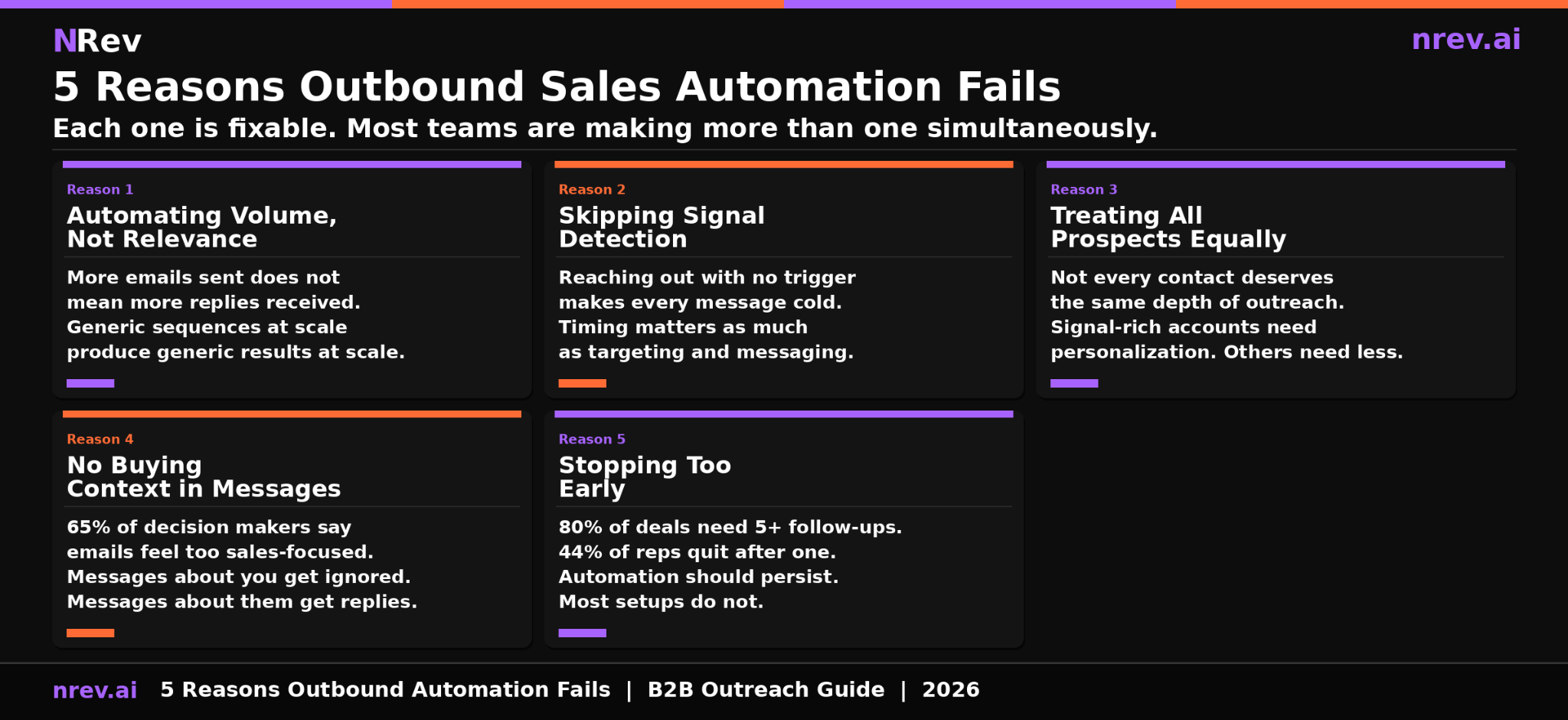
Reason 1: Automating volume instead of relevance.
The most common automation mistake is treating it as a way to send more messages rather than better-timed, better-targeted messages. When a team automates a sequence that sends 1,000 generic emails per week instead of 100 generic emails per week, the reply rate stays the same and the total number of ignored messages increases.
Automation should be used to make relevant outreach more consistent, not to make irrelevant outreach more frequent. The sequence design, the ICP targeting, and the personalization logic must all be solved before automation is introduced. If they are not solved first, automation locks those problems in at scale.
Reason 2: Skipping signal detection entirely.
Most automated outbound programs are triggered by a contact matching an ICP filter: right job title, right company size, right industry. That is necessary but not sufficient.
A prospect who matches your ICP but has no current reason to buy is still a cold contact. A prospect who matches your ICP and just hired a VP of Sales, just raised a Series B, or is currently evaluating a competitor has a specific reason to have a conversation right now. That specificity is what makes the difference between a message that lands and one that gets deleted.
Signal-based timing changes the economics of outbound dramatically. Outreach tied to a recent activity boosts response rates by 32 percent, according to LinkedIn Sales Navigator benchmarking data cited in Martal Group's outreach statistics report.
Reason 3: Treating all prospects identically.
Not every prospect on your list deserves the same level of personalization or the same sequence depth. A prospect who just joined a target account as the exact buyer you sell to, after being at a competitor for three years, deserves a fully customized first message referencing that specific context.
A prospect who broadly fits your ICP but shows no current signals gets a lighter touch. When automation applies the same sequence to every contact regardless of signal strength, it wastes deep personalization effort on cold contacts while leaving warm ones undersupported.
Reason 4: Messages focused on you rather than them.
The single most common failure in automated outreach is message content that talks about the sender. "Hi, I work at Company X and we help teams like yours with Y. We work with Z companies and have seen results of A, B, and C. Would you be open to a quick call?"
This structure puts the sender at the center of a message that the prospect can only engage with if they happen to be in the market for what the sender sells, at that exact moment, and are willing to tolerate the presumption that a cold stranger's product is relevant to them.
According to Hunter.io's State of Cold Email report, 65 percent of decision makers say cold emails fail because they feel too pushy or sales-focused. That is now the top complaint, surpassing even lack of relevance. The market has shifted from "this isn't for me" to "this is trying too hard to sell me something."
Reason 5: Stopping too early and missing the window.
According to SPOTIO's 2026 sales statistics, which cites RAIN Group 2024 research, 80 percent of deals require five or more follow-up touchpoints after initial contact. Yet 44 percent of sales reps give up after just one attempt.
Automation should solve this. It should maintain contact with a prospect across five or more structured touches, each adding a new angle or piece of value. But most automated sequences stop at two or three emails, which means most automation programs are abandoning prospects at exactly the point where they would start to respond.
What Buyers Actually Say About Automated Outreach
The buyer perspective on automated outreach is more nuanced than most sales teams assume. Buyers are not opposed to cold outreach. They are opposed to bad cold outreach.
Hunter.io's State of Cold Email research, analyzing responses from decision makers surveyed in 2025, found that 32 percent of decision makers replied to five or more cold emails in the past year. Cold outreach reaches decision makers. The channel is not broken.
What is broken is the execution. The same research found that 69 percent of decision makers say it bothers them when they can tell AI was used to write an email, unless the output feels genuinely human and relevant. The problem is not AI assistance. The problem is AI-generated messages that feel like AI-generated messages.
The same report found that smaller, more targeted campaigns dramatically outperform volume approaches. Sequences targeting 21 to 50 recipients achieve a 6.2 percent reply rate. Sequences targeting over 500 recipients achieve 2.4 percent. The math strongly favors smaller lists with higher relevance over larger lists with lower relevance.
The buyer data points to a clear conclusion: automation is acceptable when the output feels human and specific. It fails when the output feels templated and generic. That distinction lives entirely in how the automation is designed, not in whether automation is used.
What Good Outbound Sales Automation Looks Like
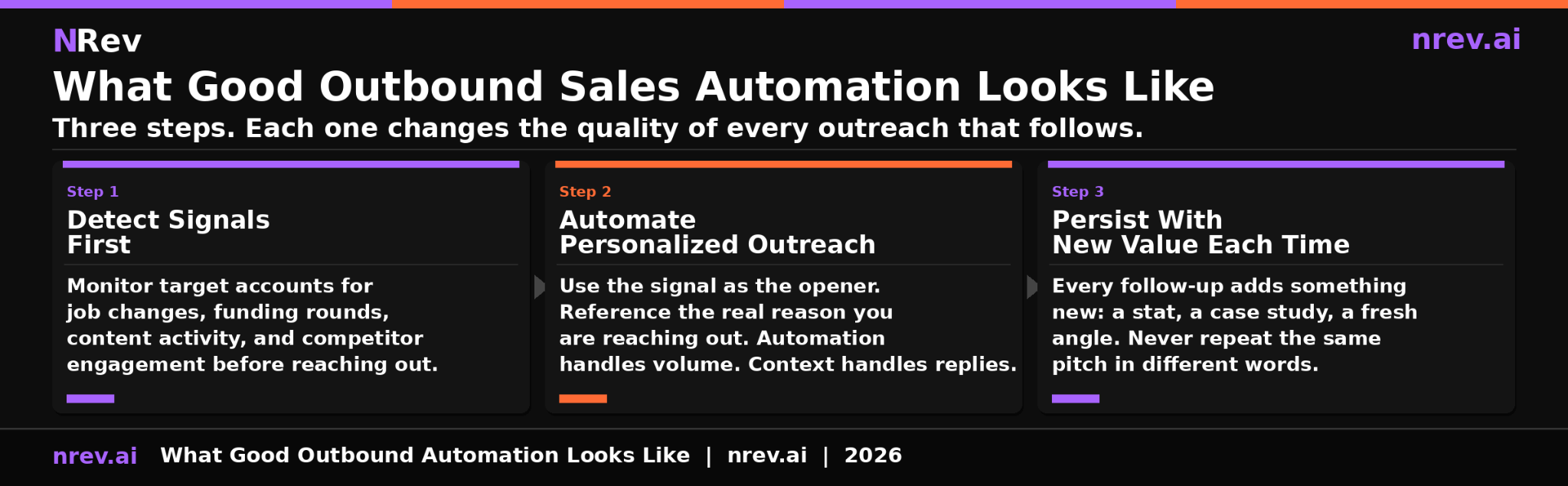
Step 1: Detect buying signals before building any sequence.
Before a single automated message goes out, the prospect needs to have generated a real, observable signal that makes them worth reaching out to right now. This could be a new hire at a target account, a funding announcement, a job posting in a function that signals a buying need, a competitor engagement, or content activity around the problem you solve.
Signal detection is what separates automated outreach that feels relevant from automated outreach that feels cold. When a prospect receives an email that opens with a specific observation about something real that happened at their company, it stops feeling automated. It starts feeling like the sender paid attention.
This is the foundation of what a signal-based outbound workflow does. Rather than starting the automation with a list of names, you start it with a list of signals. The sequence builds from there.
Step 2: Build personalization into the automation, not on top of it.
Personalization cannot be a post-automation step where someone reviews AI-generated messages and manually edits them to feel human. At any meaningful scale, that breaks down.
Personalization needs to be built into the automation architecture itself. The signal that triggered the outreach becomes the first line of the email. The prospect's specific context, their company stage, their recent activity, their role-specific challenges, gets incorporated into the message template before it sends.
This is different from mail-merge personalization where the first name and company name are inserted into a generic template. That approach produces messages that still feel generic, with a name at the top. Real automation-level personalization means each message is structurally different based on the signal that triggered it.
Step 3: Automate persistence, not just the first touch.
Most automation programs are actually just automated first-touch programs. They send one or two messages and then treat the prospect as unresponsive if no reply comes.
A real automated outbound sequence maintains contact across five or more structured touchpoints, with each one adding something new. Touch one: the signal-based opener. Touch two: a relevant data point or case study. Touch three: a direct question based on the company's specific situation. Touch four: a piece of relevant content. Touch five: a final check-in that gives the prospect an easy exit while keeping the door open.
Automating the full sequence, not just the first message, is what turns automation from a lead generator into a pipeline engine.
The Best Outbound Automation Tool Is the One That Starts With Signals
The question most sales teams ask when evaluating outbound automation tools is: which tool lets me send the most messages with the least effort?
The better question is: which tool detects the right signals and builds the outreach around them automatically?
A tool that lets you send 10,000 emails per week with three clicks will produce exactly the results that Hunter.io's data describes: a 2.4 percent reply rate at scale. A tool that monitors your target accounts, surfaces the right 50 people who have shown a relevant signal this week, and builds personalized first-touch sequences around each signal will consistently produce reply rates two to three times higher.
When evaluating any outbound automation tool, ask these four questions.
Does the tool detect signals or just match demographics? Demographic matching finds people who might buy eventually. Signal detection finds people who might buy right now. The two produce very different results.
Does personalization happen at the automation level or as a manual override? If personalization requires a human to review and edit every message, the tool will not scale. Personalization must be built into the trigger logic.
Does the tool maintain multi-touch sequences or stop at the first message? A tool that sends one automated message and marks the prospect as done is not an outbound automation tool. It is a cold email sender.
Does the tool connect to your CRM and other channels? Automation that exists in its own silo creates the same manual data transfer problems that prompted the automation investment in the first place.
For teams that use LinkedIn lead generation as part of their outbound motion, the automation tool needs to coordinate LinkedIn touches alongside email and phone rather than treating each channel as a separate campaign.
For teams that are ready to move beyond point solutions, outbound sales software that connects signal detection, personalization, and multichannel sequencing into one workflow is what the category is converging toward.
How nRev AI Builds the Right Automation
Most outbound automation tools are execution platforms. They send messages faster and more consistently than humans can manually. They do not solve the upstream problem of identifying which prospects are worth reaching out to, when, and why.
nRev AI is an Agent OS for GTM teams that starts with signals, not lists. It monitors your target accounts in real time for the buying events that indicate a prospect is worth reaching out to today: new hires in relevant roles, funding announcements, competitor activity, content engagement, and technology changes.
When a signal is detected, nRev builds the outreach automatically. The trigger event becomes the opening line. The context around the prospect's company and situation gets incorporated into the message. The sequence is queued across email and LinkedIn. Follow-ups are scheduled with new angles at each touch.
Your team receives the conversation when a prospect replies. Everything before that reply, the monitoring, the research, the personalization, the sequencing, runs automatically.
This is what outbound sales automation is supposed to do. Not send more messages. Build more relevant conversations.
Stop Automating Volume and Start Automating Relevance With nRev AI
The reason most outbound sales automation fails is not the technology. It is the approach. Volume-based automation produces volume-based results: high send counts and low reply rates.
nRev AI builds automation around the signals your prospects generate. Every sequence starts with a real reason to reach out. Every message references something specific. Every follow-up adds something new.
You describe the workflow you want. nRev builds it and runs it. No code. No manual monitoring. Just a system that converts the right signals into the right conversations at the right time.
Build your first signal-based outbound automation workflow on nRev AI and start measuring what automation is actually supposed to produce: meetings with the right people.
Frequently Asked Questions
Q1. What is outbound sales automation?
Outbound sales automation is the use of software to execute prospecting and outreach tasks without constant manual effort. This includes automated email sequences, LinkedIn outreach, follow-up scheduling, lead routing, and CRM data entry. When built correctly, outbound sales automation frees reps from repetitive operational work so they can focus on conversations and closing. When built incorrectly, it sends more generic messages to more people at a faster rate, which produces the same low reply rates at a higher volume. The difference lies in whether the automation is designed around buying signals and relevant timing, or around demographic filters and send schedules.
Q2. What is the best outbound automation tool for B2B teams?
The best outbound automation tool for B2B teams is the one that detects buying signals before triggering any outreach, builds personalization into the automation itself rather than treating it as a manual step, maintains multi-touch sequences across five or more contacts, and connects to your CRM and other channels natively. Tools that start with signal detection consistently produce higher reply rates than tools that start with demographic lists. According to Hunter.io's State of Cold Email research, sequences targeting 21 to 50 signal-selected recipients achieve a 6.2 percent reply rate, compared to 2.4 percent for sequences targeting over 500 demographically matched recipients. The signal approach consistently outperforms the volume approach.
Q3. Why does outbound sales automation often produce poor results?
Outbound sales automation produces poor results when it is used to scale the wrong approach. The five most common failure patterns are: automating volume instead of relevance, skipping signal detection and reaching out without a real reason, treating all prospects identically regardless of buying intent, writing messages that focus on the sender rather than the prospect's situation, and stopping too early before the prospect would have responded. According to SPOTIO's 2026 sales statistics, 80 percent of deals require five or more follow-ups, yet 44 percent of reps give up after one attempt. Automation that abandons prospects after two touches is failing at exactly the stage where persistence produces results.