


Cold Email Follow-Up: How to Get Replies Without Being Annoying
Here is the part most people get backwards. The first cold email rarely does the work. It lands in a busy inbox, gets half a glance, and sits there. The reply, when it comes, almost always comes off a follow-up. So the follow-up is not the cleanup step after your real outreach. It is the outreach.
Most reps treat it as an afterthought anyway. They send one carefully written email, hear nothing, and either give up or fire off a guilt-trip bump that makes things worse. Both moves leave pipeline on the table.
This guide covers the part that actually moves replies: how many follow-ups to send, when to send them, what to say in each one, and how to keep the whole thing running without sounding like a robot wrote it. The templates are yours to steal.
What is a cold email follow-up?
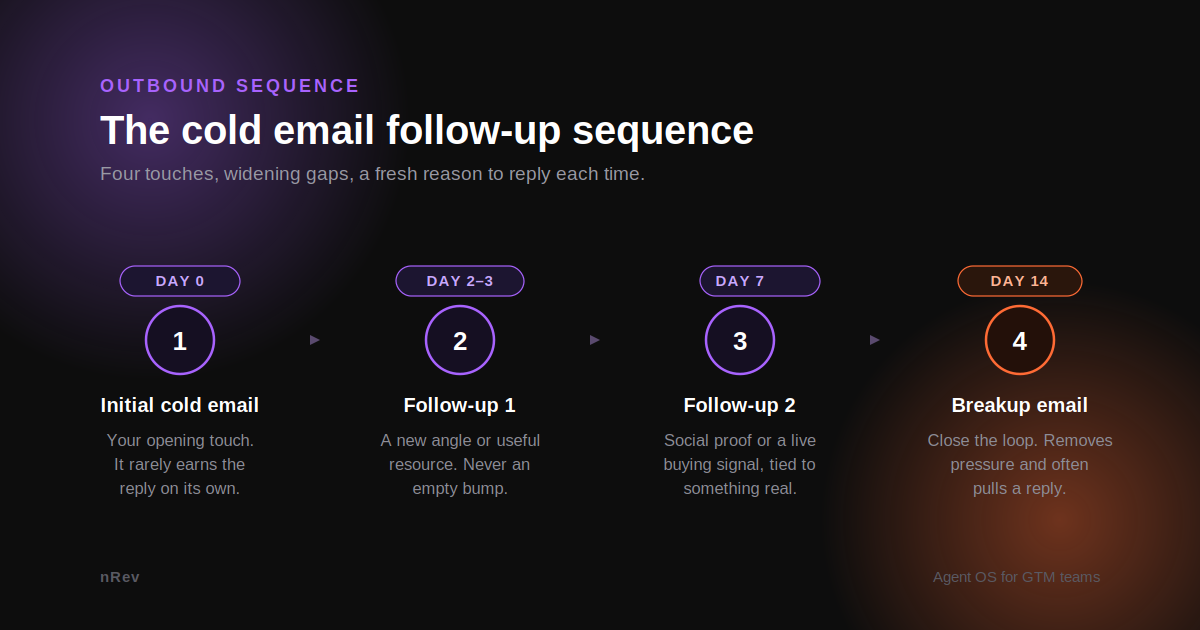
A cold email follow-up is any message you send after your first cold email to a prospect who has not replied. Its job is to re-earn attention with a new reason to engage, not to repeat the original ask louder.
That last point is the whole game. A follow-up that just says “bumping this to the top of your inbox” adds nothing. A follow-up that brings a fresh angle, a relevant proof point, or a genuinely useful resource gives the prospect a reason to look again. The first kind annoys people. The second kind books meetings.
How many follow-ups should you send?
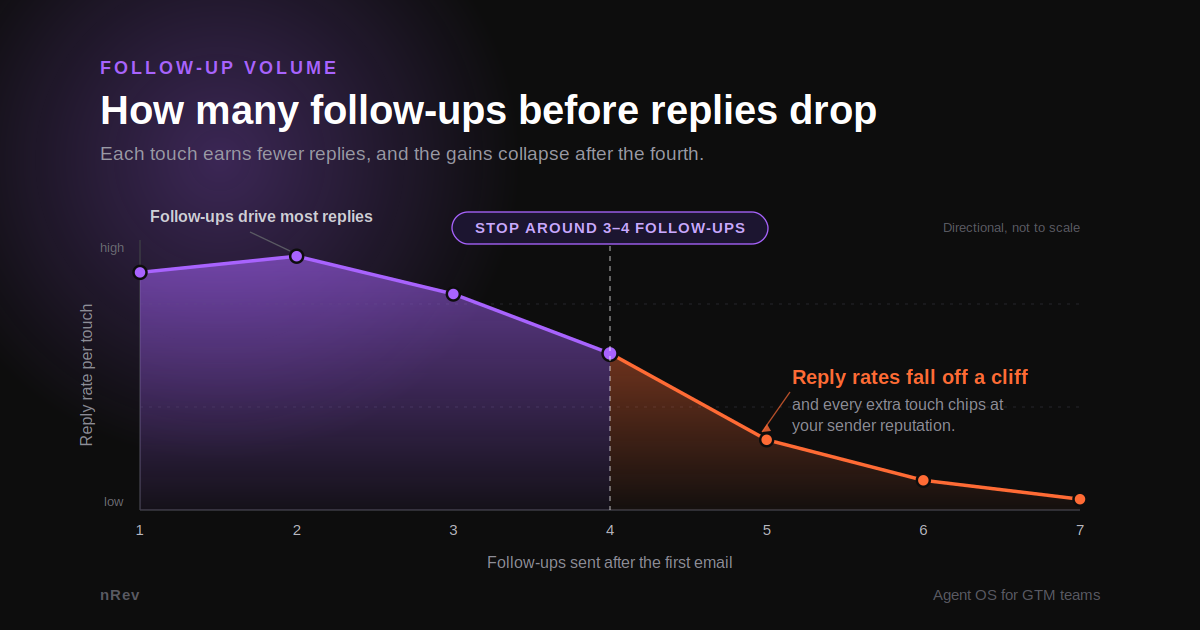
Three to four follow-ups after the first email is the range that works for most B2B teams. That gives you four to five total touches, enough to catch someone who was busy the first time without crossing into pest territory.
Past that point, reply rates fall off a cliff and the downside grows. Every extra touch on a cold thread chips away at your sender reputation and your brand, and the person who ignored four emails is not going to crack on the seventh.
The right number shifts with the deal. A high-ticket enterprise account with a six-person buying committee earns more patience than a quick self-serve sale. So does a senior buyer who simply gets more email. Read the context, but anchor on three to four and only extend when the deal size justifies it.
When to send each follow-up, and what subject line to use
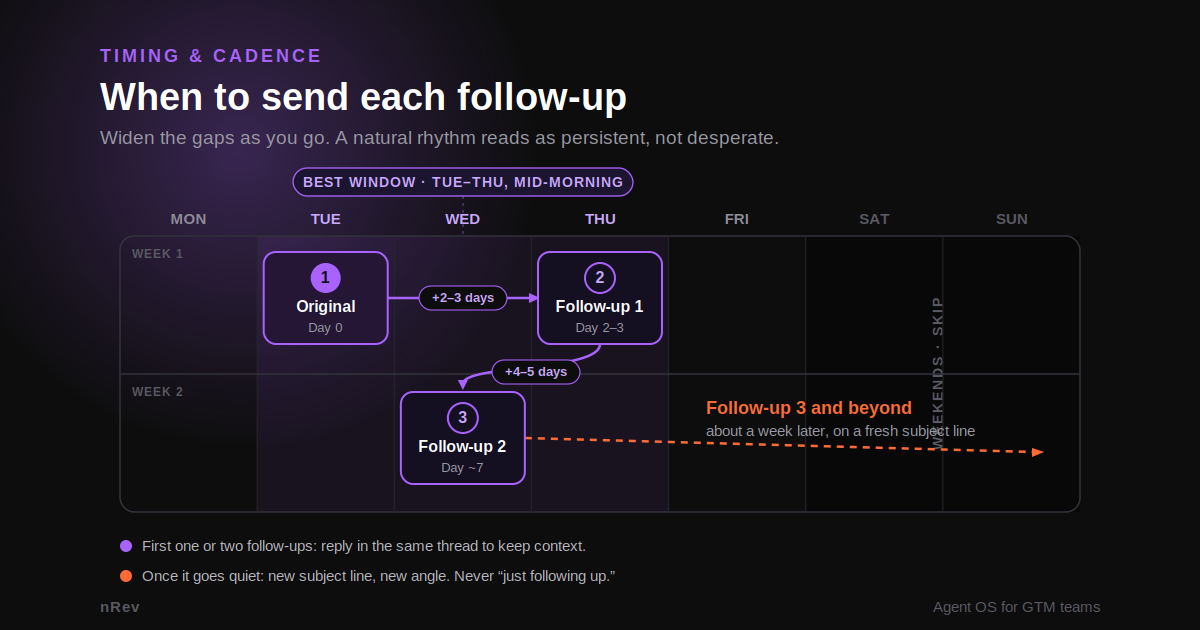
Spacing matters more than people think. Send the first follow-up two to three business days after the original. Then widen the gaps: four to five days for the next, then a week or so for the ones after that. Tight, even spacing reads as automated. A natural rhythm reads as a person who is persistent but not desperate.
For timing within the day, mid-morning on Tuesday through Thursday is a reliable window for B2B. The inbox is active but not yet buried under the day’s noise. Do not over-optimize this. Consistency and relevance beat the perfect send minute every time.
On subject lines, keep the first one or two follow-ups in the same thread. Replying in-thread preserves context and signals continuity. Once a thread has gone quiet across several touches, switch to a fresh subject line with a new angle, since a new subject can re-open a conversation the old thread cannot.
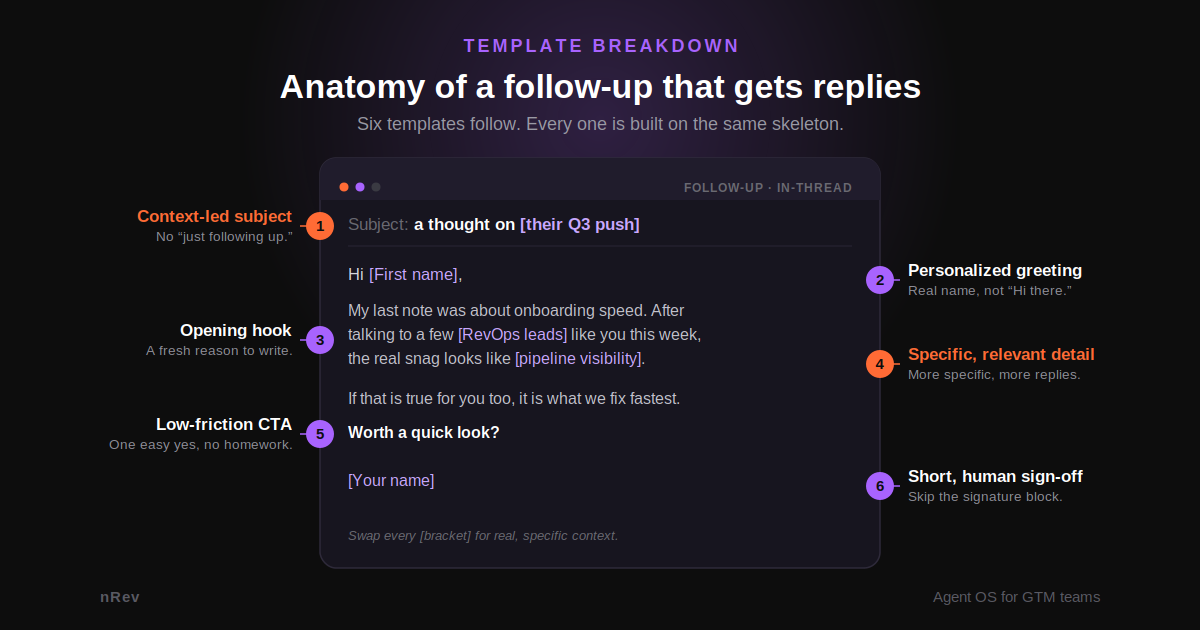
Whatever you do, retire “just following up.” It is the most ignored phrase in outbound because it tells the reader you have nothing new to say. Lead with the prospect’s context instead, something like “a thought on [their initiative]” or “[their competitor] just did X.”
A quick note on a silent killer here. None of this matters if your emails are not reaching the inbox in the first place. If reply rates are flat across every follow-up, check your email deliverability before you rewrite a single line.
Cold email follow-up templates that get replies
Here are six follow-ups you can adapt today. Each one is built around a different reason to reach back out, which is what keeps a sequence from feeling like the same email sent five times. Swap the brackets for real context. The more specific the detail, the higher the reply.
You can also generate follow-ups from a profile and use these templates as the structure.
The value-add follow-up
Send something useful and ask for nothing. This earns goodwill and proves you did your homework.
Subject: thought this might help, [First name]
Hi [First name],
Saw [their company] is pushing into [initiative], so this felt relevant. We put together a short breakdown of how teams like yours handle [specific problem]: [link].
No ask here. If it is useful and you want to compare notes, I am around.
[Your name]
The new-angle follow-up
If the first email led with one pain point, lead with a different one. People who ignored angle A sometimes light up at angle B.
Subject: a different angle on [their goal]
Hi [First name],
My last note focused on [first pain point]. Talking to a few [their role]s this week, the bigger headache seems to be [second pain point]. If that is true for you too, that is the part we tend to fix fastest.
Worth a quick look?
[Your name]
The social-proof follow-up
One relevant result from a company they recognize does more than three paragraphs about your product.
Subject: how [similar company] handled this
Hi [First name],
[Similar company], same space as you, was stuck on [problem]. They got to [specific result] in [timeframe] without adding headcount. Happy to walk you through exactly how, if it is relevant.
[Your name]
The question follow-up
Make replying effortless. One question, easy to answer, no homework required.
Subject: quick one
Hi [First name],
Are you the right person to talk to about [area], or should I be reaching out to someone else on your team?
[Your name]
The signal-triggered follow-up
This is the one that outperforms everything else, because it is tied to something that just happened. A funding round, a new hire, a tech change, a job move.
Subject: congrats on [the signal]
Hi [First name],
Saw [the signal, for example “you just brought on a new VP of Sales”]. That usually means [relevant implication]. It is the exact moment teams start looking at [your category], so the timing felt worth a note. Open to a short conversation?
[Your name]
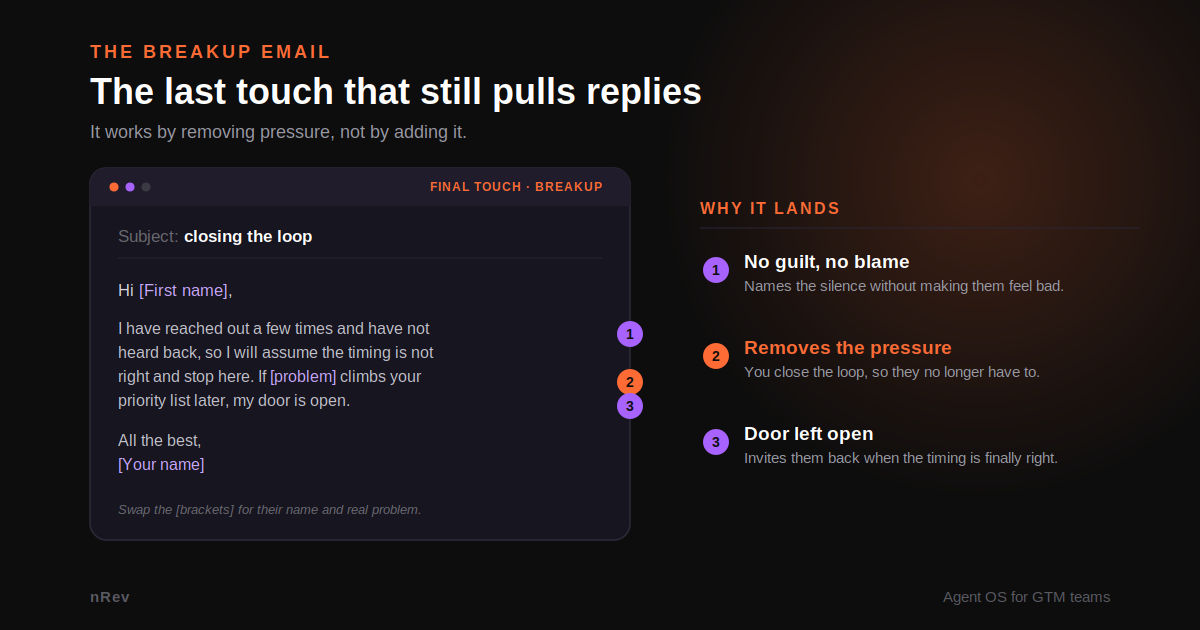
The breakup email
The last touch. It works because it removes pressure, and it often pulls a reply out of people who ignored everything before it.
Subject: closing the loop
Hi [First name],
I have reached out a few times and have not heard back, so I will assume the timing is not right and stop here. If [problem] climbs your priority list later, my door is open.
All the best,
[Your name]
How to follow up after no response
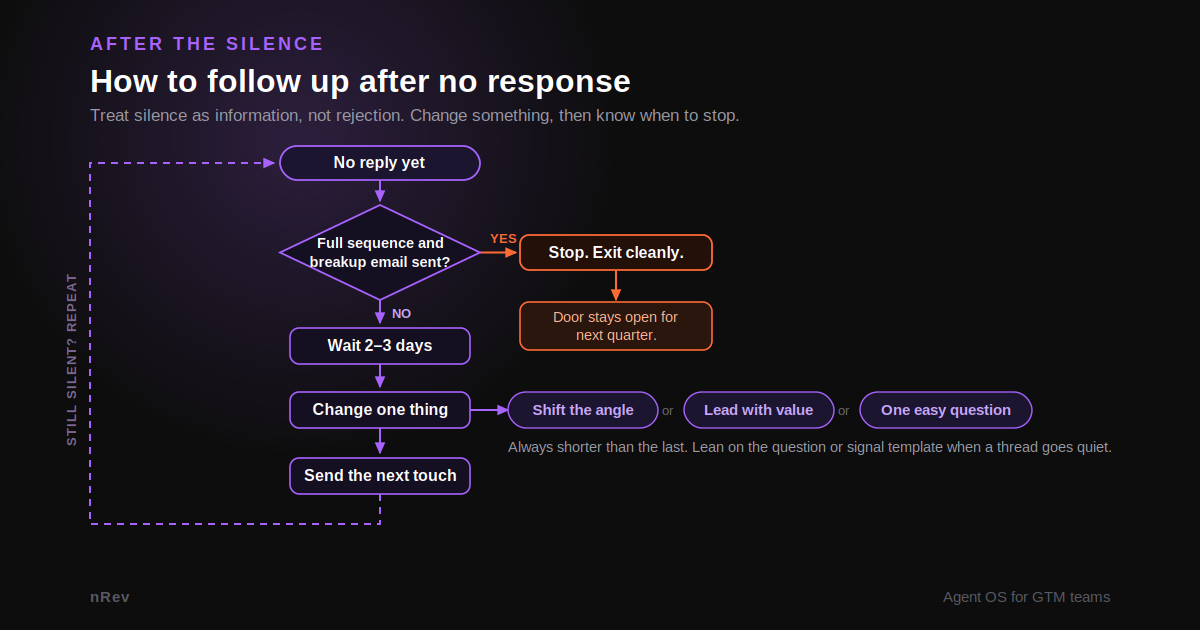
Silence is the default outcome of cold outreach, so treat it as information, not rejection. The prospect was busy, the timing was off, or your angle missed. None of those calls for sending the same email again with “just checking in” on top.
Wait the two to three days, then change something. Shift the angle, lead with value, or drop to a single easy question. Make the new email shorter than the last, since a wall of text after silence rarely gets read. The signal-triggered and question templates above are your best tools when a thread has gone quiet.
And know when to stop. Once you have run a real sequence and sent the breakup email with no engagement, close it out. Chasing past that point costs you reputation and returns nothing. A clean exit also leaves the door open for the next quarter, when the timing might actually be right.
Follow-up mistakes that kill reply rates
A few habits quietly wreck otherwise good sequences. The guilt trip is the worst of them. “I have emailed you three times now” puts the problem on the reader, and people do not book meetings out of guilt.
The empty bump is close behind. “Circling back” and “following up” with nothing new attached teaches the prospect that your emails are safe to ignore. Every touch has to carry its own reason to exist.
Then there is over-sending. Seven follow-ups does not read as persistent, it reads as not listening. The same goes for identical spacing and identical formatting on every touch, which is the fastest way to announce that a machine is running the sequence. The fix is not to send less. It is to make each message relevant enough to earn the next one.
Manual follow-ups do not scale, and most automated ones sound like bots
Here is the bind every growing team hits. Hand-writing a five-touch sequence for each prospect produces great replies and falls apart the moment your list passes a few dozen names. So teams reach for automation, and automation usually makes every prospect feel like row 4,000 in a spreadsheet. You trade relevance for reach and watch reply rates sink.
There is a third path, and it is where outbound is heading. Instead of blasting a static sequence on a fixed timer, you trigger follow-ups off real signals: a prospect opened a reply, visited your pricing page, changed jobs, or their company just raised. The follow-up then personalizes from that live context, not from mail-merge tokens that everyone can spot.
This is the model nRev is built for. As the agent OS for GTM teams, it watches for the signals, enriches the contact, and fires the right follow-up at the right moment as one connected workflow, not a pile of disconnected tools. The cadences are not guesses either. They are shaped by 10,000+ deployed GTM workflows, so the sequence reflects what has actually converted, not what sounds good in a blog post.
The point is not to send more follow-ups. It is to send the one that fits what just happened, every time, without a human stitching it together by hand. If you want to see that in motion, the signal-based outbound playbook is the place to start.
See how nRev fires these follow-ups on real buying signals →
Frequently asked questions
How many follow-up emails should you send to a cold prospect?

How long should you wait before following up on a cold email?
What is the best time to send a follow-up email?
Should a follow-up be a reply in the same thread or a new email?
How do you write a follow-up email after no response?
What is a good subject line for a follow-up email?
How many follow-ups is too many?
What is a breakup email in cold outreach?
Do follow-up emails actually increase reply rates?
How do you automate cold email follow-ups without sounding like a bot?