


Competition Tracker: What It Is and Why Your Win Rate Depends on It
Here's something most sales leaders quietly know but rarely say out loud: the numbers in their win rate report don't tell the full story. They know they're losing deals to certain competitors more often than the CRM reflects. They just can't prove it, because nobody has been tracking it properly.
That's what a competition tracker actually fixes. Not just the monitoring of what rivals are doing publicly, but the full loop: what competitors are doing, how your team is performing against each of them, which accounts are showing signs they're ready to switch, and what your win-loss ratio is telling you about where to focus next.
This guide breaks all of that down in plain terms. No jargon. No vague frameworks. Just a clear picture of what a competition tracker is, why your win rate depends on it, and how to set one up in a way that actually gets used.

What a Competition Tracker Actually Is
A competition tracker is a system, not a single tool, that combines two things most teams treat separately: watching what competitors are doing externally, and measuring how your team performs against them internally.
Most teams only do the first part. They set up Google Alerts, maybe subscribe to a CI platform, and feel like they're "tracking competitors." But without the internal data side, you're just collecting information with no way to measure whether it's making a difference.
The full loop looks like this:
You watch what Competitor X is doing. You track every deal where Competitor X appeared. You calculate your win rate against them specifically. You see it's 31%. You look at your close rate against them six months ago and it was 44%. Something changed. Now you have a reason to dig in, and actual data to take to leadership.
That's what separates a real competition tracker from a collection of alerts nobody reads.
What a Competition Tracker Actually Is
A competition tracker is a system, not a single tool, that combines two things most teams treat separately: watching what competitors are doing externally, and measuring how your team performs against them internally.
Most teams only do the first part. They set up Google Alerts, maybe subscribe to a CI platform, and feel like they're "tracking competitors." But without the internal data side, you're just collecting information with no way to measure whether it's making a difference.
The full loop looks like this:
You watch what Competitor X is doing. You track every deal where Competitor X appeared. You calculate your win rate against them specifically. You see it's 31%. You look at your close rate against them six months ago and it was 44%. Something changed. Now you have a reason to dig in, and actual data to take to leadership.
That's what separates a real competition tracker from a collection of alerts nobody reads.
Win Loss Ratio Calculation: The Formulas That Matter
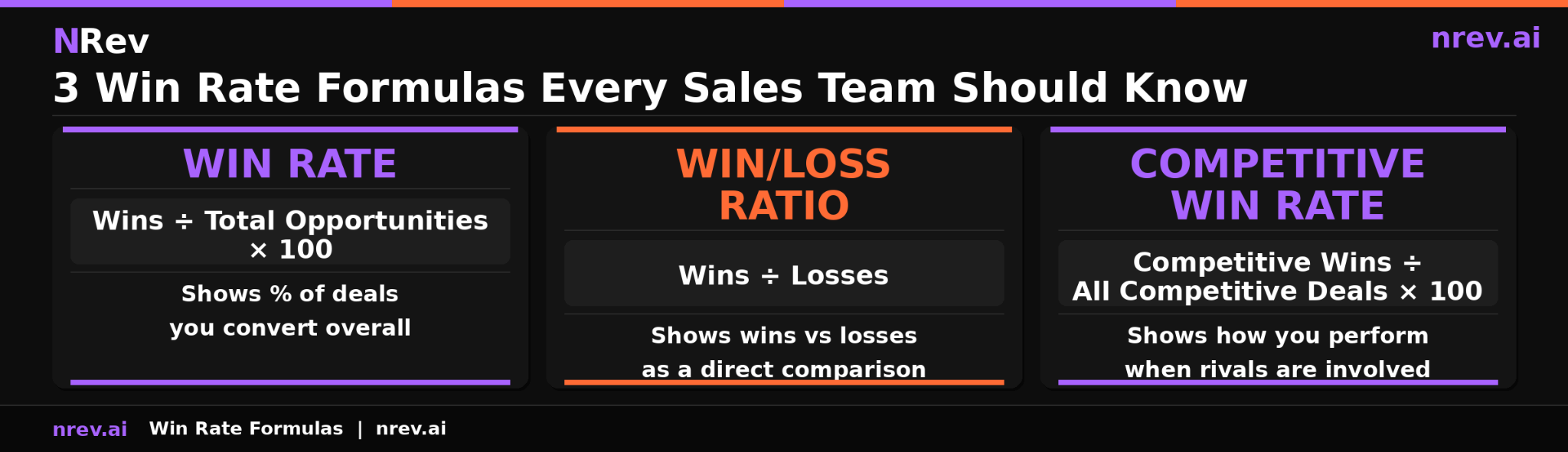
Before you can use competitors' data to improve, you need to know which numbers to actually track. There are three formulas here and they each tell you something different.
Win Rate
Win Rate = Wins divided by Total Opportunities, multiplied by 100.
If your team had 80 opportunities last quarter and closed 24 of them, your win rate is 30%.
This is your baseline. It tells you how often you convert when a decision is made. A good B2B win rate typically sits between 20% and 35%, though it varies significantly by deal size and industry.
Win/Loss Ratio
Win/Loss Ratio = Number of deals won divided by number of deals lost.
Using the same example: 24 wins and 56 losses gives you a ratio of 0.43. A ratio above 1.0 means you're winning more than you're losing. Below 1.0 means the reverse. Exactly 1.0 means it's a coin flip.
The win/loss ratio is more useful than win rate when you want a direct head-to-head comparison. "We win 0.8 deals for every deal we lose" is a concrete statement leaders and reps can react to. It makes the gap visible in a way a percentage doesn't always.
Competitive Win Rate
Competitive Win Rate = Competitive Wins divided by All Competitive Deals, multiplied by 100.
This one's the most important for competition tracking. It filters out all the uncontested deals and shows you specifically how you perform when a named rival is involved. Most teams are surprised when they calculate this for the first time. Their overall win rate might be 32%, but their competitive win rate against one specific rival might be 19%. That's the number worth investigating.
A quick practical note on win loss ratio calculation
Calculate these at least monthly. Do it by competitor, not just in aggregate. A combined competitive win rate of 28% hides the fact that you're at 45% against Rival A and 14% against Rival B. Segmented data is where the actual insights live.
Why Your Win Rate Changes When You Track Competitors Properly
There's a real mechanism here, not just a correlation.
When you track competitors properly, reps know what they're walking into. They know that Competitor X just changed pricing last Tuesday. They know the three most common objections prospects raise when comparing the two products. They know which deal stages historically see the highest dropout when that competitor is involved.
Prepared reps win more competitive deals. That's it. That's the whole mechanism.
According to Crayon's State of Competitive Intelligence, the average sales team rates its competitive selling preparedness at just 3.8 out of 10. Root source: Crayon primary research, State of Competitive Intelligence annual report. That's a remarkable number when you consider that 68% of B2B deals involve a named competitor.
A competition tracker closes that preparation gap by making the right intelligence available before the deal, not after.
The internal data side matters just as much as the monitoring. When you track win rate by competitor over time, you see which rivals are taking more ground and which you're pulling ahead of. You can spot when a competitor makes a move that shifts the competitive dynamic, because you'll see the numbers change before anyone talks about it in a QBR.
What a Full Competition Tracker Covers
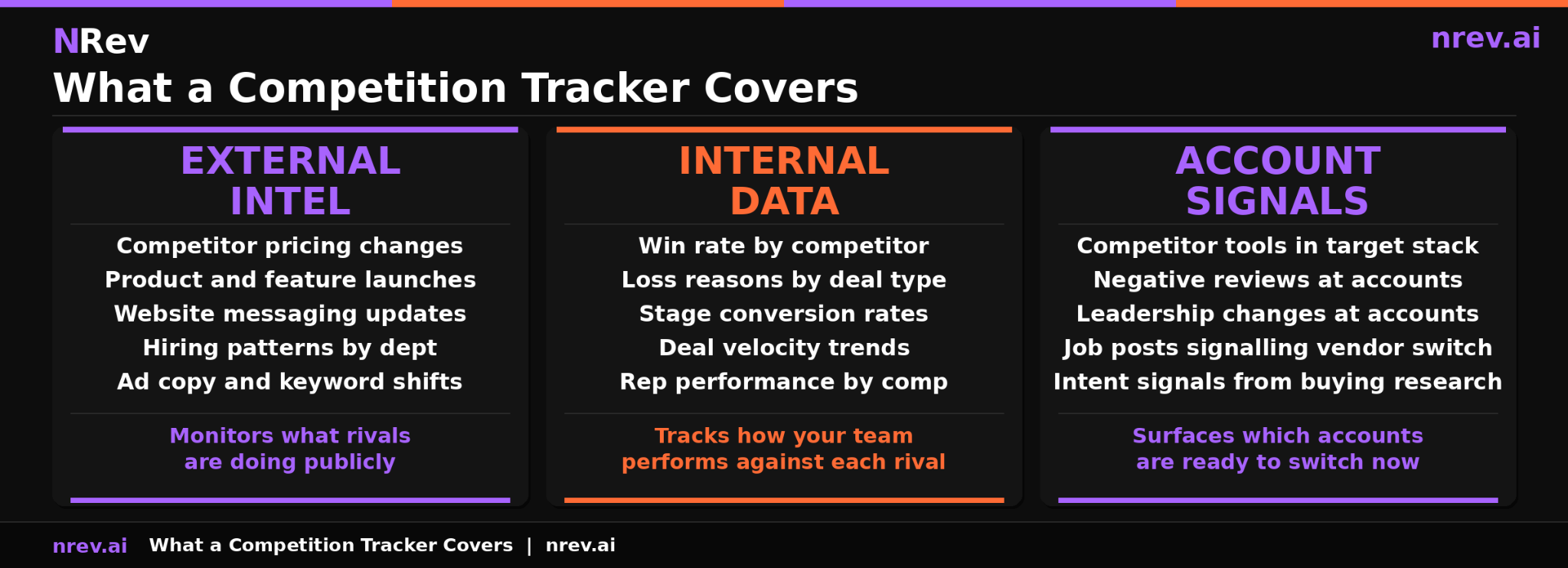
A well-built competition tracker has three distinct layers. Most teams build one and call it done.
Layer 1: External Intel
This is what most people mean when they say they're "watching competitors." Pricing changes. Product launches. Website messaging updates. Hiring patterns. Ad creative shifts.
The goal of this layer is to make sure your team never finds out about a competitor moving from a prospect. You should know before your reps walk into any discovery call where that competitor might come up.
Tools for this layer include Visualping for page change monitoring, Google Alerts for brand mentions, Kompyte or Crayon for automated monitoring at scale, and Semrush for paid search and keyword intelligence.
Layer 2: Internal Data
This is where your competitors' watch system connects to your own sales data. Win rate by competitor. Loss reasons segmented by rival. Stage conversion trends when specific competitors are involved. Which reps win competitive deals and what they do differently.
Most teams have this data sitting in their CRM right now, just not organized to show it by competitor. A simple CRM tag or custom field on every opportunity indicating which competitor was present is the starting point. Run a report on it monthly and you'll see things you've been missing.
Layer 3: Account Signals
This is the most powerful layer and the one almost nobody has built properly. It answers the question: which specific accounts in my target list are showing signs right now that they're open to a competitive conversation?
Account signals include: a target account whose tech stack shows a competitor tool that's known to have reliability issues, a cluster of negative reviews about an incumbent vendor appearing at companies you've been prospecting, a leadership change at an account that had a competitor contract renewed 18 months ago, or a job posting from a target company that mentions replacing a specific technology.
These signals are what separate reactive competitive selling from proactive competitive outbound.
Why You Should Be Careful About Monitoring Competitors
This question deserves a direct answer, not a vague hedge.
Monitoring competitors is genuinely useful. It is also genuinely risky when done without discipline. Here's what actually goes wrong.
You end up with data you can't act on
The most common failure in competitor monitoring programs is volume without direction. When you set up 40 alerts across 12 competitors, you produce a feed that nobody reads. The important signals, a pricing change, a product launch, get buried under social posts and minor website tweaks. Eventually the alerts go to a folder nobody opens.
The fix: track three to five competitors seriously. For everything else, a monthly manual review is enough.
You start copying instead of competing
This one's subtle but it happens fast. When your primary input for pricing decisions, product roadmap, and messaging is what competitors are doing, you stop leading and start following. Your product becomes a derivative of theirs. Your messaging starts echoing theirs. The differentiation that actually wins deals erodes.
Competitors' data should inform your decisions, not make them. Your strategy should be rooted in your customers' needs and your own convictions about where the market is going.
You mistake monitoring for legal intelligence gathering
All of the monitoring in this guide is based on publicly available information: competitor websites, job postings, press releases, G2 reviews, paid ad libraries. This is entirely appropriate. The line you cannot cross is accessing non-public information, which includes internal documents, trade secrets, confidential customer data, or anything obtained through deception or unauthorized system access. That's both illegal and unnecessary, because the public data is already more than enough to build a great competition tracker.
You let monitoring become a quarterly exercise
Checking competitor data quarterly is worse than helpful. It creates false confidence in stale information. A pricing change that happened in January will already have affected five deals before your Q1 review catches it.
Monitoring competitors needs a weekly touchpoint at minimum for the most important rivals. Everything else can be monthly.
How to Build a System That Gets Used
Here's the honest version. Most competition trackers fail not because of bad tools but because of bad habits. The system stops when there's no clear owner, no clear cadence, and no clear answer to "what do I do when something fires?"
Step 1: Define what you're watching
List your three to five most frequently encountered competitors. For each one, identify which signals actually affect deals. Pricing and product changes are almost always relevant. Job postings and ad shifts are useful context. Social activity and blog posts are rarely worth tracking.
Step 2: Assign a single owner
One person owns competitor monitoring. They check the alerts. They run the weekly summary. They flag urgent changes to sales leadership. If everyone owns it, nobody does.
Step 3: Set up the three layers
Layer 1 is mostly automated once you set it up. Visualping on their pricing page. Google Alerts on their brand name. Semrush monthly for keyword and ad shifts.
Layer 2 requires a CRM discipline: tag every opportunity with the competitor present, and run the report monthly. Win rate by competitor. Loss reasons. Stage drop-off.
Layer 3 is where tools like nRev come in, covered in the next section.
Step 4: Define action protocols
When a pricing change is detected, who gets notified and within how long? When competitive win rate against a specific rival drops two points in a quarter, what's the response? When an account signal fires showing a competitor is being evaluated for replacement, who builds the outreach and when?
Without action protocols, the system is just data. With them, it's a competitive advantage.
Step 5: Review win/loss ratios quarterly alongside the monitoring data
Put the two next to each other. Did competitive win rate go up this quarter? What changed in the external monitoring during the same period? A pricing change from a competitor combined with a win rate improvement tells you something. It tells you they made themselves easier to beat and your team responded. That's the feedback loop that makes a competition tracker worth building.
How nRev AI Fills the Account Signal Layer
The first two layers of a competition tracker, external intel and internal data, are things most teams can build with existing tools and some process discipline. The account signal layer is harder, because it requires continuous monitoring of target accounts at a level that's difficult to do manually.
nRev AI watches your target accounts for the specific signals that indicate competitive displacement timing: a job posting calling for expertise in replacing a technology your competitor provides, a cluster of negative reviews appearing at an account that uses a rival's product, a leadership hire at a company with an existing competitive contract that typically precedes vendor re-evaluation.
When those signals fire, nRev builds the outreach that references the specific competitive context. Not a generic "we're better than Competitor X" message, but something specific: "We noticed you're evaluating alternatives to [specific tool] and wanted to share how teams in your situation have typically approached the switch." That specificity is what earns replies.
This connects the competition tracker to something it often lacks: timing. The external intel layer tells you what competitors are doing. The internal data layer tells you how you're performing. The account signal layer tells you who is ready to hear from you right now. Together, they make your competitive intelligence tools setup actually move the pipeline instead of just producing reports.
Teams that add nRev's account signal layer on top of a functioning competition tracker consistently see higher reply rates on competitive displacement outreach, because the message arrives when the account is already asking the question your product answers. That timing advantage is what b2b buying signals make possible, and it's what separates competitive tracking that generates pipeline from competitive tracking that generates slide decks.
Start Tracking. Start Winning More.
Your win rate against competitors isn't fixed. It changes based on how prepared your team is before every deal. A competition tracker is the system that keeps your team prepared, your data current, and your outbound timed to the moments when accounts are most likely to switch.
nRev AI handles the account signal layer automatically, so your reps get the competitive context they need before the conversation instead of after. You define the triggers. nRev runs the workflow.
Build your first signal-triggered competitive workflow on nRev AI and start converting competitor intelligence into a real pipeline.
Frequently Asked Questions
What is a competition tracker?

How do you calculate the win/loss ratio in sales?
Why should you be careful about monitoring competitors?