


Competitive Intelligence Tools: How B2B Sales Teams Use Them to Win More Deals
Competitive intelligence tools are not research aids. They are revenue infrastructure. The rep who enters a competitive deal knowing exactly what the competitor is pricing, where their product falls short, and which objections to expect wins that deal at a higher rate than the rep who goes in blind.
The difference between those two reps is not talent. It is the system behind them.
This guide covers what competitive intelligence tools actually do, the four categories every B2B team should understand, how to choose the right competitive intelligence software for your stage and budget, the top tools with an honest side-by-side comparison, and how to build a CI program that actually changes behavior on the sales floor rather than producing a library of battlecards nobody opens.

What Competitive Intelligence Tools Actually Do
Competitive intelligence tools automate the collection, organization, and distribution of information about your competitors so your sales, marketing, and product teams can make faster, better-informed decisions without manual research.
The core problem these tools solve is not a lack of competitive information. It is a distribution and timing problem. Competitive information already exists across competitor websites, review platforms, job boards, social media, pricing pages, SEC filings, and sales call transcripts.
The challenge is getting the right piece of that information to the right person before it would have been useful, not after the deal is already decided.
A competitive intelligence tool watches all of those sources continuously, filters out noise, and routes the relevant signals to the team members who need them. When a competitor updates their pricing page, the tool catches it and alerts your sales leadership the same day.
When a competitor is mentioned in a deal call, the tool flags it and surfaces the relevant battlecard section to the rep. When a target account posts a job listing that reveals a planned technology evaluation, the tool connects that signal to the competitive context your rep needs to position correctly.
According to Crayon's State of Competitive Intelligence report, 68 percent of B2B sales deals involve at least one direct competitor. Root source: Crayon primary research, State of Competitive Intelligence annual report. That means two out of every three deals your team is working on right now have a competitive dimension.
The teams that arm their reps with current, specific intelligence for those deals win them at meaningfully higher rates than the teams that do not.
The Four Categories of Competitive Intelligence Tools
The market intelligence tools category has split into four distinct use cases over the past several years. Most teams fail at competitive intelligence not because they chose the wrong tool but because they chose a tool from the wrong category for what they actually need.
Understanding these four categories is the prerequisite to any useful competitive intelligence software comparison.

Category 1: Competitor Enablement Platforms
Competitor enablement platforms are the tools most people think of when they hear "competitive intelligence tools." Crayon, Klue, and Kompyte are the primary examples.
Their core workflow is: monitor competitor activity across hundreds of sources, distill that activity into structured battlecards, and deliver those battlecards to reps at the moment of a competitive deal.
These platforms are purpose-built for the deal-level win rate improvement use case.
They are the right investment when your team loses a measurable percentage of competitive deals due to poor positioning, stale battlecard content, or reps who simply do not know what to say when a competitor comes up in discovery.
Category 2: Market Intelligence Tools
Market intelligence tools operate at a broader level. Similarweb shows you competitor website traffic, audience overlap, digital channel mix, and how your competitors' digital performance is trending over time.
AlphaSense provides access to earnings calls, analyst reports, SEC filings, and expert interviews for competitive positioning at the strategic and financial level.
These tools are most valuable for product leaders, strategy teams, and marketing organizations that need to understand competitive dynamics at the market level rather than the individual deal level.
They answer questions like "what channels is this competitor investing in?" and "what did their CEO say on last quarter's earnings call about their product roadmap?" rather than "what do I say when a prospect mentions them in a demo?"
Category 3: Keyword Competitive Intelligence
Keyword competitive intelligence is the most underutilized category in B2B. Semrush, Ahrefs, and SpyFu provide data on which keywords your competitors are ranking for organically, which paid keywords they are bidding on, what their ad copy looks like, and how their search traffic is trending across topics relevant to your market.
For marketing and demand generation teams, this data is competitive intelligence in its most actionable form.
When a competitor begins ranking for keywords your content does not cover, they are capturing awareness from buyers who never reach your website. When a competitor runs paid search ads targeting your product category with a specific angle, that is a signal about how they are positioning against you in the market.
Covering this category in your CI stack closes a gap that most competitor enablement platforms miss entirely.
Category 4: Conversation Intelligence
Conversation intelligence tools like Gong and Chorus capture competitive intelligence from inside your own sales calls. They analyze call recordings to surface which competitors are mentioned most often, what objections buyers raise when those competitors come up, and which talk tracks your best reps use to win competitive deals.
This is the CI category with the most direct connection to rep behavior change.
According to the same Crayon State of Competitive Intelligence report, teams using conversational intelligence tools for competitive analysis reported an 82 percent increase in competitive sales effectiveness. Root source: Crayon primary research.
The intelligence captured from your own calls is also the most credible source of information about what actually happens in your competitive deals, as opposed to what you assume happens based on external monitoring alone.
Keyword Competitive Intelligence: The Category Most Teams Skip
Keyword competitive intelligence is the practice of using SEO and paid search data to understand how competitors are positioning their products, which buyer problems they are targeting with content, and where the gaps are in your own content and messaging relative to theirs.
The primary tool for this is Semrush, with Ahrefs as the close second and SpyFu as the most focused option for paid search competitive analysis. All three provide a similar core dataset: organic keyword rankings, estimated traffic, paid keyword targeting, ad copy, and landing page structure for any domain you want to analyze.
For B2B sales teams, keyword competitive intelligence produces three specific types of actionable insight.
First, it reveals which pain points your competitors have built their content around. If a competitor ranks in the top three positions for a set of keywords your best prospects search when they first experience the problem you solve, they are capturing awareness from your potential buyers before your brand ever enters the picture. Identifying those gaps and building content to close them is a competitive response that produces lasting pipeline impact.
Second, keyword data reveals category and positioning shifts before they become visible through other channels. When a competitor starts ranking for keywords that signal an expansion into a new market segment, they are typically six to twelve months into that strategic shift before it becomes apparent from their homepage or public announcements. Keyword monitoring catches it earlier.
Third, paid keyword analysis from SpyFu or Semrush's advertising intelligence module shows exactly which keywords a competitor is bidding on and what messaging they are using in their ads. When their ad copy starts targeting a pain point they were not previously addressing, or when they begin bidding on your brand name, it is a signal that the competitive dynamic is changing and your response should change with it.
Competitive Intelligence Databases: Where the Raw Data Comes From
Competitive intelligence databases are the underlying data sources that power the monitoring platforms, market intelligence tools, and enrichment workflows that B2B teams use. Understanding what these databases contain, who operates them, and what their limitations are is essential to evaluating any competitive intelligence software that claims to surface comprehensive competitor data.
Social is the source most databases miss. You can see who engages with your competitors on LinkedIn directly and treat that list as first-hand intel.
The major competitive intelligence databases that feed the tools in this space fall into four groups.
Web data crawlers are the foundation of most competitor enablement platforms. Crayon's engine monitors over 300 million pages across millions of domains, applying algorithmic classification to distinguish meaningful competitive signals from routine web activity. These crawlers update continuously, which is what gives CI platforms their real-time monitoring capability.
Firmographic and technographic databases like those powering ZoomInfo, Bombora, and Clearbit provide company-level data including industry, employee count, technology stack, revenue estimates, and funding history. For competitive displacement work, the most directly useful data is technographic: knowing which companies in your target market currently use a competitor's product, so you can time outreach to their evaluation cycles.
Financial and strategic data sources accessed through AlphaSense cover earnings call transcripts, broker research reports, SEC filings, investor presentations, and expert interview networks. This is the competitive intelligence database layer used by corporate strategy, M&A, and enterprise product leadership rather than frontline sales teams. It surfaces the forward-looking strategic signals that competitor websites never reveal.
Review and community data from G2, Capterra, TrustRadius, Reddit, and similar platforms is both a competitive intelligence database in its own right and a source that feeds the media monitoring tools like Brand24. Review data is uniquely valuable because it reflects what real users actually experience with a competitor's product, which is often more honest and more specific than anything the competitor publishes about themselves.
Most competitive intelligence software platforms pull from a combination of these database types. The platforms that build their own proprietary crawlers and maintain direct access to financial data sources provide significantly more current and complete intelligence than those that aggregate from third-party data providers with slow refresh cycles.
Top Competitive Intelligence Tools: A Direct Comparison
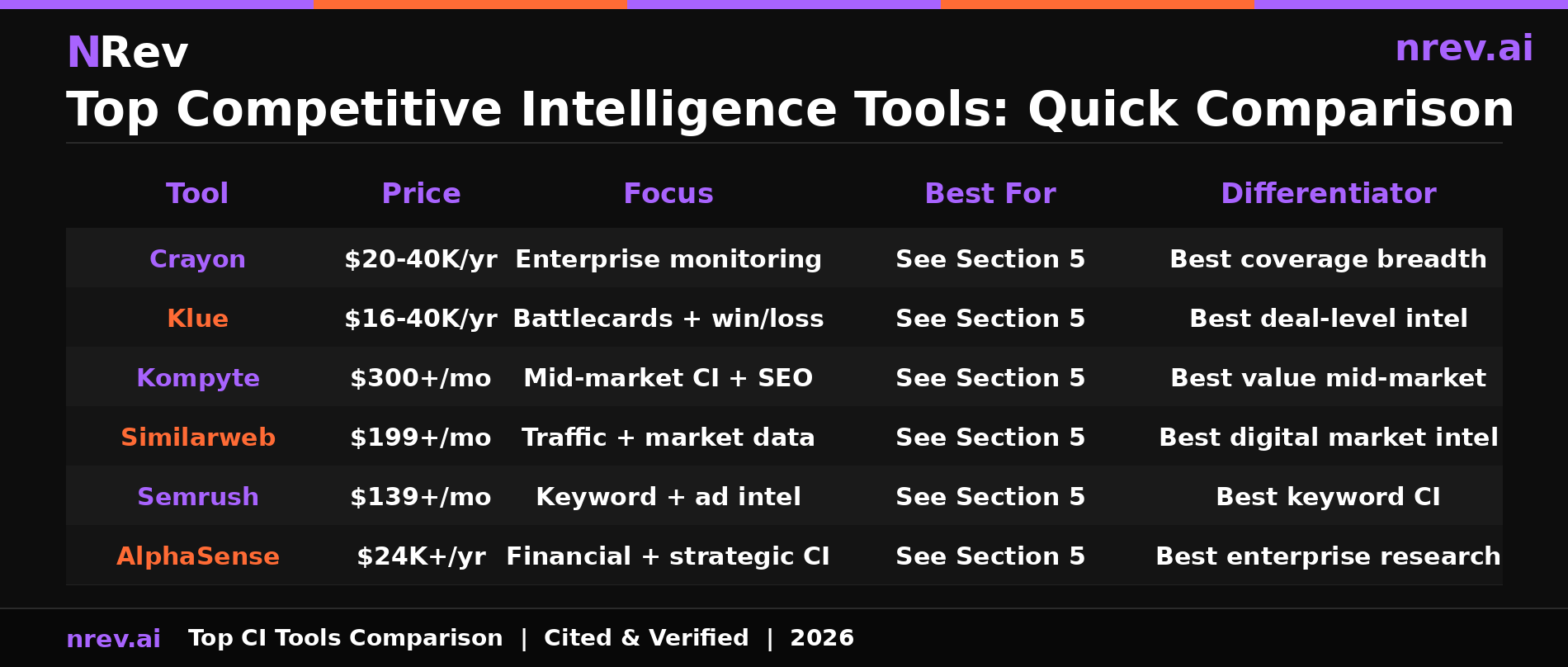
This section covers the top six competitive intelligence tools with honest assessments of what each does best and where each falls short. Use it alongside the comparison image to make an efficient evaluation decision.
Crayon: Best for enterprise monitoring breadth
Crayon is the most established dedicated competitive intelligence platform, monitoring hundreds of millions of web pages to surface competitor pricing changes, messaging updates, product launches, job postings, and market signals. Its AI-powered signal classification reduces the volume of irrelevant updates that teams have to sort through manually.
Where it wins: Crayon's coverage breadth is unmatched. For enterprise teams tracking dozens of competitors across multiple product lines, it provides the most comprehensive monitoring layer available.
Where it falls short: Crayon requires a dedicated CI owner to be effective. Without ongoing curation, the alert volume overwhelms the team and adoption drops off within months. The setup period is typically two to three weeks, and adding or changing tracked competitors incurs additional costs. Pricing is custom, typically $20,000 to $40,000 per year based on monitoring scope.
Klue: Best for deal-level competitive enablement
Klue is differentiated by its Compete Agent feature, which delivers deal-specific competitive intelligence directly to reps in their CRM or email workflow when a competitor is mentioned in a deal. Rather than requiring reps to pull a battlecard, Klue pushes the relevant intelligence to them proactively.
Where it wins: Klue combines CI collection, battlecard delivery, and automated win-loss analysis in a single platform. Its integration with Gong and Chorus for conversational CI capture is the strongest in the category.
Where it falls short: Klue's effectiveness depends heavily on curator-maintained battlecard content. Without dedicated product marketing resources keeping content fresh, the intelligence reps receive becomes stale quickly. Pricing is custom, typically $16,000 to $40,000 per year.
Kompyte: Best value for mid-market teams
Kompyte, now part of Semrush, is the strongest mid-market option for teams that want automated competitor tracking with battlecard workflows at a fraction of enterprise CI platform pricing. Starting at $300 per month with all integrations included and no additional costs for adding competitors, it is the most accessible full-featured CI tool available.
Where it wins: Fast deployment, strong Salesforce integration, and access to Semrush's digital marketing data alongside standard competitor monitoring. The combination of CI monitoring and keyword intelligence in a single platform is genuinely unique at this price point.
Where it falls short: Less mature win-loss analysis than Klue. Smaller user community and ecosystem than either Crayon or Klue.
Similarweb: Best market intelligence tool for digital benchmarking
Similarweb provides competitive market intelligence at the digital channel level: website traffic estimates, traffic source breakdown, audience demographics, app performance, and keyword ranking data for any domain globally. It is the strongest tool for understanding how a competitor's digital presence is growing or shrinking relative to your own.
Where it wins: Visualizing competitive traffic trends and benchmarking your digital channel performance against competitors and the market at large. Pricing starts at $199 per month for the Starter plan.
Where it falls short: Similarweb provides market intelligence, not deal-level sales intelligence. It does not produce battlecards, does not integrate with sales workflows in the way CI platforms do, and does not tell your reps what to say in a competitive deal.
Semrush: Best keyword competitive intelligence
Semrush is the strongest tool for keyword competitive intelligence, giving marketing and content teams detailed data on organic keyword rankings, traffic estimates, paid keyword targeting, and advertising creative across any competitor domain.
Where it wins: Semrush's Advertising Research module and its organic keyword gap analysis tools are the best in class for understanding how competitors are capturing buyer awareness through search. Pricing starts at $139 per month.
Where it falls short: Semrush is a digital marketing intelligence tool, not a sales enablement platform. It does not produce battlecards, does not monitor non-digital competitor signals like job postings, and does not route intelligence to reps in deal workflows.
AlphaSense: Best for enterprise financial and strategic CI
AlphaSense provides AI-powered search across earnings call transcripts, broker research, SEC filings, expert interviews, and trade publications. It is used by 85 percent of S&P 100 companies for deep competitive research at the strategic and financial level.
Where it wins: AlphaSense surfaces forward-looking strategic intelligence from primary documents that no web crawler can access. When a competitor's CEO discusses a product roadmap on an earnings call, that transcript is searchable in AlphaSense within hours.
Where it falls short: AlphaSense is not a sales enablement tool. At approximately $24,000 per user per year, it is primarily used by strategy teams, M&A functions, and enterprise product leadership rather than frontline sales teams.
How to Choose the Right Competitive Intelligence Software for Your Team
The most common mistake in competitive intelligence software comparisons is evaluating all tools against the same criteria regardless of what the team actually needs. The criteria that matter for a 15-person mid-market sales team are different from the criteria that matter for a 200-person enterprise with a dedicated CI function.
Before you commit to a platform, a free competitor monitoring tool will show you how much of the signal you actually need.
Start with two questions before evaluating any specific tool.
The first question is: what decision do you need to make faster? If the answer is "which competitive objections to address in a live deal," you need a competitor enablement platform. If the answer is "which keyword gaps to close before your competitor captures the organic traffic," you need a keyword competitive intelligence tool. If the answer is "how is this competitor's market share trending relative to ours," you need a market intelligence tool. These are genuinely different answers that point to genuinely different categories of tools.
The second question is: who will own this and maintain it? Every competitive intelligence tool in this guide requires human ownership to produce value. Crayon without a CI curator becomes a noise machine. Klue without updated battlecard content becomes a stale library. Semrush without a content team to act on the keyword gaps becomes a dashboard nobody opens. T
he best tool for your team is the one that matches the level of ownership and maintenance your team can realistically commit to, not the one with the most impressive feature list in a demo.
For teams at five to fifty reps without a dedicated CI owner, the practical starting stack is Kompyte for automated competitor monitoring and battlecard workflows, Semrush or Ahrefs for keyword competitive intelligence, and Gong if you are already running structured sales call reviews. This covers the core use cases without requiring a full-time CI function.
For teams above fifty reps with a dedicated product marketing or CI owner, adding Crayon or Klue for enterprise-grade monitoring and Similarweb for market intelligence benchmarking produces a comprehensive CI program that connects external signals to deal-level enablement.
The Three Failure Modes That Make CI Programs Worthless
Most competitive intelligence programs fail not because the tools are bad but because the implementation reproduces the same three failure modes across organizations at every stage and budget.
Failure mode 1: Intelligence without delivery.
Collecting competitive intelligence is not the goal. Delivering it to the rep who needs it before a specific deal call is the goal. When CI outputs are stored in a shared folder, published in a monthly newsletter, or kept in a battlecard library that reps need to remember to check, most of that intelligence never reaches a deal. The programs that produce win rate improvements are the ones where intelligence is routed proactively to the rep who is working the relevant deal, automatically, without requiring them to seek it out.
Failure mode 2: Stale battlecards.
A battlecard that was accurate six months ago and has not been updated since is worse than no battlecard at all. Reps who trust stale battlecard content and encounter a prospect who is better informed than the card lose credibility in the deal and stop trusting the CI program entirely. Research cited in the competitive intelligence community consistently shows that teams updating battlecards monthly produce meaningfully better win rate outcomes than teams updating quarterly or annually.
Failure mode 3: No executive sponsorship.
According to the Crayon research cited earlier, 52 percent of competitive intelligence programs lack a sales executive sponsor. Programs without executive sponsorship are treated by reps as optional resources rather than part of their standard pre-call workflow. The CI program that produces the highest win rate impact is one where sales leadership explicitly expects reps to review competitive context before entering a competitive deal, reinforced in coaching and pipeline reviews.
How nRev AI Connects Competitive Intelligence to Account-Level Outbound
Competitive intelligence tools tell you what competitors are doing. They do not automatically tell you which specific accounts are ready to make a move based on that competitor activity. That is where account-level signal intelligence completes the picture.
When nRev AI monitors your target accounts for buying signals, it surfaces the competitive displacement opportunities that CI platforms alone cannot identify: a company posting a job requiring integration with a technology your competitor provides, a cluster of negative reviews appearing about the incumbent vendor at a target account, or a leadership change at an account currently using a competing product that historically correlates with vendor re-evaluation.
These are not generic competitive signals. They are account-specific signals that tell your rep precisely which accounts are showing competitive displacement intent at this moment, so the outreach that follows is specific and timely rather than broad and speculative.
The combination that produces the highest-conversion competitive outbound is this: your CI program provides the positioning, the battlecard content, and the competitive context your rep needs to win the deal once it is in motion. nRev provides the account-level signal that tells your rep when to initiate the conversation in the first place.
This connects directly to how b2b buying signals feed the competitive tracking intelligence your team needs to act first, and how a clean crm data quality foundation ensures those account signals resolve to the right record rather than creating noise across fragmented data.
When a competitive displacement signal fires on a target account and your team has the CI context to personalize the outreach to what that specific account is using and what your positioning against that competitor looks like, the result is an outbound sales automation workflow that earns replies because it references something real, specific, and timely.
Stop Losing Competitive Deals to Better-Prepared Reps
The rep who enters a competitive deal knowing the competitor's current pricing, their product gaps, and the three most effective counter-positioning arguments wins that deal at a higher rate than the rep who does not. Your CI program is what closes that gap.
nRev AI surfaces the account-level competitive displacement signals that tell your team when to act. Your CI stack gives them the content to act on when they get there. Together, they turn competitive intelligence from a quarterly research exercise into a daily deal-winning system.
Build your first signal-triggered competitive outbound workflow on nRev AI and start reaching competitive displacement accounts before they renew with your rivals.
Frequently Asked Questions
What are competitive intelligence tools?

Competitive intelligence tools are software platforms that automate the collection, analysis, and distribution of information about competitors so sales, marketing, and product teams can make faster and more informed decisions. They monitor sources like competitor websites, pricing pages, job postings, review platforms, social media, and financial filings for changes and signals that affect your competitive positioning.
The top competitive intelligence tools include dedicated competitor enablement platforms like Crayon and Klue, market intelligence tools like Similarweb and AlphaSense, keyword intelligence tools like Semrush and Ahrefs, and conversation intelligence platforms like Gong and Chorus that capture competitor mentions from live sales calls.
The right tool depends on whether your primary goal is improving win rates in active competitive deals, understanding competitive dynamics at the market level, or capturing organic and paid keyword gaps in your content strategy.
What is the difference between competitive intelligence tools and market intelligence tools?
Competitive intelligence tools and market intelligence tools overlap but serve distinct use cases. Competitive intelligence tools are primarily designed to help sales teams win deals by providing deal-level intelligence: battlecards, competitor positioning data, pricing comparisons, and real-time alerts when a competitor makes a significant move.
Market intelligence tools like Similarweb and AlphaSense operate at a higher level of abstraction, providing traffic benchmarks, financial data from earnings calls and analyst reports, industry trend analysis, and strategic positioning insights that inform product roadmaps and go-to-market strategies rather than individual sales calls.
Most mature B2B organizations use both, with competitor enablement platforms serving the sales and product marketing team and market intelligence tools serving the strategy and marketing leadership. Smaller teams typically start with competitor enablement platforms because the win rate impact is more directly measurable.
How do you evaluate competitive intelligence software?
Evaluating competitive intelligence software starts with identifying which of the four categories you actually need: competitor enablement for deal-level win rate improvement, market intelligence for strategic benchmarking, keyword intelligence for content and demand generation, or conversation intelligence for rep coaching and call-level CI capture.
Within each category, the key evaluation criteria are data freshness, which determines how quickly you find out about competitor moves; delivery mechanism, which determines whether intelligence reaches reps automatically in their workflow or requires them to seek it out; CRM integration depth, which determines whether competitive context is visible inside the tools your reps already use; and the level of internal ownership required to keep the intelligence current and actionable.
The competitive intelligence software comparison that matters most is not feature-by-feature but rather which tool best matches your team size, your internal CI ownership capacity, and the specific outcome you are trying to improve.