

Competitive Tracking: How to Monitor Competitors Before They Move on Your Deals
Competitive tracking is not something most B2B sales teams do well. They know who their competitors are. They have a vague sense of what those competitors are doing. But they find out about a pricing change from a prospect on a discovery call, they hear about a new feature from a rep who happened to check the competitor's website, and they learn about a competitive displacement attempt only after the deal is already at risk.
The teams that win competitive deals at a consistently higher rate are not smarter or more experienced. They have a system. They know what signals to watch, they have a competitor tool or stack set up to surface those signals automatically, and they route that intelligence to the rep who needs it before the deal reaches a critical stage. This guide shows you exactly how to build that system.

What Competitive Tracking Actually Means for B2B Teams
Competitive tracking is the practice of systematically monitoring what your competitors do, distilling that activity into actionable intelligence, and routing the most relevant signals to the people on your team who need them before those signals become deal-threatening surprises.
The distinction between competitive tracking and simple competitor monitoring is the routing layer. Most teams monitor competitors in some form: they check a competitor's website occasionally, they set up Google Alerts, they occasionally look at competitor G2 reviews before a big pitch. What most teams do not do is systematically route what they find to the specific rep who is working the specific deal most affected by that intelligence.
A pricing change that you catch on day one and route to your sales team is competitive tracking. A pricing change that you catch on day one, file in a shared folder, and nobody reads for three weeks is competitive monitoring. The difference is whether the intelligence changes rep behavior before the deal is affected.
According to Crayon's State of Competitive Intelligence report, 68 percent of B2B sales deals involve at least one direct competitor. Root source: Crayon primary research, State of Competitive Intelligence annual report. That means your competitive tracking system is affecting the majority of your pipeline, not a niche subset of deals.
The Signals Worth Watching and the Signals Worth Ignoring
One of the most common mistakes in competitive tracking is trying to monitor everything. When you track 200 competitor signals across ten competitors, you produce a feed that nobody reads and an alert inbox that everyone ignores. Effective competitive tracking starts with deciding which signals actually affect deals and prioritizing those above everything else.
Product-launch signals sit at the top of that list, because a competitor shipping into your category changes what your reps need to say this week.
Signals that affect live deals directly:
Pricing changes are the highest urgency signal. When a competitor drops their price on a tier that overlaps with your most common deal size, every rep currently working a deal where that competitor is involved needs to know within hours. The information has immediate tactical relevance to conversations happening today.
Messaging changes on key competitor pages, particularly the homepage, pricing page, and comparison pages, reveal deliberate positioning shifts. When a competitor starts leading with a pain point your prospects frequently raise, they are competing directly for the framing of the problem in your buyers' minds.
Product launch announcements and changelog entries affect deals in the proposal and evaluation stage. When a competitor announces a capability your prospects have been requesting, reps need a prepared response before the next demo or proof-of-concept review where it will inevitably come up.
Signals that affect pipeline strategy over weeks and months:
Job postings reveal strategic direction with a six to nine month lead time. A competitor posting five new enterprise account executive roles signals a market segment investment that will affect your deals in the next two quarters, not immediately. These signals inform how you adjust territory planning and ICP focus rather than what you say in tomorrow's discovery call.
Review patterns on G2 and Capterra provide a window into persistent product weaknesses that your prospects may be hearing about from peers. When a competitor accumulates reviews citing a specific implementation challenge or support failure, that becomes ammunition for competitive positioning across all deals where that competitor is involved.
Funding announcements and executive changes signal strategic inflection points. A new CMO typically precedes a significant messaging overhaul. A Series B typically precedes an aggressive market expansion. These signals are worth tracking but require weeks or months to produce deal-relevant intelligence.
Signals you can safely ignore:
Social media post frequency, blog publish cadence, and award announcements are signals most competitive tracking programs watch by default and very few programs convert into anything actionable. Unless a competitor publishes content that directly contradicts your positioning or announces something specific, social activity is noise.
Why Should You Be Careful About Monitoring Competitors
Competitive tracking is genuinely valuable. It is also genuinely risky when it is done without discipline. Understanding the risks is not an argument against monitoring the competition. It is an argument for doing it in a way that produces intelligence rather than distraction.
The overload trap
The most common failure in competitive tracking is collecting more data than your team can process. When you receive 50 competitor alerts per week and can only act on five of them, the program degrades quickly. Reps stop reading the alerts. The shared channel becomes background noise. A genuinely important signal, a pricing change or a major product announcement, gets lost in the feed alongside dozens of irrelevant social posts and minor website updates.
The fix is to narrow the signal list ruthlessly. Before adding any source to your tracking setup, ask one question: what specific decision will this information enable? If you cannot answer that question concisely, do not track it.
The reactive copying trap
The most dangerous outcome of poor competitive tracking is a team that mirrors competitor moves rather than executing its own strategy. When competitive intelligence becomes the primary input to product roadmap, pricing decisions, and positioning choices, you have replaced your own strategy with a derivative of your competitor's strategy.
Competitive tracking should inform your decisions, not make them. The intelligence you collect about a competitor's pricing page is useful context for how you discuss your own pricing. It should never become the reason you change your pricing model without evidence that the change serves your customers.
The legal and ethical boundary
Competitive tracking of publicly available information is entirely legal and standard practice. Monitoring competitor websites, job postings, press releases, review platforms, and social media is acceptable and appropriate. The boundary is clear: publicly available information is fair game. Internal documents, trade secrets, confidential customer lists, and any data obtained through deception or unauthorized access are not.
According to the competitive intelligence community's standard guidance, the legal rule is straightforward: if a competitor shared it publicly, you may monitor it. If they did not, you may not access it regardless of how easily accessible it might appear through technical means. Competitive tracking programs that operate exclusively within this boundary produce fully defensible and highly effective intelligence without legal or reputational risk.
The stale data problem
Competitive tracking can produce a false sense of security when the data it surfaces is outdated. A competitor analysis you ran six months ago and have not refreshed reflects the market as it existed six months ago. Competitors change pricing, messaging, and product capabilities continuously. An intelligence program that reports accurately on the past creates exactly the wrong kind of confidence: reps who believe they know the competitive landscape but are working from information that has been superseded by events they missed.
The fix is continuous monitoring with clear refresh cadences rather than periodic deep-dive projects.
Competitive Advertising Tracking: Your Fastest ROI Signal
Competitive advertising tracking is the practice of monitoring what your competitors are bidding on in paid search, what messaging they are testing in their ads, and how aggressively they are targeting the keywords your prospects use when they start researching a solution.
This is the highest return-per-hour competitive tracking activity for most B2B teams because it reveals competitive intent in real time. When a competitor begins bidding on your brand name, they have made an explicit decision to intercept your pipeline. When they change their ad copy to lead with a pain point they were not previously addressing, they have identified a messaging opportunity they believe is worth paying for.
The primary tools for competitive advertising tracking are Semrush's Advertising Research module, which shows every keyword a competitor is bidding on along with the ad copy variants they are testing; SpyFu, which provides historical paid keyword data and estimated monthly ad spend; and Similarweb's paid channel intelligence, which combines traffic source data with landing page analysis.
For most B2B teams, a monthly competitive advertising tracking audit takes 30 to 45 minutes and produces three specific actions. First, check whether any competitor has started bidding on your brand name or company name. This requires an immediate response from your demand generation team to protect your branded search traffic. Second, review which non-branded keywords your competitors are most actively bidding on and compare that list to your own organic and paid keyword coverage. Third, read the ad copy your competitors are running for their top-spend keywords. The messaging they are investing paid budget behind is the messaging they believe is most compelling to your shared audience.
This is not a theoretical exercise. When a competitor shifts their primary ad message from "ease of use" to "enterprise security," they have identified a buyer concern that is worth tracking across your own sales conversations.
The Right Competitor Tool by Team Size
The correct competitor tool for your team depends on how many competitors you need to track, how much internal capacity you have to maintain a competitive tracking program, and what the primary use case is: sales enablement, marketing intelligence, or strategic planning.
If you are starting from zero, our free competitor monitor covers the website and announcement side without a subscription.

Solo rep or startup: 20 minutes per week, free tools
Google Alerts on each competitor's brand name, product names, and CEO's name gives you real-time news coverage for free. Set the top three competitors to "as it happens" and the rest to a weekly digest. Visualping's free tier monitors up to five competitor web pages for changes and emails you when something changes. Use it on competitor pricing pages, key product pages, and comparison pages.
G2 review monitoring is free and highly underused. Set a monthly reminder to read the most recent reviews for your top three to five competitors. One-star and two-star reviews are your richest source of publicly available customer frustration data. LinkedIn manual checks on competitor company pages take five minutes per week and catch hiring patterns and product announcement posts that automated tools often miss.
5-50 rep GTM team: One dedicated owner, $300 to $600 per month
Kompyte at $300 per month is the strongest single tool at this budget tier. It monitors competitor websites, ads, and content across hundreds of sources, scores and filters the signals, and delivers the relevant intelligence into Slack, Teams, or your CRM. The Semrush integration adds keyword competitive intelligence alongside standard competitor monitoring for no additional cost.
Brand24 at $149 per month provides media monitoring across 25 million sources including social media, forums, review sites, and news. It is the strongest tool for tracking competitor mentions in public conversations and catching sentiment shifts before they become mainstream.
Gong for competitive call intelligence requires an existing Gong subscription but adds significant value to any competitive tracking program. When a competitor is mentioned on a sales call, Gong captures it, and your CI owner can analyze those mentions across your entire call library to surface objection patterns and talk tracks that actually work.
50+ rep sales org: Dedicated CI function, enterprise investment
At this scale, the tradeoff between enterprise CI platforms and internal maintenance cost is worth evaluating directly. Crayon at approximately $20,000 to $40,000 per year provides the broadest monitoring coverage and is the strongest choice for teams that need to track dozens of competitors across multiple product lines. Klue at approximately $16,000 to $40,000 per year is the strongest choice for teams that want deal-level intelligence delivery, where competitive briefs reach reps automatically when a competitor is mentioned in a deal.
Both platforms require a dedicated CI owner to function. Without someone maintaining battlecard content, curating the alert feed, and ensuring intelligence reaches reps before deals rather than after them, enterprise CI platforms degrade into expensive alert inboxes within 90 days.
AlphaSense adds strategic market intelligence at the financial and executive level for organizations where competitive strategy extends beyond sales enablement into product roadmap and M&A decisions. Similarweb adds digital market benchmarking for teams whose competitive context includes web traffic trends and channel investment patterns.
How to Build a Competitive Tracking Cadence That Sticks
A competitive tracking cadence is the recurring schedule of activities that keeps your intelligence current without consuming more time than the organization is willing to commit. The cadence that works is the one that actually gets done every week, not the most comprehensive one that gets abandoned after the first quarter.
Weekly: 15 to 20 minutes, one person
One person scans Google Alerts, checks automated CI tool feeds, and looks at any new reviews posted for your top three competitors. They post a three-sentence summary in a dedicated Slack channel: what changed, which competitor, and what it means for active deals. Nothing elaborate. Just signal and implication.
This weekly check is the most important cadence element because it is the one that catches time-sensitive signals before they affect deals. A pricing change caught in the weekly scan on Monday can reach the sales team before Tuesday's pipeline call. The same change caught in a monthly review might be too late for three deals that closed in the meantime.
Monthly: One hour, CI owner
Check competitor pricing pages, product changelogs, and job posting patterns across your full competitive list. Update battlecard sections if anything material changed. Review what reps are hearing on calls and cross-reference it against what the monitoring tools are surfacing. Sometimes the most important competitive signal is a gap: a competitor features your prospects asking about something that your tools have not yet captured because it was mentioned in a customer Slack community rather than a public announcement.
Quarterly: Half day, CI owner plus sales and product leadership
Run a structured review covering positioning shifts, win-loss trends, feature gap evolution, and any emerging competitors that have entered deals in the quarter. This is also the time to audit the tracking setup itself. Are there sources you should add? Competitors you should drop? Signals that have been generating noise without ever producing actionable intelligence?
Four Pitfalls That Make Competitive Tracking Programs Worthless
Most competitive tracking programs fail not because the tools are inadequate but because the implementation falls into one of four predictable failure modes.
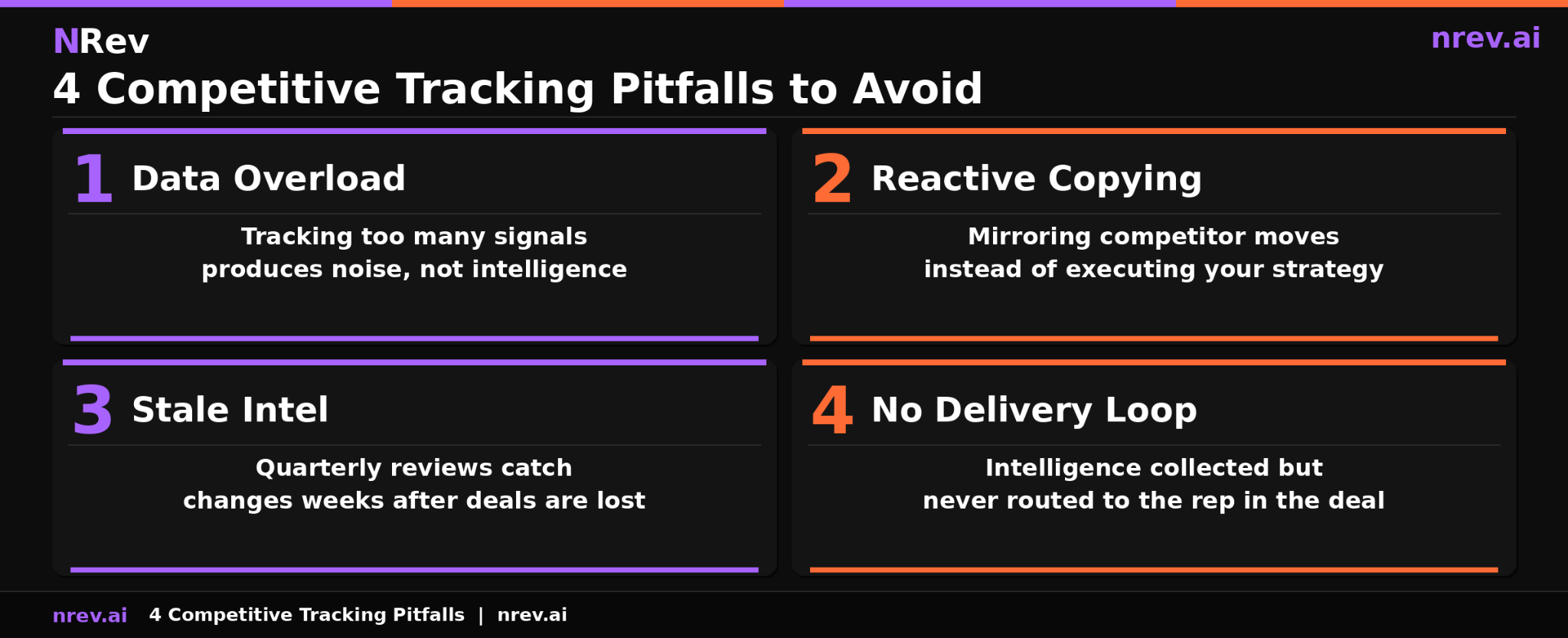
Pitfall 1: Data Overload
Tracking too many signals across too many sources produces a feed that overwhelms the team within weeks. When every change to a competitor's website, every social media post, and every mention across 25 million sources generates an alert, the truly important signals get buried. Reps stop reading. Alerts go unprocessed. The competitive tracking program effectively ceases to function even though the tools are still running.
The solution is to define the maximum number of signals your team will actively process per week before choosing any tool. Work backwards from that number to determine how many competitors you can track, which sources are worth monitoring, and what alert threshold settings to configure. A well-curated feed of 10 relevant signals per week is worth more than an uncurated feed of 200.
Pitfall 2: Reactive Copying
When competitive tracking becomes the primary driver of product roadmap and pricing decisions, the organization loses its own strategic direction. Teams that spend more time watching competitors than executing their own strategy tend to make reactive decisions: matching a competitor's price because the competitor changed theirs, building a feature because a competitor built it, adjusting messaging because a competitor adjusted theirs.
Competitive intelligence should be one input among many. It is most useful for identifying threats that require a response and opportunities that competitors have missed. It is least useful as the sole basis for strategic decisions that should be grounded in customer research and internal conviction.
Pitfall 3: Stale Intel
A quarterly competitive review feels comprehensive but produces intelligence that is already outdated before it reaches most of the team. In a market where competitors adjust pricing, launch features, and update messaging on a weekly basis, quarterly reviews mean your reps are operating from intelligence that is 60 to 90 days old in the most time-sensitive part of their work.
The fix is the continuous monitoring layer described in the cadence section: automated tools that watch for changes daily, a weekly human review that catches what automation misses, and a clear escalation path for high-urgency signals like pricing changes that bypasses the weekly cadence entirely.
Pitfall 4: No Delivery Loop
The most common failure mode is collecting competitive intelligence without routing it to the people who need it. Intelligence stored in a shared Google Drive folder, published in a monthly newsletter, or locked inside a CI platform that reps never open produces no competitive advantage regardless of how comprehensive the collection effort was.
The delivery loop is the most important component of a competitive tracking system. When a pricing change is detected, who receives the alert? In what tool do they receive it? What action are they expected to take, and by when? When a competitor is mentioned in a discovery call, how does that signal reach the rep's battlecard update? Defining these answers before deploying any tool is what separates competitive tracking programs that improve win rates from ones that become expensive data collection exercises nobody uses.
How nRev AI Turns Competitive Tracking Into Account-Level Outbound
Competitive tracking tells you what competitors are doing at the market level. Account-level competitive intelligence tells you which specific accounts are most likely to be open to a competitive conversation right now. That is the combination that converts tracking into pipeline.
nRev AI monitors your target accounts for the signals that indicate competitive displacement timing: a cluster of negative reviews about an incumbent vendor appearing at a target account, a job posting calling for expertise in replacing a technology your competitor provides, a leadership change at an account with an existing competitive contract, or website visitor activity from a company using a competing product that is actively comparing alternatives.
When those signals fire, nRev builds the outreach that references the specific competitive context. The message does not lead with a generic competitive claim. It references what the account is experiencing: the review pattern, the evaluation signal, the specific trigger that makes this moment different from any other moment in the past 12 months. That specificity is what earns replies.
This connects directly to the competitive intelligence tools your team uses for market-level tracking and the b2b buying signals that surface account-level displacement intent. The combination covers both layers: what competitors are doing in the market, and which specific accounts are showing signs of switching right now.
When competitive tracking and signal-based account intelligence work together through outbound sales automation, your reps enter competitive displacement conversations with timing advantage and message precision. That combination closes more competitive deals than any battlecard alone.
Build a Competitive Tracking System That Reaches Your Reps Before the Deal Does
A competitor move your team catches on day one is an opportunity. The same move caught on day 30 is a liability. Competitive tracking is only worth the effort when it is timely, routed correctly, and connected directly to the deals and accounts your team is working.
nRev AI monitors your target accounts for the competitive displacement signals that indicate when a company is ready to evaluate alternatives. It builds the outreach, routes it to the right rep, and delivers it when the account is most likely to respond. You define the competitive triggers. nRev runs the workflow.
Build your first competitive displacement outbound workflow on nRev AI and start reaching competitive accounts before your rivals consolidate their position.
Frequently Asked Questions
What is competitive tracking?

Why should you be careful about monitoring competitors?
What is a competitor tool?