


Intent Based Marketing: How to Reach B2B Buyers at the Right Moment
Most B2B marketing misses buyers at the worst possible time. It reaches them too early, when they are not yet thinking about a solution, or too late, after they have already shortlisted vendors and formed strong preferences. Intent based marketing closes this timing gap by identifying which companies are actively researching your category right now and reaching them with a relevant message at exactly that moment.
The signal is already there. Every B2B buyer leaves a trail of digital behavior: they visit pricing pages, consume competitor comparison content, search for category-specific terms, read review site profiles, and download solution guides. Intent based marketing uses this behavior, called buying intent data, to identify which accounts are in an active research phase, score them by urgency, and trigger personalized outreach at the moment their interest peaks.
This guide covers exactly how intent based marketing works for B2B teams, what types of B2B intent signals matter most, which third party intent data providers produce the best results, and how to build an intent marketing system that converts signals into pipeline.

What Is Intent Based Marketing
Intent based marketing is a B2B go-to-market strategy that uses behavioral data, known as intent data, to identify which companies are actively researching your product category and reach them with personalized outreach at the moment their interest is highest.
Traditional B2B marketing targets prospects based on who they are: job title, company size, industry, revenue range. Intent based marketing adds a second dimension: what they are doing right now. A VP of Sales at a 200-person SaaS company is a demographic profile. That same VP spending six hours across three days reading competitor comparison guides, pricing pages, and category review content on G2 is a buying intent signal.
The distinction matters because timing is the single most controllable variable in B2B conversion rates. The same message that earns a 3 percent reply rate from a cold list earns a 15 to 25 percent reply rate when it reaches an account at the moment they are actively researching a solution. Intent based marketing is the system that ensures your message arrives at that moment rather than three weeks before or three weeks after.
Intent based marketing is not a replacement for content strategy, outbound sequences, or account-based marketing. It is the timing and prioritization layer that makes all of those tactics more efficient by ensuring your resources are concentrated on the accounts that are most likely to buy right now.
Why Buying Intent Changes the Economics of B2B Outreach
The case for intent based marketing is built on a gap that every B2B marketing team knows exists but few have systematically closed.
According to Forrester's Q1 2023 Global B2B Intent Data Survey, published on Forrester's own blog citing their primary research, over 85 percent of companies using intent data report achieving business benefits. Root source: Forrester's Global B2B Intent Data Survey, Q1 2023. The most common benefits reported are increased response rates from outbound marketing and more successful sales prospecting.
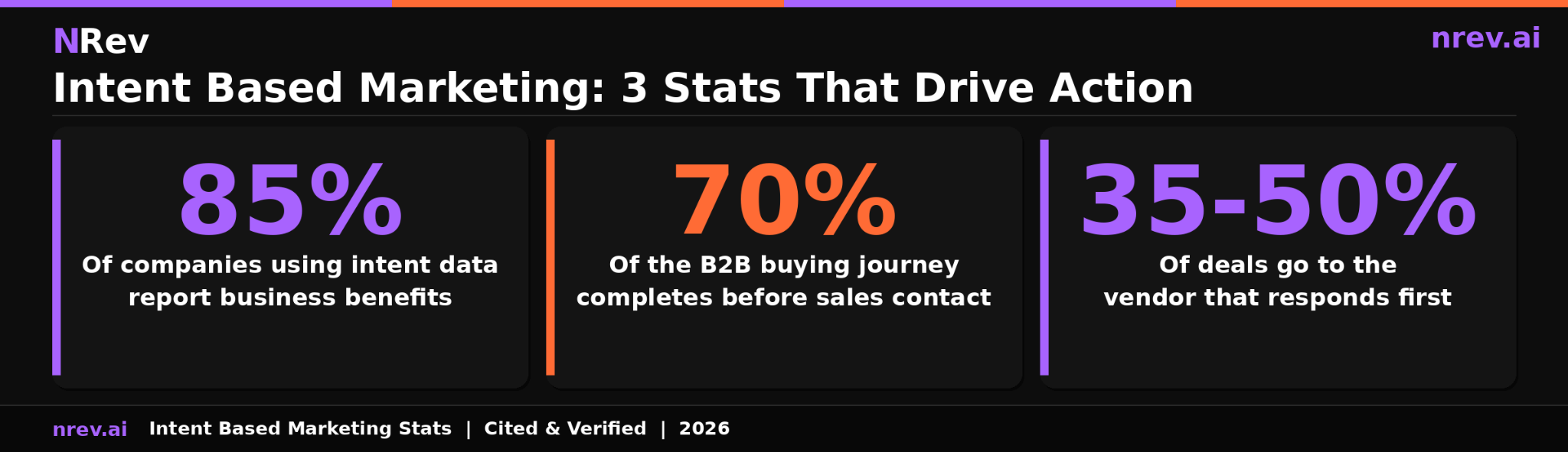
According to 6sense's 2024 Buyer Experience Report, which surveyed 2,509 B2B buyers, approximately 70 percent of the B2B buying journey is complete before buyers initiate first contact with any vendor. Root source: 6sense primary research, survey of 2,509 B2B buyers, 2024. By the time your demo form is submitted, the shortlist is already built and vendor preferences are largely set.
This creates two competing imperatives for B2B teams. The first is being present and credible during the anonymous research phase, which requires consistent content and brand investment. The second is identifying and reaching the accounts that are in that research phase right now, which requires intent data. Intent based marketing is the strategy that combines both.
According to SPOTIO's 2026 sales statistics, which cites Peak Sales Recruiting research as the root source, 35 to 50 percent of all B2B deals go to the vendor that responds first to a buying signal. This means the competitive advantage in intent based marketing is not just identifying signals but acting on them faster than your competitors.
Three Types of B2B Intent Signals
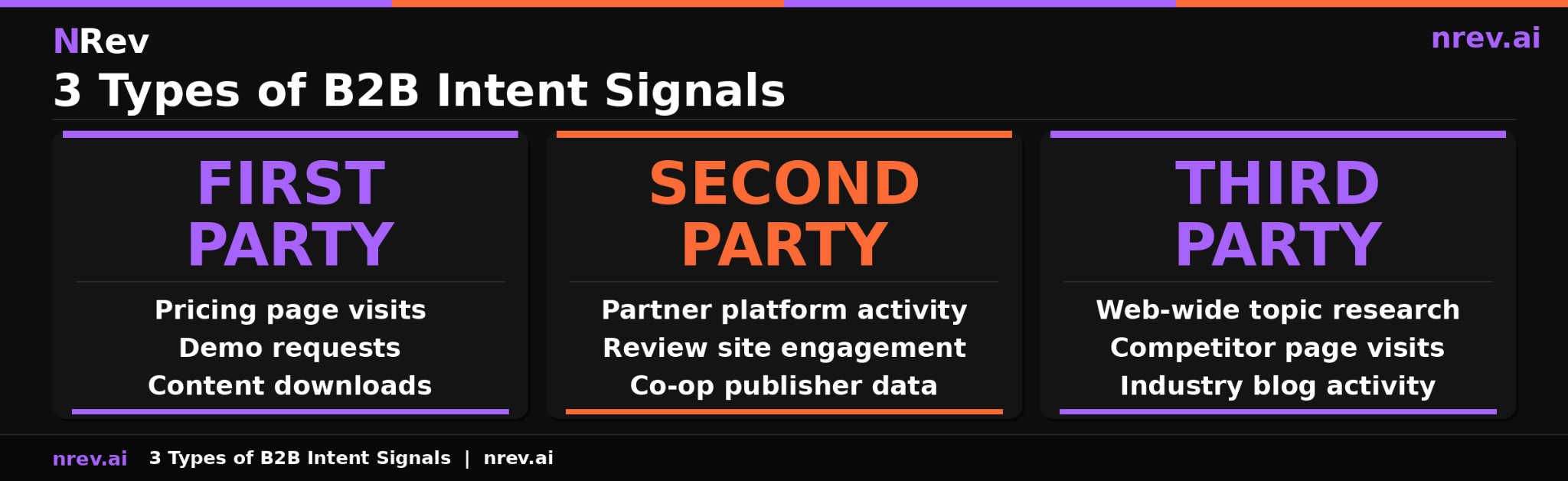
Not all intent data comes from the same place or carries the same reliability. Understanding the three categories of B2B intent signals determines both which data sources you invest in and how much weight to give each signal in your prioritization system.
The clearest place to start is with website intent signals, since they come from your own property and need no vendor contract.
First-Party Intent Signals
First-party intent signals are behaviors that happen on your own digital properties. They are the most reliable form of intent data because they represent direct engagement with your brand.
Your pricing page visits, demo request submissions, case study downloads, product feature page views, and email click-throughs on purchase-intent CTAs are all first-party signals. When multiple people from the same company visit your pricing page across the same week, or when a single visitor returns to your competitor comparison page three times in five days, these patterns reveal purchasing intent that warrants immediate sales attention.
First-party signals are highly accurate because there is no inferential layer: you observed the behavior directly. Their limitation is reach. They only surface buyers who are already aware of your brand and have chosen to visit your site. They miss the large majority of buying activity that happens before a prospect ever lands on your website.
Second-Party Intent Signals
Second-party intent data is first-party data collected by a partner organization and shared directly with you. Review site activity from platforms like G2 and Capterra, where companies are researching and comparing vendors, is a form of second-party intent for the vendors being reviewed.
When a target account's employees are actively reading your G2 profile, comparing it to competitors, and reading customer reviews, G2 can surface that activity to your sales team as a second-party intent signal. This is more reliable than broad third-party data because the research behavior is specific to your category and is happening on a platform your buyers use specifically for vendor evaluation.
Third-Party Intent Data
Third-party intent data captures buying signals from across the broader web, outside of your owned properties and direct partner relationships. Platforms like Bombora aggregate research behavior from a cooperative network of thousands of B2B publisher websites. When a company's employees begin consuming significantly more content about a specific technology topic, that surge in research activity is surfaced as a third-party intent signal.
Third-party intent is valuable because it identifies buying interest before the prospect ever visits your site. If a company is researching your category across industry blogs, analyst reports, and peer communities, that is a signal worth acting on even though they have never heard of your specific product. This gives your team a window to create awareness and initiate contact before competitors who rely only on first-party signals.
The limitation of third-party intent is signal quality. Someone reading about "sales automation" might be a buyer, a journalist, a student, or a competitor doing research. False positives are a real challenge, which is why the most effective intent based marketing programs layer all three signal types rather than relying on any single source.
How Third Party Intent Data Works
Understanding the mechanics of third party intent data helps you set accurate expectations about what it can and cannot tell you, which directly affects how you prioritize and act on signals.
Third party intent data is collected through several primary methods. The most established is publisher cooperative networks. A data platform like Bombora operates a co-op of thousands of B2B websites, blogs, analyst reports, and industry publications. When employees from a company consume content on these sites, their behavior is logged, anonymized at the individual level, and aggregated at the company level. If a company's employees consume significantly more content about a specific topic than their historical baseline, that surge is flagged as an intent signal.
A second method is bidstream data from programmatic advertising exchanges. When ads are served across the web, bid requests include anonymized contextual information about the page being viewed. Intent data platforms can use this information to infer what topics companies are researching based on the pages their employees visit.
Review site platforms like G2 and TrustRadius provide a third method. These sites capture highly specific purchase-intent behavior: buyers who are actively comparing vendor options, reading user reviews, and building shortlists. This data is particularly valuable because the research intent is direct rather than inferred.
Once collected, intent platforms assign topic scores to accounts based on the frequency, recency, and relevance of the behaviors observed. An account that recently started consuming significantly more content about a specific technology category than usual receives a high topic score for that category. That score is what your sales and marketing teams use to decide which accounts to prioritize.
Best Intent Data Providers for B2B Teams in 2026
The intent data market has grown significantly, with providers ranging from broad third-party data aggregators to niche first-party tools. The right choice depends on your ICP, geographic focus, existing tech stack, and whether you need company-level or contact-level signals.
Bombora
Bombora is the most established third-party intent data provider for B2B. Its Company Surge data is built on a cooperative network of thousands of B2B publisher websites, giving it broad topic coverage and significant reach. Bombora's data is company-level rather than contact-level, meaning it tells you which companies are researching your category but not which specific individuals are doing the research.
Bombora integrates with most major CRM and ABM platforms and is widely used as an enrichment layer for account prioritization. It is best suited for teams that want third-party topic signals at scale and have an enrichment step to find the right contacts within identified accounts.
6sense
6sense is a full account engagement platform that combines intent data with predictive scoring, advertising, and orchestration. Its intent tracking spans over 40 languages and draws on multiple data sources including its own network, Bombora, and other providers. 6sense is particularly strong at predicting the buying stage, not just identifying which accounts are researching, but estimating where they are in their buying journey.
According to the Forrester Wave: Intent Data Providers for B2B, Q1 2025, 6sense and Bombora are among the most evaluated platforms in the B2B intent data space. Root source: Forrester's Q1 2025 evaluation of 15 intent data providers across 21 criteria.
Demandbase
Demandbase combines intent data with account-based marketing infrastructure. It identifies company-level intent signals and allows marketing teams to use those signals to trigger targeted advertising, personalize website experiences, and route high-intent accounts to sales teams for immediate outreach.
G2 Buyer Intent
G2 surfaces intent signals specifically from the G2 review and comparison platform. When companies visit your G2 product profile, read competitor comparisons, or engage with review content in your category, G2 flags those accounts. This is particularly high-value intent data because it represents buyers who are actively in vendor evaluation mode rather than general category research.
ZoomInfo Intent
ZoomInfo layers intent signals on top of its B2B contact and company database. When a target account shows elevated research activity on ZoomInfo's publisher network, the platform can surface the right contacts within that account simultaneously, reducing the enrichment step required with tools like Bombora.
What to evaluate before choosing:
Signal source and coverage: Does the provider cover the channels where your buyers actually research? Signal type: First-party, second-party, or third-party, and which you need most. Contact-level vs company-level: Can the tool identify specific individuals or only organizations? CRM and sequencing integration: Does intent data flow automatically into your sales rep's workflow? Privacy compliance: Is the data collection GDPR and CCPA compliant for your geographic markets?
How to Prioritize and Score Buying Intent Signals
Receiving intent signals and acting on them productively are different problems. Most teams that invest in intent data struggle not with identifying signals but with prioritizing which ones deserve immediate response and what that response should look like.
Weight first-party signals above everything else, because they describe what a real buyer did rather than what a data panel inferred.
The most effective intent scoring frameworks combine three dimensions: signal strength, ICP fit, and signal freshness.
Signal strength measures how directly a behavior indicates purchase intent. A demo request is stronger than a pricing page visit. A pricing page visit is stronger than a competitor comparison article view. A competitor comparison article view is stronger than a general blog post read. Map every signal you can observe to a strength tier before building your response workflow.
ICP fit determines whether the account showing intent is actually a company you want as a customer. A high-intent signal from an account that is too small, in the wrong industry, or in a geography you do not serve should not receive the same response urgency as the same signal from a perfectly matched account. Score intent signals against your ICP criteria before routing to sales.
Signal freshness measures how recently the behavior occurred. Intent is perishable. A company that visited your pricing page twice last week has different urgency than a company that did the same thing three weeks ago. Build recency decay into your scoring model so that signals lose priority as they age and gain priority as new behaviors stack on top of existing ones.
Stacked signals are significantly more valuable than single signals. An account that is a strong ICP match, has visited your pricing page twice, downloaded a case study, and is simultaneously showing elevated third-party intent on your category topic is showing compounding intent. These stacked signal accounts should be at the top of every rep's daily priority list.
This is where your intent based marketing system connects to your b2b buying signals framework. Stacked signals, combining website intent, third-party research activity, and external triggers like funding rounds or executive hires, convert at dramatically higher rates than any single signal acting alone.
Intent Marketing Tools: How to Activate Signals Into Pipeline
The gap between most intent based marketing programs and the ones that actually generate pipeline is not in signal detection. It is in activation: what happens in the minutes and hours after a signal is identified.
Most intent marketing tools surface signals in dashboards. The rep checks the dashboard on Monday morning, finds 40 accounts showing elevated intent from the previous week, and has to manually research each one, identify the right contact, draft a personalized message, and determine which channel to use. By the time this is done at scale, many of those signals have decayed. The window has closed.
The intent marketing tools that produce real pipeline results are the ones that eliminate manual steps between signal detection and outreach delivery. The moment a high-intent signal fires on an account, the tool should identify the right contact within that account, enrich the contact with email and LinkedIn profile, surface the relevant context for personalization, and either draft the outreach automatically or route a pre-built sequence to the right rep for same-day delivery.
For teams building a website visitor tracking system alongside their third-party intent program, the integration layer is critical. A company showing elevated third-party intent on your category topic that also visits your pricing page the same week is showing compounding confirmation. Those two signals together should trigger a higher-priority response than either signal alone.
The practical workflow for an intent marketing activation system has four steps. First, intent signal fires and is scored against ICP fit and signal strength. Second, accounts above your response threshold are automatically enriched with the right contacts and the context behind the signal. Third, a personalized first-touch message is drafted or queued referencing the specific topic the account was researching, without surveillance-level creepiness. Fourth, the message is routed to the right rep with a clear response target, typically same-day for Tier 1 signals and within 48 hours for Tier 2.
For teams that have invested in outbound sales automation infrastructure, intent signals should serve as the primary trigger for outbound sequence initiation. Instead of sequences triggered on a calendar schedule, sequences triggered by intent signals reach prospects at the moment they are most receptive to a relevant message.
How nRev AI Turns Intent Signals Into Automated Outbound
nRev AI is built specifically to close the gap between intent signal detection and pipeline-generating outreach. When a target account triggers a high-intent signal, whether from your own website visitor data, third-party intent providers, or external buying signals like funding rounds and executive hires, nRev does not create a dashboard alert and wait for a rep to notice.
It cross-references the signal against every other available data point for that account: current ICP fit, prior engagement history, stacked signals from external triggers, and contact-level enrichment. It then builds a personalized first-touch sequence that references the relevant signal context and queues it for same-day delivery to the right rep or sends it automatically based on your configured workflow.
For B2B teams that have invested in intent data for lead generation but found that the gap between data and pipeline remains wide, nRev fills the activation layer. The signal becomes the sequence trigger. The context becomes the personalization. The rep handles the conversation when a prospect replies.
Your intent marketing tools reveal who is in-market. nRev ensures they hear from you before your competitors do.
Turn B2B Intent Signals Into Pipeline With nRev AI
Intent data without activation is just a dashboard. The teams that win with intent based marketing are the ones that move from signal to outreach in hours, not days.
nRev AI monitors your target accounts across first-party website signals, external buying signals, and intent data integrations. When a high-intent signal fires, nRev identifies the right contact, builds the personalized outreach, and queues it for same-day delivery. You describe the workflow. nRev runs it.
Build your first intent-triggered outbound workflow on nRev AI and start reaching B2B buyers at the exact moment they are looking for a solution like yours.
Frequently Asked Questions
What is intent based marketing?

What is buying intent in B2B marketing?
What are the best intent data providers for B2B?