

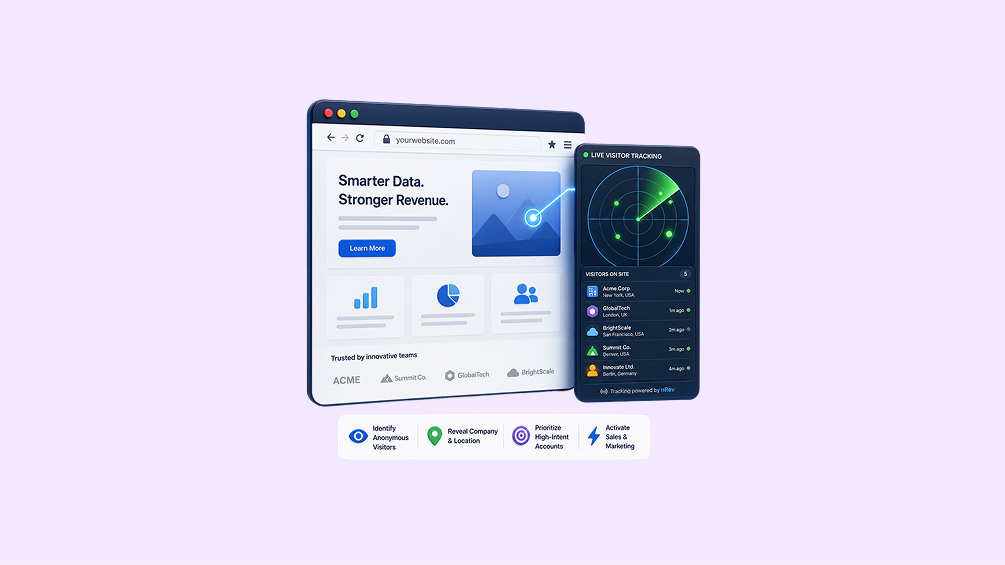
Website Visitor Tracking: How to Identify Who Is on Your Site and Turn Them Into Pipeline
Your website is getting traffic every day. Decision makers from target accounts are reading your pricing page, comparing you to competitors, and reviewing your case studies. Then they leave. No form. No email. No name.
Website visitor tracking is the technology that changes this. It reveals which companies are visiting your site, which pages they viewed, and how long they spent on high-intent content, all without requiring a form fill. For B2B sales and marketing teams, this is one of the highest-leverage tools available because it converts dark funnel activity into actionable pipeline intelligence.
This guide covers exactly how website visitor tracking works, how to identify website visitors at both the company and person level, which website visitor tracking tools produce real results, and how to turn that data into pipeline before your competitors do.
What Is Website Visitor Tracking
Website visitor tracking is the process of monitoring who visits your website, what they do while they are there, and in B2B contexts, which company or individual is behind each session. Standard analytics platforms like Google Analytics show you traffic volume, page views, and time on site. What they cannot tell you is who those visitors actually are.
B2B website visitor tracking goes further. It uses IP address matching, cookie data, and identity resolution technology to reveal the companies and, in many cases, the specific people behind anonymous traffic. When a prospect from a target account visits your pricing page three times in one week, a visitor tracking tool surfaces that information and routes it to the right sales rep with context about what they viewed.
This matters because of where most B2B buying decisions happen. Decision makers research vendors, compare alternatives, and build shortlists almost entirely before contacting any salesperson. By the time a prospect fills out your demo form, the shortlist is already formed and preferences are set. Website visitor tracking gives you visibility into the research phase, which is exactly when there is still an opportunity to influence the outcome.
Technology is not magic. It identifies a meaningful percentage of your traffic, typically 15 to 40 percent at the company level depending on the tool and your traffic mix, and routes that intelligence to your team in real time. What your team does with that intelligence in the next 24 to 48 hours determines whether it becomes a pipeline or disappears.
Why Website Visitor Tracking Matters for B2B Teams
The core problem that website visitor tracking solves is the gap between traffic and pipeline. Most B2B teams invest heavily in driving visitors to their site through paid ads, SEO, content, events, and outbound campaigns. But the vast majority of that investment produces anonymous sessions that cannot be connected to accounts or contacted.
According to multiple B2B visitor identification platforms citing consistent research, up to 98 percent of B2B website visitors leave without filling out a form. They browse, research, compare, and leave without identifying themselves. That gap between the traffic you are paying for and the pipeline you are generating represents the biggest conversion opportunity most B2B teams have access to.
The average B2B website converts 2 to 3 percent of visitors into leads, according to MetricHQ's visitor-to-lead conversion rate data, which aggregates conversion benchmarks across industry sources. For every 100 visitors who arrive on your site, only 2 to 3 leave their contact information. The remaining 97 to 98 visitors are your best source of untapped pipeline because they have already demonstrated interest by showing up.
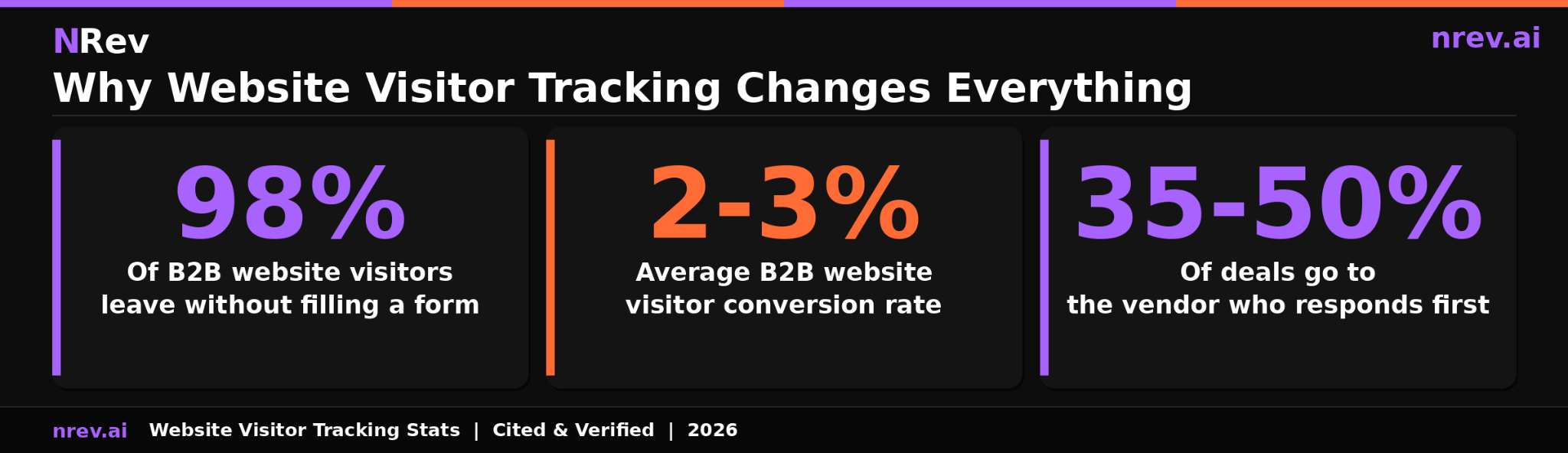
The competitive pressure is real. According to SPOTIO's 2026 sales statistics, which cites Inside Sales research as the root source, 35 to 50 percent of all B2B deals go to the vendor that responds first when a buying signal fires. If a prospect is visiting your pricing page and your competitor has visitor tracking while you do not, your competitor may reach out with a relevant message before you even know the visit happened.
Companies that use visitor tracking data to trigger same-day outreach on high-intent visits are not just closing more deals. They are closing deals that would have otherwise gone to faster competitors.
How Website Visitor Tracking Works
Understanding the mechanics of B2B website visitor tracking helps you set realistic expectations about what the technology can and cannot do, and why choosing the right tool matters significantly.
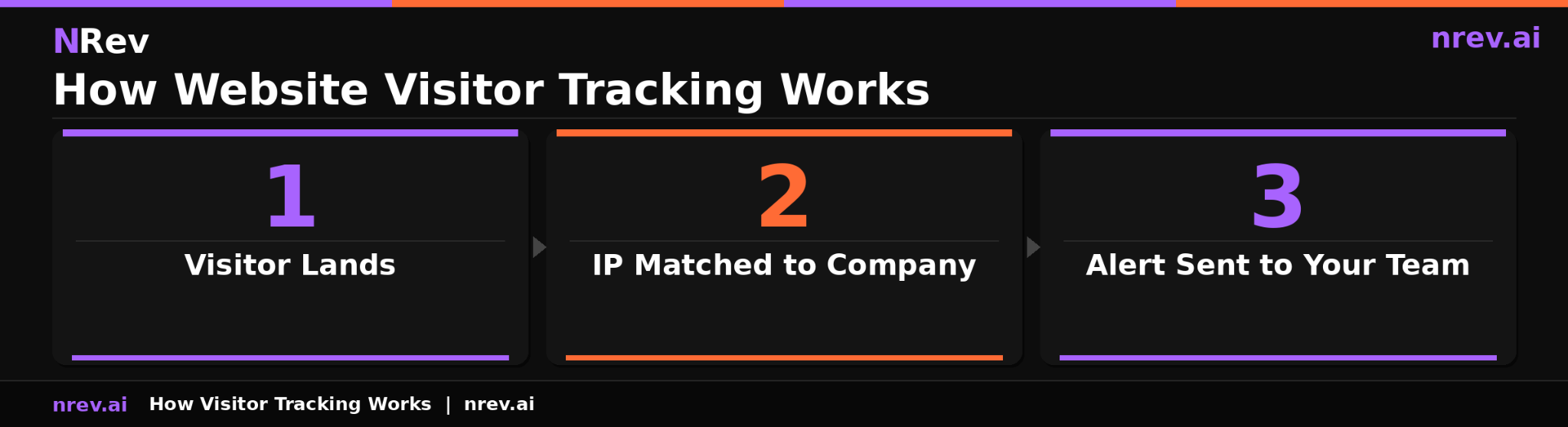
Step 1: The visitor lands on your site.
When someone from a company visits your website, their browser sends a request that includes their IP address. This request is logged by your website infrastructure along with the pages visited, the duration of each session, and the sequence in which pages were viewed. Modern tracking tools also place a first-party cookie in the browser to link sessions across multiple visits over time.
Step 2: The IP address is matched to a company.
The visitor tracking tool takes the IP address from that session and looks it up against a database of corporate IP ranges. Most large companies have static IP addresses registered to their organization. When a match is found, the tool enriches it with firmographic data: company name, industry, size, location, and technology stack.
This is where the limitations begin. Over 60 percent of knowledge workers are now remote or hybrid, according to estimates across industry sources. Remote workers browse from residential IP addresses that resolve to ISPs, not company networks. Modern tools address this by layering additional methods on top of IP matching, including cookie graphs, marketing automation data, and identity resolution using third-party data partnerships. These supplemental methods improve match rates for remote traffic but do not eliminate the gap.
Step 3: Your team receives an alert with context.
When a company is identified, the tracking tool routes the information to your team. The most useful implementations include the company name, firmographic details, the specific pages visited, the order of those pages, the total time spent, and in some cases, identified contacts from that company who might be the right person to reach out to.
The best visitor tracking tools connect this alert to your CRM, create or update the account record, and route it to the right sales rep based on territory or account ownership. The least useful ones drop the data into a dashboard that nobody checks regularly.
How to Identify Website Visitors: Company vs Person Level
B2B website visitor tracking operates at two distinct levels. Understanding the difference prevents mismatched expectations when evaluating tools.
Company-level identification reveals which organization visited your site. You see the company name, industry, size, and location, along with the pages they viewed and when. You do not know which person within that company was browsing. This is the most common and most privacy-compliant form of visitor tracking. It is highly actionable because you can use firmographic data to determine whether the company fits your ICP, check whether they are already in your CRM, and identify who the right contact would be to reach out to.
Person-level identification goes further by attempting to identify the specific individual, providing name, email, job title, and LinkedIn profile. This typically requires matching browser signals against larger identity databases. Person-level identification is significantly harder technically, has lower match rates, and raises more complex privacy considerations under regulations like GDPR and CCPA. For most B2B teams, company-level identification paired with enrichment to find the right contact is a more practical and compliant starting point.
When evaluating visitor tracking tools, the most important metric to compare is match rate, which is the percentage of your traffic that gets successfully identified. Company-level tools typically achieve 15 to 40 percent match rates depending on your traffic mix and geographic focus. Tools that claim dramatically higher rates often mix different measurement methods, so always ask for match rate evidence from companies with similar traffic profiles to yours.
Which Pages Should Trigger Immediate Outreach
Not all website visits carry the same weight. A prospect reading a general blog post about industry trends is doing early-stage research. A prospect visiting your pricing page, reviewing a competitor comparison guide, and then returning to view a case study from their industry in the same session is building an internal business case.
Website visitor tracking is most valuable when you configure it to prioritize high-intent pages and route those alerts for same-day response. Here is how to tier your pages:
Tier 1: Immediate outreach required.
These pages signal active vendor evaluation. Route alerts to SDRs with a target response window of the same business day.
Pricing page, especially multiple visits or multi-person visits from the same company. Demo request page, even if no form was completed. Competitor comparison pages. Integration documentation pages, which indicate technical evaluation is in progress. ROI calculator or cost savings tools.
Tier 2: Follow up within two to three business days with relevant content.
These pages indicate consideration stage research. The visitor is gathering information but has not yet entered active vendor selection.
Case study pages, particularly those from the visitor's industry or company size. Product feature documentation. Security and compliance pages, which signal a technical buyer is involved. Webinar recordings related to your product category.
Tier 3: Add to nurture sequences, monitor for escalation.
These pages indicate early awareness. Direct outreach is premature and often counterproductive.
General blog posts and educational content. Career pages. General about us or company pages.
When a company visits multiple pages in different tiers within one session, escalate based on the highest-tier page visited. A company that reads a blog post and then immediately views your pricing page has moved into Tier 1 territory regardless of how the session started.
Best Website Visitor Tracking Tools for B2B in 2026
The website visitor tracking tools market has expanded significantly. Here is an honest overview of the main categories and the tools that lead each one, without vendor spin.
Company-level identification with CRM integration.
Leadfeeder, now part of Dealfront, is one of the most established options in this category. It connects to your Google Analytics account, uses reverse IP lookup to identify companies, and syncs identified accounts to your CRM. It is particularly strong in European markets given Dealfront's data partnerships. Best for teams that need company-level identification with strong CRM workflow integration.
Visitor Queue offers a lower-cost option focused on company identification for small and medium businesses. It provides firmographic data on visiting companies and basic contact information for key employees at those companies. Best for teams with budget constraints who need the core functionality without enterprise pricing.
Enterprise ABM platforms with visitor tracking.
ZoomInfo WebSights connects visitor identification to ZoomInfo's database of over 320 million contacts and 100 million company profiles. When a company visits your site, WebSights enriches the account record with full firmographic data, available contacts, and buying intent signals from ZoomInfo's broader platform. Best for teams already using ZoomInfo that want visitor tracking as part of their existing infrastructure.
6sense and Demandbase sit at the high end of the market. They combine website visitor tracking with broader account-based marketing capabilities: intent data aggregation, ad targeting, CRM enrichment, and sales prioritization. These are enterprise investments that require dedicated implementation and operations resources to use effectively.
Person-level identification tools.
RB2B focuses on identifying the specific LinkedIn profile of individual visitors to US-based websites. It offers a free tier and is particularly popular with early-stage companies doing founder-led sales. Limitations include US-only coverage and lower match rates than company-level tools.
Warmly combines company and person-level identification with real-time alerts and automated workflows. It uses a multi-provider waterfall approach to maximize match rates and integrates directly with Slack, CRM platforms, and sequencing tools.
What to evaluate before choosing.
Match rate for your specific traffic mix and geography. CRM integration depth, specifically whether data flows automatically or requires manual export. Alert configurability, so you can filter by page, company size, or ICP criteria. Privacy compliance, particularly if you have significant European traffic.
How to Turn Identified Visitors Into Pipeline
Identifying which company visited your site is only the beginning. The pipeline impact comes entirely from what you do with that information and how quickly you do it.
Tracking is only the collection step. What you are really building is a feed of website monitoring signals that a rep can act on.
Step 1: Prioritize by intent signal, not just company name.
A Fortune 500 company visiting your blog once is less valuable than a 50-person company in your ICP visiting your pricing page three times in one week. Configure your alerts and routing logic to surface the highest-intent visits first, regardless of company size. Tier 1 pages from ICP-matched companies should always get the first response.
Step 2: Research the account before reaching out.
Visitor tracking tells you what the company looked at on your site. Before reaching out, combine that with what you know about the company from other sources: Are they hiring for roles that signal a buying need? Did they recently raise funding? Has a new executive joined? This context transforms your outreach from a generic follow-up into a relevant, specific message.
This is where visitor tracking integrates naturally with your b2b buying signals workflow. A pricing page visit combined with a recent funding round is a significantly stronger signal than either alone. Stacked signals convert at dramatically higher rates than single-touch triggers.
Step 3: Open with the topic, not the surveillance.
The message that works references what the prospect was researching in general terms, not the specific session data. "Noticed your team has been exploring pricing options for GTM automation" works. "I saw you spent 12 minutes on our pricing page at 2:47 PM" does not. Reference the category of interest and connect it to a relevant outcome without revealing that you have detailed behavioral data.
Step 4: Act within the same business day for Tier 1 signals.
The window for acting on high-intent website visits is narrow. Intent fades as quickly as it builds. A prospect who was comparing vendors this morning may have shortlisted their options by tomorrow. According to SPOTIO's 2026 sales statistics, citing Inside Sales research, 35 to 50 percent of deals go to the vendor that responds first. Same-day response to Tier 1 visitor signals is the most controllable variable in capturing this advantage.
For teams looking to build a complete outbound sales lead generation system, visitor tracking is one of the strongest intent signals available. A prospect who found you through organic search and visited your pricing page is already significantly warmer than a cold outbound target.
Step 5: Connect identified visitors to your broader outbound sequences.
Companies that identified a visitor but did not convert on the first touch are not lost. They belong in a targeted follow-up sequence that combines website intent with other buying signals. A company that visited your pricing page last week and then posted a job for a Head of Revenue Operations is showing compounding signals. Your outbound sales automation workflow should connect these signals into a coordinated sequence rather than treating them as separate events.
How nRev AI Connects Visitor Tracking to Outbound Sequences
Most visitor tracking tools create alerts. nRev AI creates sequences.
When a target account is identified visiting a high-intent page, nRev does not just send a Slack notification. It cross-references the visit with other signals from that account: recent funding, hiring activity, executive changes, and competitor research. It then builds a personalized first-touch sequence that references the most relevant trigger available, routes it to the right rep, and queues it for same-day delivery.
The visitor tracking signal becomes the starting point of a coordinated outbound motion rather than a one-off alert that gets buried in a dashboard. When multiple signals stack on the same account, the system elevates the priority automatically.
For teams running b2b website visitor tracking as part of a broader signal detection system, nRev connects the visibility layer with the action layer. You see who is on your site and the sequence goes out the same day, with context drawn from every available signal, not just the website visit.
This is what website visitor tracking is supposed to do. Not just show you a list of companies. Convert that list into meetings.
Stop Watching Visitors Leave Without Knowing Who They Are
Your prospects are on your site right now. They are reading your pricing page, comparing your features to competitors, and deciding whether you belong on their shortlist. Most of them will leave without filling out a form.
nRev AI monitors your target accounts across all buying signals, including website intent, and builds personalized outreach the moment a high-intent visit is detected. You describe the workflow. nRev builds it and runs it.
Build your first visitor-triggered outbound workflow on nRev AI and start having conversations with the prospects who are already looking at you.
Frequently Asked Questions
How does website visitor tracking work?

How do you identify website visitors without a form fill?
What are the best website visitor tracking tools for B2B?