


Lead Enrichment Tools: How to Keep Your CRM Contacts Accurate and Up to Date
Your CRM is only as useful as the data inside it. The moment a contact changes jobs, gets promoted, or moves to a new company, every field attached to that record begins losing value. Name stays the same. Everything else starts decaying. Lead enrichment tools exist to stop that decay and reverse it automatically, keeping your contact data accurate, complete, and ready to drive outbound action.
B2B data enrichment is not a one-time project. It is an ongoing system. Contacts change roles at a rate that makes periodic manual cleanup ineffective. The solution is a layer of lead enrichment tools that continuously appends, verifies, and updates CRM records as the real world changes, so your sales team always starts each outreach from a position of accurate intelligence rather than guesswork.
This guide covers exactly what lead enrichment is, why data enrichment for CRM is critical, the four types of B2B data enrichment your team needs, how to evaluate data enrichment providers, and which tools produce the best results for B2B teams in 2026.
What Is Lead Enrichment and Why It Matters
Lead enrichment is the process of taking a basic contact or company record and automatically filling in missing fields, verifying existing information, and appending additional attributes that make the record actionable for sales and marketing teams.
When a new lead enters your CRM, whether through a form fill, a cold outreach response, or a list import, you typically capture a small number of fields: name, company, email, and perhaps job title. Lead enrichment tools take that minimal record and expand it into a full profile: verified email address, direct phone number, LinkedIn profile, company headcount, revenue range, technology stack, industry vertical, and in some cases, current buying intent signals.
The business case is direct. A sales rep working from a complete, verified contact record spends their time selling. A rep working from an incomplete or outdated record spends their time researching: manually looking up LinkedIn profiles, Googling company sizes, calling main office lines to find direct dials, and bouncing emails that were already invalid before they were sent.
B2B data enrichment removes that research overhead systematically. It gives every contact in your CRM the same rich context your best reps would build manually, but at the scale of your entire database, and in the time it takes to run an automated workflow rather than an afternoon of manual work.
The Data Decay Problem: Why Your CRM Is Always Getting Worse
The most important thing to understand about B2B data enrichment is that it solves an active, ongoing problem. Your CRM does not stay accurate after you clean it. It decays continuously, driven by a rate of change in the real world that no static database can keep up with.
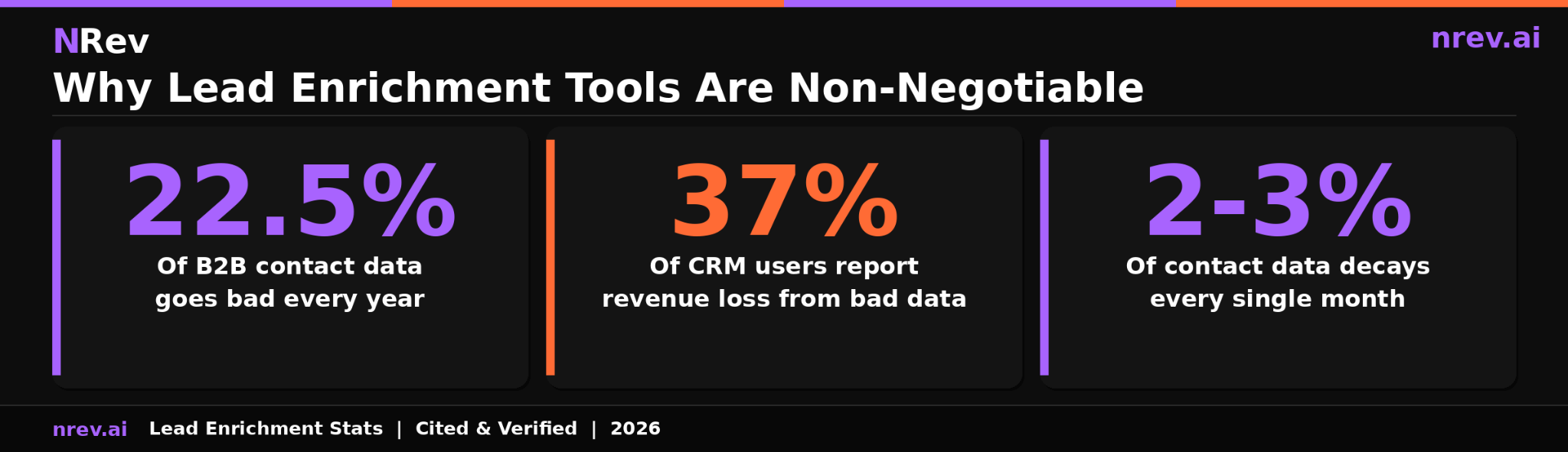
According to MarketingSherpa's research on B2B data decay, which cites MarketingSherpa as the root source for its data decay statistics, B2B contact data decays at approximately 2 to 3 percent per month. Compounded over a full year, this translates to roughly 22.5 percent of your entire contact database becoming inaccurate or unreachable within 12 months. Root source: MarketingSherpa's research on B2B contact data decay rates, independently corroborated by IndustrySelect and multiple industry sources.
For a company with 10,000 CRM contacts, this means approximately 2,250 records will contain outdated or wrong information by this time next year, even if the database was perfectly clean today. Those records include the wrong email address, an obsolete job title, a company the contact no longer works for, or a phone number that connects to no one.
The financial impact is concrete. According to Validity's 2025 State of CRM Data research, cited by RocketReach's data accuracy report which names Validity's 2025 survey as its root source, 37 percent of CRM users reported losing revenue as a direct consequence of poor data quality. Root source: Validity's 2025 State of CRM Data survey.
The primary driver of data decay is job change. When a contact moves from one company to another, their email becomes invalid, their phone number changes, their LinkedIn URL may update, and their title is no longer accurate. With professionals changing employers at a consistently high rate, this event alone accounts for the majority of database rot. No CRM updates itself automatically when a contact changes jobs. Only a lead enrichment system connected to real-time data sources can catch those changes and update your records before your team wastes time on dead outreach.
Four Types of B2B Data Enrichment Your CRM Needs
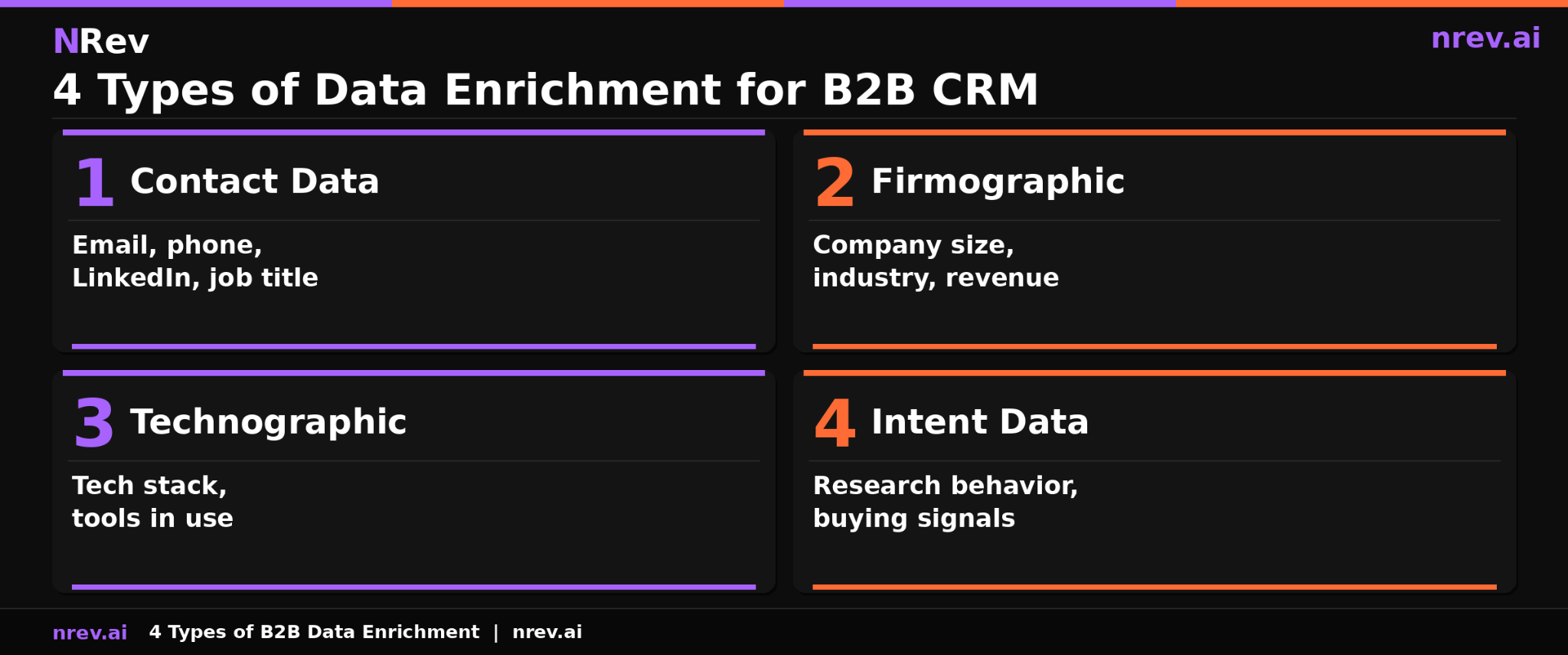
Not all enrichment adds the same value. Understanding the four distinct types of B2B data enrichment helps you decide what your database is missing and what data enrichment tools to prioritize for your specific GTM motion.
Type 1: Contact Data Enrichment
Contact data enrichment fills in the fields your sales team needs most: verified work email address, direct phone number, LinkedIn profile URL, and current job title. This is the foundation of any enrichment program. Without accurate contact data, no other type of enrichment matters because your team cannot reach the person.
Contact data enrichment also handles corrections: updating a title that changed six months ago, replacing a previous employer email with the current one, and flagging records where multiple data points suggest the contact has left the company.
Type 2: Firmographic Enrichment
Firmographic enrichment appends company-level information to contact records: employee headcount, estimated revenue, headquarters location, industry vertical, funding stage, founding year, and number of office locations. This data drives ICP scoring and segmentation.
Firmographic data is particularly critical for data enrichment CRM workflows that power lead routing and territory assignment. When you know a company's size and industry accurately, you can route the lead to the right rep, score it correctly in your lead scoring model, and personalize the outreach to reference the relevant use case for that company's scale.
Type 3: Technographic Enrichment
Technographic enrichment reveals what software tools a company currently has deployed. Knowing that a prospect uses Salesforce, runs their marketing on Marketo, and relies on a specific category of tool your product complements or replaces is powerful outbound context that dramatically improves personalization quality.
Technographic data is most valuable for SaaS companies whose product integrates with, replaces, or serves as an add-on to specific platforms. It lets your team identify exactly which accounts in your database are already set up to use your product and reach them with a message that speaks directly to their existing stack.
Type 4: Intent Data Enrichment
Intent data enrichment layers behavioral signals onto contact and company records. It flags which accounts in your database are currently researching topics related to your product category, which ones have recently visited competitor sites, and which ones are showing elevated content consumption around the problems your product solves.
Intent enrichment transforms a static CRM into a live signal feed. Instead of reaching out based on firmographic fit alone, your team reaches out based on fit plus active buying behavior. The combination consistently produces higher reply rates because it targets the right company at the right moment.
How Lead Enrichment for CRM Works: Point-in-Time vs Continuous
There are two fundamentally different approaches to implementing lead enrichment for CRM, and choosing between them determines how quickly your data re-decays after each enrichment cycle.
Enriching one contact is rarely enough either. A free buying committee finder maps the rest of the account so the record reflects who actually decides.
Point-in-Time Enrichment
Point-in-time enrichment is a batch process. You export your CRM records, pass them through a data enrichment tool, receive an enriched file, and import it back. This approach was standard practice for most of the past decade and remains common in teams that have not yet invested in continuous enrichment infrastructure.
The limitation is built into the method. The moment a batch enrichment run is complete, the data starts decaying again. A contact who changed jobs two weeks after your quarterly enrichment run will have a stale record for the next ten weeks. If your enrichment cadence is quarterly, approximately 5.5 percent of your database will have decayed before you catch it. Annual enrichment runs are effectively worthless for fast-moving B2B markets.
Continuous Enrichment
Continuous enrichment runs in the background at all times, monitoring your CRM records against real-time data sources and updating fields when changes are detected. New leads are enriched automatically the moment they enter your CRM. Existing records are refreshed when job changes or company events are detected.
This approach eliminates the re-decay problem entirely. Your database does not have a freshness window because it is always being refreshed. Reps working from a continuously enriched CRM always have current contact information, current firmographic data, and current intent signals without ever doing manual research.
For most B2B teams, the right implementation combines both: continuous enrichment for active pipeline and high-priority accounts, with scheduled batch refreshes for the broader database that falls outside the active outbound window.
What to Look for When Evaluating Data Enrichment Providers
The data enrichment provider market is large and varies enormously in data quality, coverage, compliance posture, and integration depth. These are the criteria that separate providers that produce real pipeline improvement from those that add noise to your database.
Data accuracy and bounce rate
The single most important metric when evaluating any data enrichment provider is email deliverability. A tool that returns email addresses with a 15 to 20 percent bounce rate is not enriching your database. It is polluting it. High bounce rates damage your sender domain reputation and reduce deliverability for every email your team sends, including to valid contacts. Evaluate providers against your own sample: take 200 to 500 records, run them through the tool, and measure the actual bounce rate before committing to a contract.
Coverage for your specific market
Database coverage is not uniform. A provider that claims 500 million contacts may have strong coverage for US enterprise accounts and weak coverage for mid-market European companies. Evaluate coverage specifically for your ICP: geographic region, company size tier, and job function. Test coverage on a representative sample of your target accounts before evaluating on database size alone.
CRM integration depth
The value of enrichment is fully realized only when it flows automatically into your CRM without manual export and import steps. Evaluate whether the provider offers a native integration with your CRM, whether that integration supports automatic record updates, and whether it handles deduplication intelligently rather than creating parallel records with conflicting data.
Compliance and data sourcing
GDPR and CCPA compliance is not optional. Verify that any data enrichment provider you evaluate can document how their data is collected, can demonstrate compliance with the privacy regulations relevant to your target markets, and can provide data processing agreements that your legal team will accept. This is particularly important for teams selling into European markets.
Refresh frequency
Ask providers how often their underlying database is refreshed. A provider that updates records every 90 days will always deliver staler data than one that verifies in real time or weekly. For fast-moving contact fields like email and phone, real-time or near-real-time verification is significantly more valuable than batch database refreshes on a quarterly schedule.
Best Lead Enrichment Tools for B2B Teams in 2026
The right lead enrichment tool depends on your team's size, existing tech stack, primary ICP, and whether you need contact enrichment, company enrichment, or both. Here is an honest assessment of the major categories.
For teams wanting maximum email accuracy and engagement built in:
Amplemarket combines contact data enrichment with a native outreach platform, meaning enriched contacts flow directly into email and LinkedIn sequences without requiring additional tools. It consistently delivers among the lowest bounce rates in independent testing, cited by Amplemarket's own benchmark data at under 3 percent for verified emails. Best for teams that want enrichment and outreach in a single platform.
For teams in the HubSpot ecosystem:
Clearbit, now rebranded as HubSpot Breeze Intelligence following HubSpot's acquisition, enriches contacts and companies directly within HubSpot. For teams already operating on HubSpot CRM, this is the path of least friction: enrichment runs natively, updates sync automatically, and form enrichment reduces the number of fields required for a visitor to complete a lead capture form.
For teams needing the largest US enterprise database:
ZoomInfo provides the largest proprietary B2B contact and company database available, with strong firmographic and technographic coverage for US enterprise accounts. Its WebSights visitor identification product adds first-party intent signals to the enrichment layer. Best for enterprise teams with significant database size requirements and existing ZoomInfo contracts.
For teams building custom waterfall enrichment pipelines:
Clay connects to over 100 data providers through a single interface, allowing RevOps teams to build custom waterfall enrichment workflows that query providers in sequence until a verified result is found. Clay does not include built-in outreach, so it works best for teams with a dedicated outreach platform already in place and a RevOps engineer to manage the workflow configuration.
For European-market teams:
Cognism focuses on GDPR-compliant B2B contact data with strong coverage across European markets. Its Diamond Data feature provides phone-verified mobile numbers, which significantly increases connect rates for teams that rely on phone outreach alongside email.
For teams needing broad contact lookups with a LinkedIn workflow:
Apollo.io combines a 275M+ contact database with a built-in outreach platform and LinkedIn extension. It offers a strong accuracy-to-price ratio for small to mid-market teams that need both enrichment and sequencing without a significant budget. Best for teams that are earlier in their GTM maturity and need an affordable all-in-one starting point.
Waterfall Enrichment: How to Maximize Coverage and Accuracy
Waterfall enrichment is the methodology used by the most data-mature B2B teams to maximize both contact coverage and accuracy across their CRM. Rather than relying on a single data enrichment provider and accepting their coverage limitations, waterfall enrichment queries multiple providers in sequence.
The process works like this. When your enrichment system processes a contact record, it first queries Provider A for a verified email. If Provider A returns a result, enrichment stops. If Provider A returns nothing or returns a result with low confidence, the system queries Provider B. If Provider B also fails, it moves to Provider C. This continues until a verified result is found or all providers have been queried.
The practical impact is significant. A single data enrichment provider typically returns a result for 60 to 70 percent of a given contact list, leaving a meaningful portion unreachable. A well-configured waterfall across three or four providers consistently covers 85 to 90 percent of the same list, with each additional provider closing more of the coverage gap.
Waterfall enrichment also improves accuracy by creating validation redundancy. When multiple providers return the same email address for a contact, confidence in that result is significantly higher than when a single provider returns it. Conflicting results between providers flag records for manual review rather than writing potentially incorrect data into your CRM automatically.
For teams with the RevOps infrastructure to manage it, waterfall enrichment is the highest-quality approach to contact data enrichment available. Tools like Clay make this accessible without requiring custom API development, though configuration and ongoing management require dedicated RevOps time.
How nRev AI Uses Enrichment to Power Signal-Based Outbound
Lead enrichment tools solve a data quality problem. nRev AI connects that clean data to the outbound action it enables.
When a target account shows a b2b buying signal, whether through a website visit identified by website visitor tracking, a funding announcement, or an executive hire, nRev does not simply surface the account name. It cross-references the signal against enriched contact data to identify the right person to reach, enriches that contact with current email, LinkedIn, and job title, and builds a personalized first-touch message that references the specific signal driving the outreach.
The enrichment step is what separates a signal from a conversation. Without accurate contact data, intent and buying signals are just observations. With enriched contact data connected to a signal-triggered outbound sales automation system, every signal produces a same-day outreach to the right person at the right company with the right context.
This is the full lead enrichment workflow nRev enables. Your database stays accurate through continuous enrichment. Your target accounts are monitored for buying signals continuously. When a signal fires, enrichment produces the right contact. nRev builds and routes the outreach. Your rep handles the reply.
Stop Letting CRM Decay Kill Your Outbound Results
Every bounced email, disconnected phone call, and "that person left six months ago" reply is a symptom of the same problem: contact data that decayed faster than your team noticed. Lead enrichment tools fix this permanently, not as a one-time cleanup but as a continuous system that keeps your CRM accurate as the real world changes.
nRev AI connects your enrichment layer to your outbound motion. When a buying signal fires on an enriched account, nRev builds the personalized outreach and routes it to your rep before the intent window closes. You describe the workflow. nRev runs it.
Build your first enrichment-powered outbound workflow on nRev AI and start reaching the right people with accurate data every time.
Frequently Asked Questions
What is lead enrichment?

What is B2B data enrichment?
How often should you enrich your CRM data?