


Monitoring Competitors: Stop Losing Deals to Blind Spots
Monitoring competitors is one of those activities that every B2B sales and marketing team says they do and almost none do systematically. There is a vague awareness of what competitors are charging, a rough sense of what their product does, and a mental note to check their website when something important seems to have changed. That is not competitor monitoring. That is reactive research triggered by lost deals.
Actual competitor monitoring is a structured system. It watches specific competitor activity continuously, routes the right intelligence to the right person, and delivers that intelligence before it becomes deal-critical rather than after. This guide covers the five types of competitor activity worth monitoring, the tools that handle each category, how to approach competitor advertising monitoring specifically, why you should be careful about monitoring competitors, and how to build the full system around your team size and capacity.
What Monitoring Competitors Actually Requires
Monitoring competitors requires three things that most teams skip: a defined signal list, an assigned owner, and a delivery mechanism that gets intelligence to the right person before it is needed rather than after.
The signal list is the foundation. Without deciding upfront what you are watching and what you are ignoring, every competitor monitoring setup devolves into a noise machine. You will receive hundreds of alerts per week about social posts, minor website updates, and blog publications that have no bearing on your active deals. The signal list focuses the system on the specific competitor activity that affects how your reps position, price, and compete.
The assigned owner is what separates programs that produce results from programs that run for 90 days and quietly stop. According to Crayon's State of Competitive Intelligence, 44 percent of companies lack competitor visibility within their CRM. Root source: Crayon primary research, State of Competitive Intelligence annual report. The underlying cause is almost always the same: nobody owns the intelligence after it is collected.
The delivery mechanism is the layer most teams build last but should build first. Intelligence that sits in a shared folder, a weekly newsletter, or a CI platform nobody logs into produces zero competitive advantage. The delivery mechanism defines: which channel does intelligence arrive in, who receives which type of signal, and what specific action is expected from the recipient within what timeframe.
Five Types of Competitor Activity Worth Your Attention
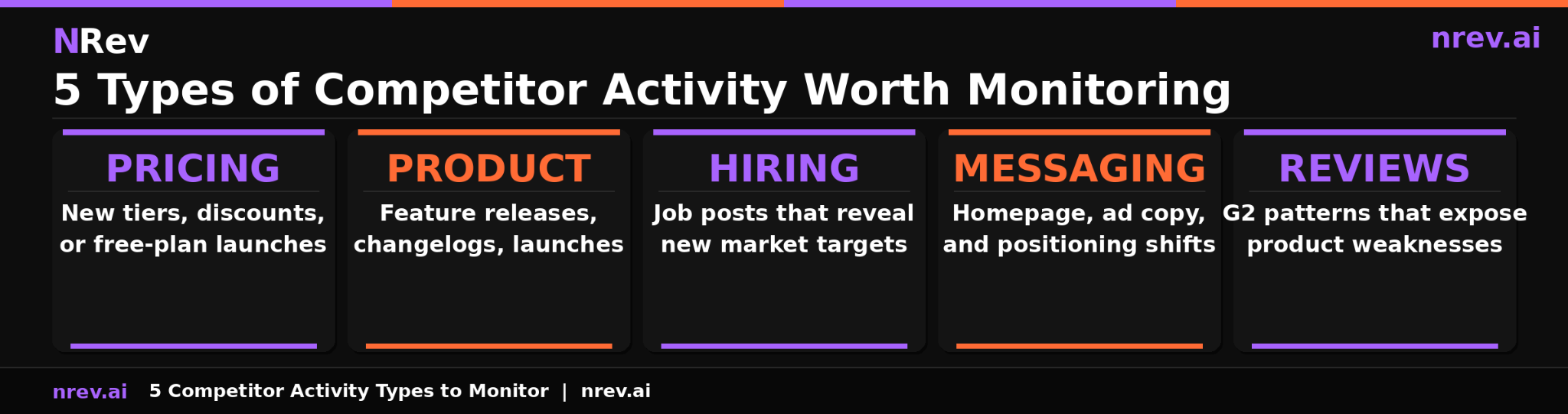
Not all competitor activity is worth monitoring. The five types below are the ones that consistently affect deal outcomes, rep positioning, and pipeline strategy. Everything else is background noise.
Most of these surface as website-change signals first, because pricing and positioning move on the site before they move anywhere else.
Pricing activity
A competitor dropping their price, launching a free tier, or restructuring their packaging is one of the highest-urgency competitor activity signals. It affects every deal currently in your pipeline where that competitor is being evaluated. Your reps need to know the same day it happens, not at the next monthly review.
Monitoring competitor pricing is best done through a combination of direct page monitoring on their pricing URL, a Google Alert on their brand name plus the word "pricing," and a G2 review filter that flags any recent review mentioning price changes. When all three fire at the same time, it is a reliable signal that something significant has changed.
Product activity
Feature launches, product announcements, and changelog updates tell you exactly which capability gaps your competitors are closing. The specific competitor activity that matters most is a new feature that overlaps with something your prospects have been asking for, because that is the one that will come up in your next demo.
Monitor product updates through the competitor's changelog page directly via Visualping, their product-focused social accounts, and their release notes if they are publicly available. Job postings in engineering for specific technical areas are often the earliest signal of a product capability that is six to nine months away from release.
Hiring activity
Job postings are one of the most underused competitor activity signals in B2B. When a competitor posts five new enterprise account executive roles, they are building out a sales team that will be reaching your target accounts within 90 days. When they post for a Head of Channel Partnerships, they are about to shift their go-to-market motion in a way that will affect your competitive positioning with resellers and partners.
Set up a weekly review of competitor job boards for your top three to five competitors. Filter for roles in sales, marketing, and executive leadership. Note which departments are growing and which are not. The hiring pattern is often a more honest signal of strategic direction than anything a competitor publishes on their website.
Messaging activity
Competitor website changes, particularly to the homepage, the pricing page, and any comparison or "versus" pages targeting your brand, are messaging signals that tell you how a competitor is choosing to position against you.
When a competitor launches a dedicated comparison page targeting your brand, they have decided that a percentage of their prospect base is also evaluating you. That page is designed to win the comparison. Your team needs to see it the day it goes live. Visualping on that competitor's website, combined with Semrush's organic keyword monitoring, catches messaging changes as they happen rather than weeks after prospects have already seen them.
Review activity
G2 and Capterra review patterns are a public window into what a competitor's customers actually experience with their product, as opposed to what the competitor says about it. One-star and two-star reviews in particular are a primary competitive intelligence source that most teams do not use systematically.
When a competitor's G2 page accumulates reviews citing a specific implementation failure, a support bottleneck, or a pricing dispute, that pattern is your positioning ammunition. It tells you which pain points your prospects are most likely to have heard about from their peers, which objections you can proactively address, and where your own product's strengths are most directly relevant.
Why Should You Be Careful About Monitoring Competitors
This question surfaces frequently in competitive intelligence discussions and deserves a direct answer. Monitoring competitors is valuable. It is also a practice that produces specific, predictable risks when it is not done with discipline.
The overload risk
The most common failure mode in monitoring competitors is collecting more data than the team can process. When you monitor 15 competitors across 20 sources, you generate a volume of alerts that overwhelms anyone trying to read them. The important signals, a pricing change or a product launch, arrive buried in a feed of social posts and blog updates that have no deal relevance. Reps stop engaging with intelligence. The system runs on autopilot producing output nobody uses.
The solution is to monitor fewer sources more carefully. Define a maximum of three to five high-priority competitors for continuous real-time monitoring. Add the rest to a monthly manual review that takes 60 minutes rather than trying to monitor everything continuously.
The reactive copying risk
Monitoring competitors becomes dangerous when it becomes the primary input to strategic decisions. When your pricing changes because a competitor changed theirs, when your product roadmap prioritizes features because a competitor shipped them, and when your messaging shifts to mirror a competitor's repositioning, you have replaced your own strategic vision with a derivative of someone else's. This is the most common way that active competitor monitoring actually weakens competitive positioning over time rather than strengthening it.
Use competitor intelligence to identify threats that require a response and opportunities the market is underserving. Do not use it as a substitute for building your own point of view about where the market is going.
The legal and ethical boundary
Monitoring competitors through publicly available information is entirely appropriate and standard practice. Competitor websites, job postings, press releases, pricing pages, G2 reviews, earnings calls, and any other information a competitor has voluntarily published are all fair game.
The boundary is clear: information that a competitor has not made publicly available is off-limits. This includes internal documents, trade secrets, confidential customer lists, and any data obtained through unauthorized system access or deception. Monitoring programs that stay within the public information boundary produce fully defensible competitive intelligence without legal or reputational risk.
The stale intelligence risk
Monitoring competitors on a quarterly cadence is worse than useful. In a B2B market where competitors adjust pricing, launch features, and update messaging continuously, quarterly intelligence is already outdated by the time it reaches your team. Reps who rely on quarterly competitive briefings often enter deals with information that is 60 to 90 days stale in the most time-sensitive parts of their work.
The fix is continuous monitoring at the signal level combined with a weekly human review that surfaces and routes the most important changes before they affect the next discovery call.
Competitor Advertising Monitoring: The Signal Most Teams Miss
Competitor advertising monitoring is the practice of tracking what your competitors are bidding on in paid search, what ad creative they are running, how long specific ads have been active, and which landing pages they are driving traffic to. It is the fastest-return monitoring activity most B2B teams have not set up.
The reason it is so valuable is that paid advertising reveals deliberate competitive intent. When a competitor begins bidding on your brand name in Google Ads, they are explicitly trying to intercept your branded search traffic. That is a direct attack on your pipeline that requires a response within days. When they increase spend on keywords your prospects use when they start researching a solution to the problem you solve, they are investing in capturing awareness from buyers who might otherwise have found you first.
Primary tools for competitor advertising monitoring
Semrush's Advertising Research module is the most comprehensive tool for B2B competitor ad intelligence. Enter any competitor domain and see every keyword they are currently bidding on, the ad copy variations they are testing, estimated monthly spend, and position history. The keyword gap analysis identifies keywords where competitors are paying for traffic that you are not capturing organically or through your own paid campaigns.
SpyFu is the strongest tool for historical ad intelligence. Its database shows every keyword a competitor has bid on, every ad variation they have tested, and how their spending patterns have evolved over time. When a competitor has been running the same ad continuously for eight months, it is almost certainly converting well. That is both a signal about what messaging resonates with your shared audience and a creative reference point for your own testing.
The Meta Ad Library is a free, publicly available resource that shows every active ad a company is running across Facebook and Instagram, including start date, creative format, and geographic targeting. For B2B companies running awareness campaigns on social platforms, the Meta Ad Library provides direct visibility into competitor messaging and creative strategy at no cost.
Google Ads Auction Insights is a native Google tool available to any advertiser that shows which competitors are appearing in the same auctions as your ads. It reveals overlap rate, impression share, and position data relative to each competitor. Unlike third-party tools, Auction Insights is based on actual auction data rather than estimates.
What to look for in a monthly competitor advertising monitoring audit
Check first whether any competitor has started bidding on your brand name or company name. This is an explicit competitive move that your demand generation team needs to respond to. Check second which non-branded keywords your competitors are most actively bidding on and compare that list to your own paid keyword coverage. Check third what messaging competitors are using in their highest-spend ads. The creative they invest the most budget behind reflects what they believe is most compelling to your shared audience.
Competitor Monitoring Tools Organized by Use Case
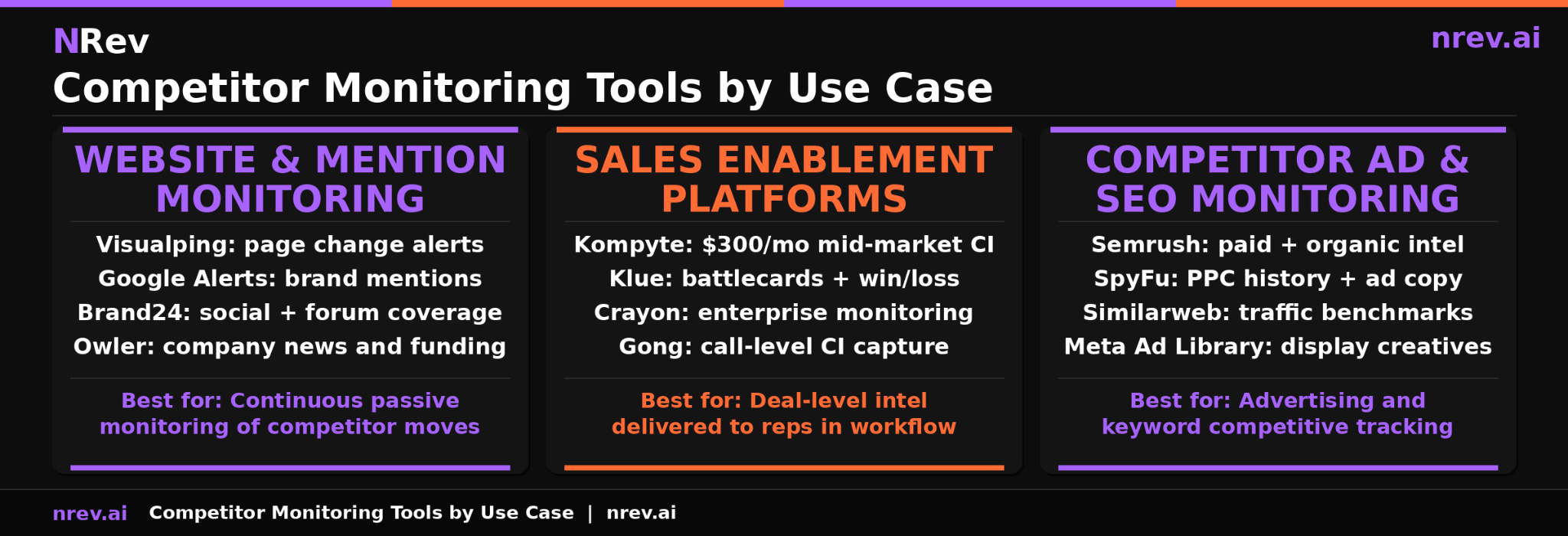
The right competitor monitoring tools depend on what you need the intelligence to do: passively watch for changes, arm reps in active deals, or track digital marketing and advertising activity. These three use cases require different tools and different workflows.
Use Case 1: Website and mention monitoring
Visualping monitors specific web pages you select, alerts you when a change is detected, and provides a visual diff showing exactly what changed. Use it on competitor pricing pages, homepage, product pages, and any "versus" pages targeting your brand. The free tier covers a small number of monitors. The Business plan at $100 per month covers teams monitoring dozens of competitor pages continuously.
Google Alerts on competitor brand names, product names, and key executive names remains the most accessible baseline for news coverage. It misses social activity and page changes but catches press releases, funding announcements, and media coverage in real time at no cost.
Brand24 at $149 per month provides mentions monitoring across 25 million sources including social media, forums, review sites, and news outlets. It is the strongest tool for catching the unstructured competitor mentions, negative reviews, and community discussions that formal press monitoring misses.
Owler provides competitive profiles on privately-held companies, including funding rounds, revenue estimates, and executive changes. The free tier provides basic alerts. Owler Pro at approximately $49 per month adds full alert customization and CRM integration for teams that need structured company news in their workflow.
Use Case 2: Sales enablement platforms
Kompyte at $300 per month is the strongest mid-market sales enablement tool, combining automated competitor website monitoring with battlecard workflows and Semrush's digital marketing data. It is the best single tool for teams that need both monitoring and battlecard delivery without enterprise pricing.
Klue and Crayon are the two enterprise options, both priced at approximately $16,000 to $40,000 per year. Klue is differentiated by deal-level intelligence delivery, pushing competitive context to reps automatically when a competitor is mentioned in a deal. Crayon is differentiated by monitoring breadth, covering hundreds of millions of pages across millions of domains. Both require a dedicated CI owner to maintain battlecard content and curate the intelligence feed.
Gong for competitive call intelligence works alongside any monitoring tool by capturing competitor mentions from inside your own sales conversations. When a competitor comes up on a call, Gong logs it, enabling your CI owner to analyze mention frequency, objection patterns, and the talk tracks that correlate with wins.
Use Case 3: Competitor advertising monitoring and SEO
Semrush is the most complete tool for competitor advertising monitoring and organic keyword intelligence. Its Advertising Research module provides keyword-level ad intelligence for any competitor domain. Its Keyword Gap analysis identifies where competitors are capturing search traffic you are not. Pricing starts at $139 per month.
SpyFu is the specialized tool for PPC competitive intelligence, with 15-plus years of historical ad data showing every keyword a competitor has bid on and every ad variation they have tested. At $39 per month for the basic plan, it is the most cost-effective tool specifically for paid search competitor advertising monitoring.
Similarweb provides traffic source benchmarking at the channel level, showing how much of a competitor's traffic comes from organic search, paid search, social, referral, and direct. It is the tool that answers "are they investing more in paid search or organic?" and "which channels are actually driving their growth?" Pricing starts at $199 per month.
How to Set Up Monitoring in a Single Day
The goal of setup day is to get a working monitoring system running before spending any budget on paid tools. The free and low-cost layer covers enough ground to be useful for most teams and gives you a baseline to validate before committing to a larger investment.
Morning: Set up continuous passive monitoring
Set up Google Alerts for each of your top three to five competitors. Create one alert per competitor covering their brand name, their primary product name, and their CEO's name. Set the top three to "as it happens" delivery frequency and the rest to daily digest. This takes 30 minutes and catches news coverage, press releases, and media mentions without any ongoing maintenance.
Add Visualping monitors for each competitor's pricing page and homepage. Point the free tier monitors at the pages most likely to change in ways that affect deal conversations. When a change is detected, you will receive a visual diff by email.
Set a recurring monthly calendar reminder to review G2 for your top competitors. Filter for reviews in the last 30 days sorted by lowest rating first. This costs nothing and is the most consistently underused competitive intelligence activity in B2B sales.
Afternoon: Set up advertising intelligence
Create a free Semrush account and run an Advertising Research report on each of your top three competitors. Screenshot the current keyword list and save it as your baseline. Run the same report monthly and compare. Any keywords that appear in the current month but were not in the previous month's baseline are new competitive bids worth investigating.
Check the Meta Ad Library for each competitor. Search their brand name and filter for active ads. Note the headlines, descriptions, and creative formats they are currently running. Save the output as a reference document.
Both of these activities take under an hour and require no paid subscriptions.
The first week: assign and route
Assign one person as the CI owner for competitor monitoring. Define their specific responsibilities: checking the Visualping alert inbox daily, running the weekly Slack summary, and owning the monthly G2 review and Semrush audit. Without a named owner, the system stops producing value within 60 days regardless of how well it was set up.
Turning Competitor Intelligence Into Deal-Level Action
Collecting competitor intelligence is not the goal. Converting it into specific actions that improve deal outcomes is the goal. The gap between programs that produce win rate improvements and programs that produce data nobody acts on is the action protocol layer.
An action protocol defines: when signal X is detected, person Y takes action Z within timeframe T. For pricing changes, the action is: the CI owner sends a one-paragraph briefing to all sales reps within the same business day, including two prepared responses to the most likely prospect objection and a recommendation on whether to adjust positioning in current proposals. For product launches, the action is: the CI owner updates the relevant battlecard section within 48 hours and sends a targeted alert to reps who are in deals where that feature gap was identified as a concern.
The pre-call brief is the most direct connection between competitor monitoring and deal outcome. When a rep knows a specific competitor is in a deal, they should be able to pull a current one-page brief in under two minutes covering the competitor's current pricing, their strongest positioning claims, their documented product weaknesses, and your team's most effective counter-positioning. This document should be updated continuously by the CI owner as monitoring surfaces new intelligence, not rebuilt from scratch for each deal.
This is where monitoring competitors connects directly to competitive intelligence tools: the monitoring system feeds the intelligence layer, and the intelligence layer feeds the rep at the moment of the deal.
How nRev AI Connects Competitor Monitoring to Outbound Timing
Monitoring competitors tells you what the market is doing. What it does not tell you on its own is which specific accounts are most likely to be evaluating a switch right now. That account-level layer is where monitoring becomes outbound.
When nRev AI monitors your target accounts for buying signals, it surfaces the competitor-specific displacement opportunities that general monitoring misses: a company posting jobs that require integration with a technology your competitor provides, a cluster of negative reviews appearing at a known target account, a leadership hire at an account with an existing competitive contract that historically correlates with vendor re-evaluation.
These signals connect directly to what your monitoring competitors system has already surfaced about the competitor in question. When nRev detects that a target account is showing displacement intent against a specific competitor, your team already has the context: the competitor's current pricing, their documented weaknesses from G2, their recent messaging shifts from Visualping, and the talk tracks from your battlecard. The combination produces outreach that is specific, timely, and backed by the intelligence your monitoring system has been collecting continuously.
This is the full loop that separates teams that win competitive deals at scale from teams that win them occasionally: monitoring competitors produces the intelligence, b2b buying signals surface the accounts ready to act on it, and outbound sales automation delivers the right message at the right moment before the competitor has consolidated their position.
Stop Finding Out About Competitor Moves in Lost Deal Reviews
Every competitive insight that arrives after a deal closes is information that arrived too late. Monitoring competitors is the system that moves that intelligence earlier, to the prep call, the proposal stage, or ideally the first discovery conversation before a competitor has framed the narrative.
nRev AI monitors your target accounts for the account-level signals that tell your team when the timing for a competitive conversation is right. It builds the outreach, routes it to the right rep, and delivers it before the window closes. You define the competitive signals. nRev runs the workflow.
Build your first competitor-triggered outbound workflow on nRev AI and start reaching competitive accounts while the intelligence from your monitoring system is still fresh.
Frequently Asked Questions
What is monitoring competitors?

Why should you be careful about monitoring competitors?
What are the best competitor monitoring tools?