

SaaS Demand Generation: How to Turn Website Visitors Into Pipeline
Most SaaS companies treat their website as a brochure. They invest in paid ads to drive traffic, publish blog posts to rank in search, and wait for visitors to fill out a demo form. Then they wonder why the pipeline is inconsistent and CAC keeps climbing.
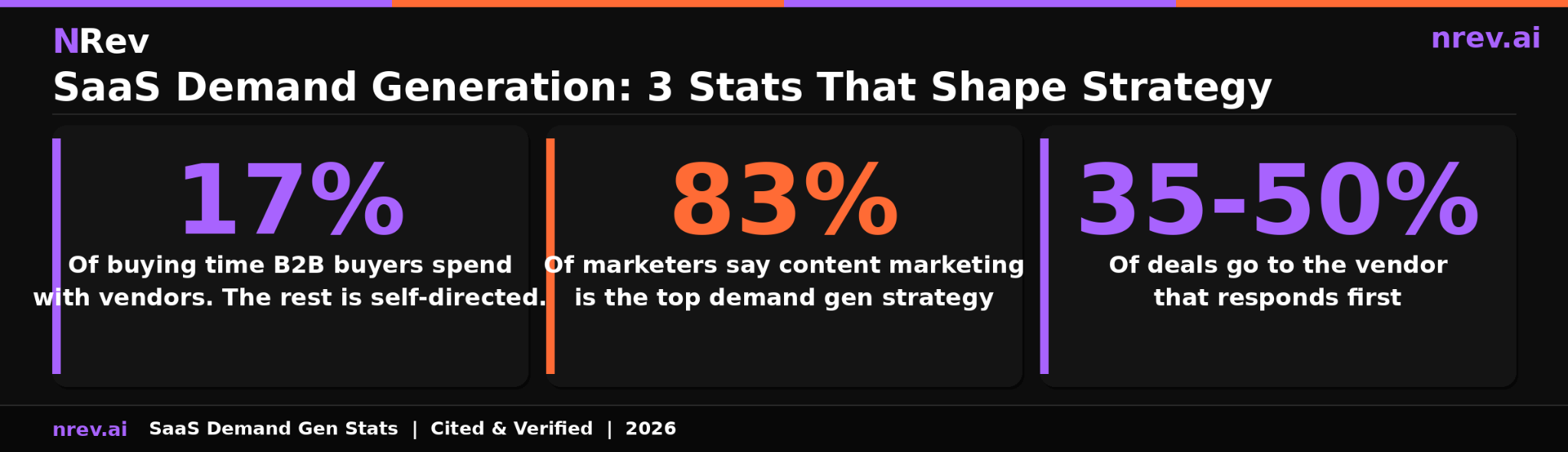
The problem is a fundamental misunderstanding of where SaaS deals are actually won. According to Gartner's research on the B2B buying journey, B2B buyers spend only 17 percent of their total buying time in direct meetings with potential vendors. The other 83 percent happens independently: through content consumption, peer recommendations, review site research, and anonymous website visits. Root source: Gartner primary research on B2B buying behavior.
SaaS demand generation is the strategy that wins business during that 83 percent. It builds awareness and preference before a prospect ever contacts your sales team, so that when they do reach out, they already know who you are and why you are the right choice. This guide covers what SaaS demand gen actually is, how it differs from lead generation, and the specific channels and workflows that turn website visitors into pipeline.

What Is SaaS Demand Generation
SaaS demand generation is the end-to-end strategy of creating awareness, building credibility, and generating interest in your product across your entire target market, including the large majority of potential buyers who are not yet in an active buying cycle.
Demand generation is not a single tactic. It is a system. It combines content marketing, SEO, paid media, thought leadership, community participation, and outbound outreach into a coordinated program that keeps your SaaS brand visible throughout the long, self-directed research phase that precedes most B2B purchases.
The defining characteristic of SaaS demand gen is the timeline. It operates on months, not days. Its goal is to ensure that when a prospect in your target market finally enters an active buying cycle, your brand is already familiar, trusted, and on their shortlist before your sales team ever speaks to them. The companies that win SaaS categories are rarely the ones that contact prospects first. They are the ones that built the strongest preference during the anonymous research phase.
Demand generation is both a marketing function and a revenue function. Its success is measured not in traffic, clicks, or marketing qualified leads, but in pipeline contribution, sales cycle velocity, and the quality of conversations your sales team has when a prospect finally does reach out.
SaaS Demand Generation vs Lead Generation: The Critical Distinction
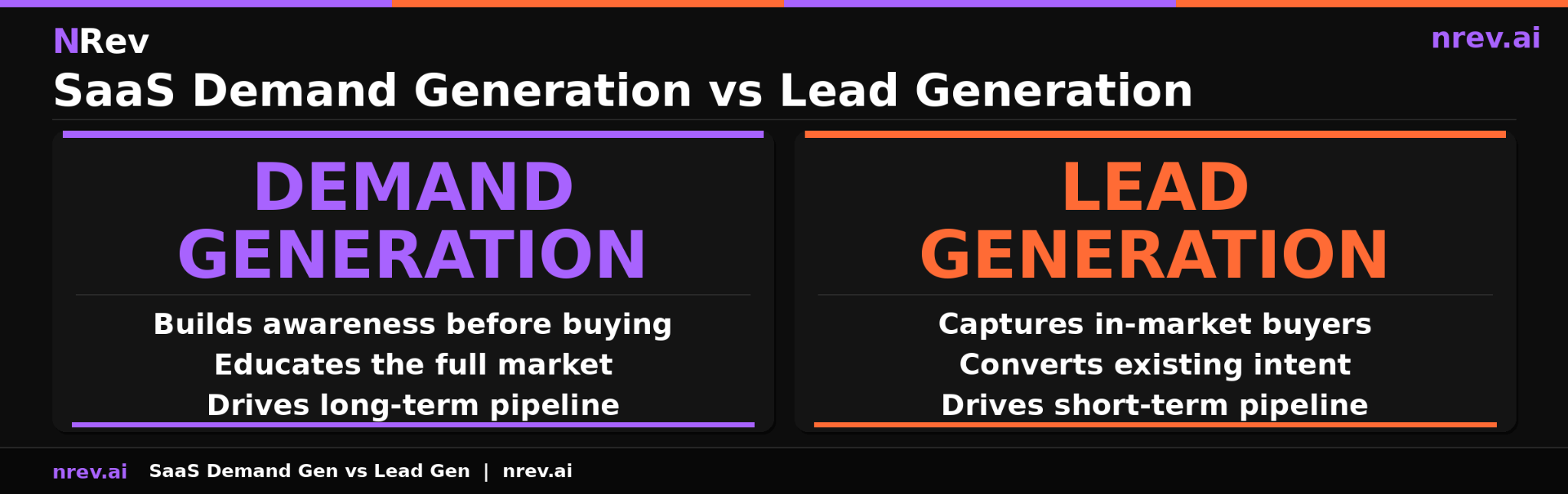
SaaS demand generation and lead generation are not the same thing. Treating them as synonyms is the root cause of most inconsistent SaaS pipelines.
Lead generation focuses on capturing existing demand. It targets prospects who are already in a buying cycle, already looking for a solution in your category, and ready to engage with a vendor. Lead generation tactics include paid search ads targeting high-intent keywords, demo request forms, gated content that captures contact information, and inbound SDR follow-up on engaged prospects. Lead generation produces short-term pipeline by converting buyers who are already in-market.
Demand generation creates demand that does not yet exist. It targets prospects who have not yet entered a buying cycle, reaches them before they begin actively searching for solutions, and builds awareness and preference that influences their eventual vendor choice. Demand generation tactics include ungated educational content, SEO-driven thought leadership, LinkedIn content from founders and practitioners, community participation, and free tools or calculators. Demand generation builds the pool of future buyers that lead generation will eventually convert.
The relationship between the two is sequential. Demand generation expands your total addressable pipeline over time. Lead generation converts the portion of that pipeline that is ready to buy right now. A SaaS company that runs only lead generation will have a consistent near-term pipeline but will hit a ceiling as it exhausts the readily available market. A company that runs only demand generation will build strong brand awareness but will not convert enough of it into immediate revenue. The companies that compound growth run both.
Why the Website Is the Center of Every B2B SaaS Demand Gen Strategy
Every channel in a SaaS demand gen program eventually flows back to the website. A prospect who sees a LinkedIn post clicks through to read the full article. A paid search ad drives a click to a landing page. An outbound email prompts a prospect to visit the pricing page before responding. The website is where demand is either captured or lost.
Most SaaS websites are not optimized for demand generation. They are built around what the company wants to say rather than what the buyer needs to understand at each stage of their research. This mismatch between the content available and the questions buyers are asking during the anonymous research phase is where most SaaS demand gen programs leak the most pipeline.
According to Gartner's research, 80 percent of all B2B sales interactions between suppliers and buyers will occur through digital channels. Root source: Gartner primary research published in their newsroom. Your website is the primary digital channel your buyers interact with. If it is not optimized to build awareness, establish credibility, and capture intent at every stage of the buyer journey, your demand gen investment in other channels is producing traffic that converts poorly.
The specific pages that matter most in a SaaS demand gen website are not your homepage. They are your pricing page, your comparison pages that position you against competitors, your category-level content that educates prospects who are still choosing between solution types, and your case study pages that demonstrate what results customers actually achieve. These pages convert demand into pipeline when they are built correctly and serve anonymous visitor intent signals to your sales team when they are connected to visitor identification systems.
The Two Engines of SaaS Demand Generation: Creation and Capture
Effective B2B SaaS demand generation runs two distinct engines in parallel. Most teams invest almost entirely in one and neglect the other, which produces either a brand-heavy program with low pipeline conversion or a short-term conversion program with no compounding growth.
Engine 1: Demand Creation
Demand creation targets buyers who are not yet looking for your solution. It builds awareness of a problem they have not yet prioritized and positions your SaaS product as the solution to that problem. Demand creation content is typically ungated, widely distributed, and designed to reach your target market wherever they spend time: search engines, LinkedIn, industry communities, podcasts, and newsletters.
The compounding economics of demand creation are its greatest advantage. A piece of content that ranks on page one of Google for a high-intent keyword continues generating awareness and inbound traffic for months or years without additional investment. Brand awareness built through consistent LinkedIn content compounds as your audience grows. Community presence built through genuine contribution compounds as you become a recognized expert rather than an anonymous vendor.
Engine 2: Demand Capture
Demand capture targets buyers who are already in a buying cycle and converts their existing intent into a sales pipeline. Demand capture tactics include paid search targeting bottom-of-funnel keywords, competitor comparison pages, pricing pages optimized for conversion, visitor identification to surface anonymous high-intent visitors, and outbound outreach triggered by buying signals.
The relationship between the two engines is important. Demand capture is more efficient when demand creation has already established brand familiarity. A prospect who has seen your content, read your case studies, and encountered your brand across multiple channels over several months converts at significantly higher rates when your outbound team reaches out or when they encounter your paid ad. This is why the best-performing SaaS demand gen programs run both engines simultaneously and measure their combined impact on pipeline quality and sales cycle velocity.
Demand Creation: Channels That Build Awareness Before the Buying Cycle
Content Marketing and SEO
Content marketing is the foundation of every effective SaaS demand gen program. According to research cited by GTM 80/20's demand generation statistics compilation, which cites the original source as a 2024 survey across B2B marketers, 83 percent of marketers view content marketing as the most effective demand generation strategy.
The content that performs best in SaaS demand gen is not top-of-funnel awareness content. It is the specific, detailed content that answers the questions buyers are asking during active evaluation: "best [category] software for [specific use case]," "[competitor] alternatives," "how to choose a [category] platform," and "[category] pricing." This content reaches buyers who are already warming up and positions your brand favorably before your sales team ever initiates contact.
SEO and content work as compounding assets. A well-researched article that ranks for a relevant buying-intent keyword continues generating organic traffic and demand month after month. The cost per lead from organic content decreases over time as the asset continues to perform. This stands in direct contrast to paid acquisition, where costs increase over time as competition drives up CPMs and CPCs.
LinkedIn Thought Leadership
LinkedIn is the single highest-ROI social channel for B2B SaaS demand generation. The mechanism is different from traditional content marketing: rather than ranking for a keyword searched by buyers in the market, LinkedIn content reaches your target ICP through their professional network while they are in a passive research mode, months before they enter an active buying cycle.
Effective LinkedIn demand gen content for SaaS is not product promotion. It is practitioner-led content: specific frameworks, counterintuitive observations about your category, data-driven insights your audience would not find elsewhere, and direct engagement with the specific problems your buyers face. Founders and senior operators who build genuine audiences on LinkedIn consistently generate a meaningful portion of their company's pipeline from inbound interest driven by that audience.
Community and Peer Channels
B2B SaaS buyers increasingly rely on peer communities, Slack groups, industry forums, and dark social channels to validate vendor choices before they ever contact a sales team. Participation in these communities as a genuine contributor rather than a vendor pitching products builds the kind of credibility that influences buying decisions during the anonymous research phase. This cannot be tracked in standard attribution models, but its impact on pipeline quality is significant.
Demand Capture: Converting Intent Into Pipeline
Demand capture is the set of tactics that convert existing buying intent into qualified sales pipeline. It targets buyers who are actively evaluating solutions and ensures your SaaS product is the one they choose.
Most of what demand capture reads as intent arrives as marketing engagement signals, which is what tells you a warm account is ready for a rep rather than another email.
Competitor Comparison Content and Pages
One of the highest-converting demand capture tactics in SaaS is owning the comparison search space. When a prospect searches for "[your competitor] alternatives" or "[your competitor] vs [your category]," they are signaling active vendor evaluation. They have a budget, a need, and a timeline. If your website ranks for those searches and provides a genuinely useful comparison, you enter the buyer's consideration set at exactly the moment when decisions are being made.
Competitor comparison pages work best when they are honest, specific, and structured around the criteria buyers actually use to evaluate options: pricing model, specific features that differentiate your product, implementation timeline, integration ecosystem, and the type of customer you serve best.
High-Intent Paid Search
Paid search targeting bottom-of-funnel keywords captures demand that has already been created, whether by your own content marketing or by the category's general growth. Targeting keywords with commercial intent, including "[category] software," "[category] pricing," and direct competitor brand terms, reaches buyers who are actively in-market.
The key discipline in SaaS demand gen paid search is maintaining a tight connection between the search query, the ad copy, and the landing page. A prospect searching for a specific comparison should land on a page that directly addresses that comparison, not a generic homepage.
Retargeting to Warm Website Audiences
Prospects who have visited your website but not converted are your warmest retargeting audience. They have already cleared the awareness hurdle, demonstrated specific interest by visiting your site, and are likely still in research mode. Retargeting these visitors with relevant, specific content or offers, rather than generic brand ads, produces significantly higher conversion rates than cold acquisition campaigns.
Turning Anonymous Website Visitors Into Demand Gen Pipeline
The single largest gap in most SaaS demand gen programs is the treatment of anonymous website traffic. Most SaaS companies invest significantly in driving traffic through content, SEO, and paid media, and then have no system for what happens when visitors arrive, research, and leave without submitting a form.
Up to 98 percent of B2B website visitors leave without filling out a form. They visit your pricing page, read your case studies, and compare you to competitors. Then they leave without identifying themselves. For most SaaS demand gen programs, this anonymous traffic represents the largest untapped pipeline opportunity available.
Website visitor identification technology reveals which companies are behind your anonymous traffic and which pages they viewed during each session. When a target account visits your pricing page and spends significant time reviewing your case studies, that behavioral pattern is a buying signal worth acting on immediately.
This is where SaaS demand generation and website visitor tracking connect. Visitor identification converts the demand your content marketing and SEO created into specific, actionable account intelligence. Instead of watching traffic volume in a dashboard, your sales team receives alerts when ICP-matched accounts visit high-intent pages, with enough context to send a relevant first-touch message the same day.
The response to a high-intent website visit must be fast. According to SPOTIO's 2026 sales statistics, which cites Peak Sales Recruiting research as the root source, 35 to 50 percent of all deals go to the vendor that responds first to a buying signal. A pricing page visit from a target account that goes unanswered for 48 hours has already cooled significantly.
For SaaS teams running signal-based outbound alongside inbound demand gen, the website is the richest signal source available. Connecting visitor intelligence to your outbound sales automation workflow ensures that every high-intent signal generates an immediate, personalized response rather than a dashboard entry no one acts on until Monday's pipeline review.
Building on b2b buying signals from multiple sources, including website visits, funding announcements, executive hires, and job postings, produces the stacked signal approach that converts at the highest rates. A company visiting your pricing page while simultaneously announcing a Series B funding round is showing compounding intent. The response to that account belongs at the top of every rep's daily priority list.
How nRev AI Connects Demand Generation to Signal-Based Outreach
nRev AI is the connective layer between the demand your content marketing creates and the pipeline your sales team closes. When a target account engages with your demand gen content, whether through direct website visits, organic search traffic, or referral channels, nRev identifies the account, cross-references the engagement against every other available signal from that company, and builds a personalized first-touch sequence that references the most relevant combination of signals.
The result is a SaaS demand gen program where no identified intent signal goes unanswered. A company that reads your competitor comparison page and visited your pricing page twice this week receives a same-day outreach from the right rep with a message that references the category they were evaluating, not a generic "I saw you visited our site" opener. The demand you worked to create becomes pipeline before the intent window closes.
nRev monitors your target account list continuously across buying signals, website intent, and external events. You describe the workflow you want. nRev builds it, runs it, and routes the conversations to your team.
Turn Your SaaS Demand Gen Investment Into Pipeline That Closes
Most SaaS demand gen programs create traffic and awareness but fail to connect that investment to pipeline. Visitors arrive, research, and leave. Signals fire and go unnoticed. Deals go to the vendor that responded first.
nRev AI connects your demand gen content to your outbound motion automatically. When an ICP-matched account shows high-intent behavior on your website, nRev identifies them, builds the personalized outreach, and routes it to the right rep the same day. You describe the workflow. nRev runs it.
Build your first demand gen to pipeline workflow on nRev AI and start converting the awareness you have already created into meetings and revenue.
Frequently Asked Questions
What is demand generation for SaaS?

What is the difference between demand generation and lead generation in SaaS?
How long does SaaS demand generation take to produce results?