


How to Track Competitors in Real Time Before They Steal Your Deals
Your competitors are not sitting still. They are changing their pricing, updating their messaging, launching new features, and running paid campaigns targeting your exact prospects right now. The question is not whether they are making moves. The question is whether you find out in time to respond, or weeks after the damage is already done.
To track competitors effectively means building a system that surfaces the signals that matter, routes them to the people who need them, and connects the intelligence directly to the deals that are currently at risk. This guide covers what to monitor, which tools handle it at every budget tier, and how to turn competitor intelligence into a concrete action your team takes before the next deal review.
Why Most Teams Are Always a Step Behind Their Competitors
Most B2B sales teams find out about a competitor move in one of two ways: a prospect mentions it during a discovery call, or a rep loses a deal and the closed-lost reason is "went with competitor X." Both are too late. The competitor already positioned, the prospect already compared, and your team responded from a defensive crouch rather than a prepared position.
According to Crayon's State of Competitive Intelligence report, 68 percent of B2B sales deals involve at least one direct competitor, yet the average sales team rates its competitive preparedness at just 3.8 out of 10. Root source: Crayon State of Competitive Intelligence, primary research. That gap between how often competitors appear and how ready reps are to handle them costs organizations an estimated two to ten million dollars per year in deals they could have won.
The root cause is not a lack of information. It is a lack of a system. Most teams have access to the same competitive data their best reps manually piece together before high-stakes calls. The difference between teams that win competitive deals consistently and teams that do not is whether that intelligence is automated, current, and available to every rep at the moment they need it, not just the ones who know where to look.
The Five Competitor Signals Worth Monitoring in Real Time
Not all competitor activity is worth tracking. The goal of competitive tracking is not to collect everything but to surface the signals that are most likely to affect your deals. There are five categories that consistently matter for B2B GTM teams.
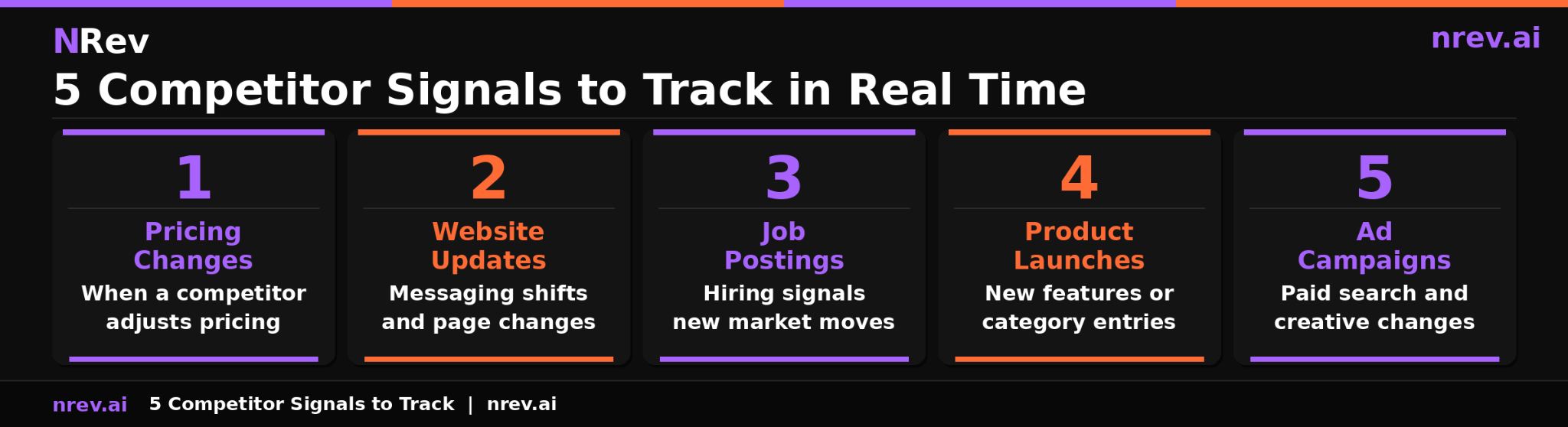
Signal 1: Pricing Changes
A competitor dropping their price on a tier that overlaps with your most common deal size is one of the highest-urgency signals in competitive tracking. It affects every deal currently in your pipeline where that competitor is involved. Your reps need to know within hours, not weeks.
Pricing pages are not always updated transparently. Tracking them directly through a page monitoring tool that alerts you to specific changes gives your team a reliable early-warning system for competitive pricing moves, even when the change is not announced publicly.
Signal 2: Website Messaging Updates
When a competitor updates their homepage headline, repositions their primary value proposition, or adds a new comparison page targeting a keyword your customers use, it signals a deliberate messaging shift. They have either learned something from their recent deals, identified a gap in their positioning, or decided to attack a specific segment more directly.
Tracking competitor website changes through a tool like Visualping means your product marketing team sees the shift when it happens rather than months later when prospects start echoing the new messaging during your own discovery calls.
Signal 3: Job Postings
Hiring patterns are one of the most underused competitor signals in B2B. A competitor posting five new enterprise sales roles in the financial services vertical tells you they are making a market investment six to nine months from now. A competitor hiring three ML engineers tells you a product capability gap is closing. A competitor posting for a Head of Partner Ecosystem tells you they are about to change their go-to-market motion entirely.
Job postings are public, freely available, and updated continuously. Tracking a competitor's open roles by department and seniority level on a weekly basis gives your product, marketing, and sales teams forward-looking intelligence that no other signal type provides as consistently.
Signal 4: Product Launches and Feature Updates
Feature launches, product announcements, and changelog updates tell you exactly where a competitor is investing development resources and which capability gaps they are closing. When a competitor announces a feature your prospects have been asking you about, your team needs to know the same day so they can prepare a response before the next demo where it comes up.
Product pages, changelogs, and release notes are the primary sources. Supplementing them with monitoring of competitor job postings in engineering roles gives you advance notice of what is coming before it is officially announced.
Signal 5: Paid Advertising and Competitive Advertising Tracking
Competitive advertising tracking reveals which keywords a competitor is bidding on, which ad creative they are testing, and which landing pages they are driving traffic to. When a competitor starts bidding on your brand name, your company name, or the specific pain points your best prospects search for, it is an explicit attack on your pipeline.
Tools like Semrush's advertising intelligence module, Similarweb's paid search tracker, and SpyFu surface competitor ad activity including bid history, keyword targeting, and estimated spend. This gives your demand generation team the data to respond with counter-positioning before the campaign reaches significant scale.
How to Build a Competitive Tracking System From Scratch
A competitive tracking system has three components: signal collection, signal routing, and action protocols. Most teams that fail at competitive intelligence have invested in the first and ignored the second and third completely.
Step 1: Define your competitive universe.
List every direct competitor your reps encounter in active deals. Add the indirect competitors that show up in your closed-lost data. Then add the emerging competitors your most informed prospects are evaluating. This list should have no more than ten names for most B2B companies. Trying to track more than ten competitors at once produces noise that the team stops reading.
Step 2: Assign a signal owner for each competitor.
Someone on your team needs to own the competitive profile for each monitored competitor. This does not have to be a full-time role. A product marketer owning three competitor profiles with a weekly 30-minute review cadence produces more actionable intelligence than a centralized CI function that publishes quarterly reports nobody reads in time.
Step 3: Set up automated monitoring before doing anything manual.
Configure your tools to watch competitor websites, job listings, social profiles, and advertising activity before spending any time on manual research. Automation handles the continuous layer. Manual research fills in the strategic depth that automation misses.
Step 4: Build an alert routing system.
Alerts that go to a shared inbox nobody checks produce zero value. Route pricing change alerts to your sales leadership directly. Route product launch alerts to your sales engineering and product marketing teams. Route job posting alerts to your strategy and product leadership. Route ad campaign alerts to your demand generation team. The alert has to reach the person who can act on it within the same business day.
Step 5: Create a pre-call competitive brief template.
Every rep entering a deal where a known competitor is involved should be able to pull a current competitive brief in under two minutes. This brief should cover the competitor's current positioning, their most recent pricing, the key objections your prospects typically raise about them, and your team's prepared responses. Keep it to one page. If it is longer, it will not be read before a call.
Competitor Monitoring Tools by Budget Tier
The right competitor monitoring tool depends on your team size, the number of competitors you need to track, and how much of your competitive intelligence workflow you want to automate.
At the zero-budget tier, a LinkedIn competitor engagement finder gives you the account-level view that most paid tools do not.
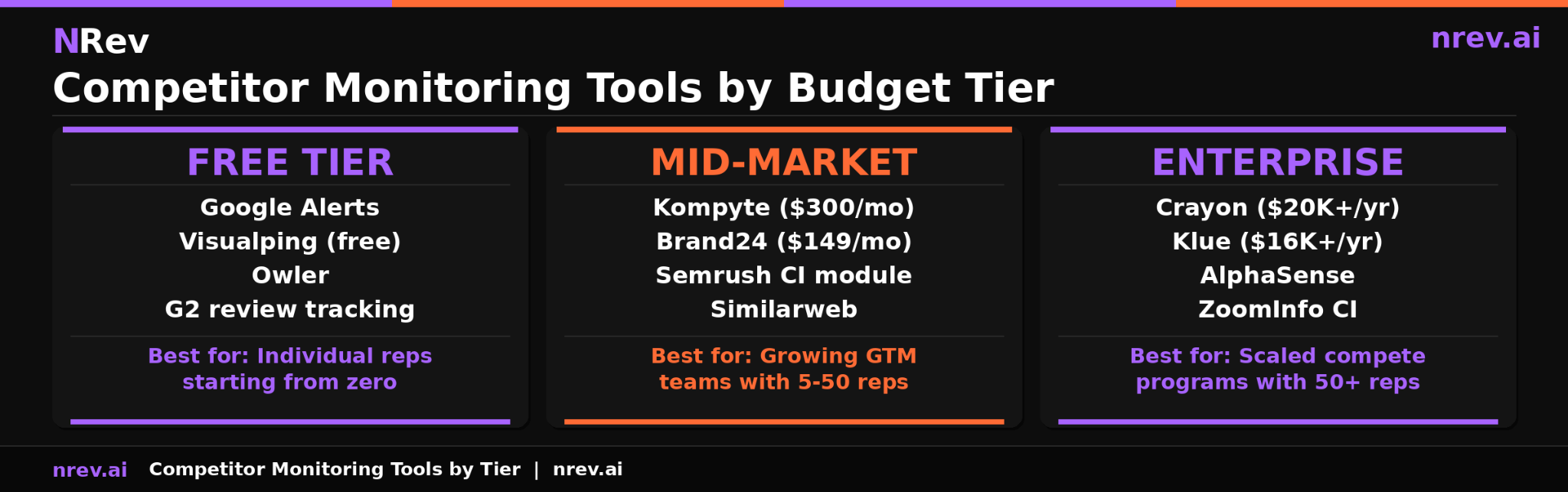
Free Tier: Build the habit before buying the tool
Google Alerts is the most accessible starting point for competitor monitoring. Set alerts for each competitor's brand name, their key product names, and their CEO's name to capture press coverage, funding announcements, and major news in real time. It misses social activity, product page changes, and ad activity, but it is free and takes fifteen minutes to set up.
Visualping's free tier monitors specific web pages for changes and emails you when a change is detected. Use it on competitor pricing pages, product pages, and comparison pages. When a change is detected, you receive an email with a highlighted visual diff of what changed. The free plan covers a limited number of pages but handles the highest-priority monitoring for most small teams.
Owler provides competitive intelligence on company news, funding rounds, and executive moves for free. It is particularly strong for tracking competitor funding announcements, which are among the most actionable signals for competitive positioning.
G2 review tracking is a free and underused signal. When a competitor receives a cluster of reviews mentioning a specific weakness or complaint, that is a direct window into the objections your prospects will raise. Set up a monthly review of your top three to five competitors' G2 pages and note recurring themes.
Mid-Market Tier: Add automation and coverage
Kompyte, acquired by Semrush, is the strongest mid-market competitor monitoring tool for B2B teams. Starting around $300 per month, it automates tracking of competitor websites, ads, and content across hundreds of sources and feeds the insights into battlecard workflows. The Semrush integration makes it particularly strong for competitive advertising tracking alongside standard competitor website monitoring.
Brand24 at $149 per month provides media monitoring across 25 million sources including social media, news, forums, review sites, and podcasts. It is the strongest tool in its price range for tracking competitor mentions in public conversations and catching sentiment shifts before they become mainstream.
Similarweb's paid tier adds traffic intelligence showing how competitor website traffic is trending, which channels are driving their growth, and which content is performing best. When a competitor's organic traffic suddenly spikes, it means their SEO strategy produced a breakthrough that your team should study and respond to.
Enterprise Tier: Scale the program
Crayon and Klue are the two dominant enterprise competitor monitoring platforms, both priced around $16,000 to $40,000 per year. Both provide automated monitoring across thousands of sources, battlecard creation and distribution, CRM integration, and win-loss analytics. The core difference is emphasis: Crayon focuses on the breadth of external signal collection, while Klue focuses on the quality of battlecard delivery and the integration of conversational intelligence from Gong and Chorus.
Both platforms are only worth the investment when the team has a dedicated owner who can curate, distribute, and act on the intelligence. According to the Crayon research cited earlier, 52 percent of competitive intelligence programs lack an executive sponsor. Programs without sponsorship and accountability return to manual research behavior within months regardless of the tool.
Competitive Advertising Tracking: What Your Rivals Are Running Right Now
Competitive advertising tracking is one of the fastest-returning investments in the competitor monitoring stack. It tells you directly which of your prospects your competitors are targeting with paid spend, what message they are leading with, and how aggressively they are pushing into your market right now.
The three primary tools for competitive advertising tracking in B2B are Semrush's Advertising Research module, which shows every Google Ads keyword a competitor is bidding on along with the ad copy they are testing; SpyFu, which provides historical paid keyword data and estimated ad spend; and Similarweb's paid channel intelligence, which combines paid traffic data with landing page analysis.
What to look for first is whether a competitor is bidding on your brand name or your company name directly. Brand bidding is an explicit competitive attack that your demand generation team needs to respond to within days, not weeks. The second thing to check is whether they are bidding on the exact pain point keywords your prospects use when searching for a solution. If your best-converting keyword is now being bid on aggressively by a competitor, your cost per click is rising and your share of voice in paid search is declining simultaneously.
Competitive advertising tracking is worth running as a monthly audit at minimum, with a trigger-based check any time a significant campaign shift is detected through your website monitoring tools.
How to Turn Competitor Intelligence Into Sales Action
Collecting competitor intelligence without connecting it to action is the most common failure mode in competitive tracking programs. The signal goes into a shared folder, the folder gets ignored, and the rep walks into a competitive deal as unprepared as they were before the program existed.
The fix is defining specific action protocols for each signal type before you launch the monitoring system. When a competitor drops their price, the action is: send a one-paragraph pricing context update to all reps with an active deal where that competitor is involved, include two approved responses to the most likely prospect objection, and schedule a brief team sync if the change is significant enough to affect the quarter.
When a competitor launches a new feature, the action is: update the relevant battlecard section within 48 hours, notify the reps who are most likely to encounter that competitor in their current deals, and schedule a product marketing review to determine whether a positioning response is needed.
The pre-call competitive brief workflow is the most direct connection between intelligence and outcome. When a rep knows a specific competitor is involved in a deal, they should pull the current brief, review it for five minutes before the call, and enter the conversation knowing: what the competitor's current price is, what their strongest positioning claims are, where their product has documented weaknesses, and what the most effective counter-positioning is. This is not a new idea. The teams that do it consistently win more competitive deals. The teams that do not do it at all are the ones paying the $2 to $10 million annual competitive preparedness tax.
Monitoring the Competition at the Account Level
Most competitor monitoring programs focus on the competitor rather than the account. This is backwards for B2B sales teams. The intelligence that matters most is not what a competitor is doing in the market generally. It is what they are doing at the specific accounts your reps are currently working.
Account-level competitive monitoring means knowing which competitor products a target account is currently using, whether they have an existing relationship with a competitor, and whether any signals at that account suggest dissatisfaction with their current vendor. When a target account starts posting negative reviews about a competitor they use, when they post a job requiring integration with a competing platform they want to replace, or when their CTO posts about a failed implementation, those are real-time signals that an account may be open to evaluating alternatives.
This is where competitive tracking connects directly to b2b buying signals. Intent signals, job postings, and website behavior at the account level reveal competitive dynamics that no battlecard can show you. A target account actively researching your category while they have an existing competitor contract is a displacement opportunity. Identifying it requires monitoring the account, not just the competitor.
This account-level view is also what makes website visitor identification a competitive intelligence asset: when a company using a competitor's product visits your pricing page, they are telling you directly that they are evaluating alternatives. That is the highest-intent competitive displacement signal available, and it fires without any manual research or monitoring setup.
How nRev AI Connects Competitor Intelligence to Outbound Timing
The most effective competitive outreach is not a generic "we heard you use Competitor X, here is why we are better" sequence. It is a specific message sent to the right contact at the right account at the exact moment a signal suggests they are open to evaluating alternatives.
nRev AI monitors your target accounts for the signals that indicate competitive displacement timing: a competitor review cluster mentioning implementation failures, a job posting calling for a replacement for the competitor's specific technology, a leadership change that historically correlates with vendor re-evaluation, or a website visit from a company using a competing product.
When those signals fire, nRev builds the outreach that references the specific context: the recent review, the leadership hire, the integration job posting. The message does not say "we are better than Competitor X." It says "we noticed X at your company and wanted to share how other teams in your situation have solved it." That framing converts because it is specific and timely.
The teams that connect competitive tracking to outbound timing through nRev consistently produce higher reply rates on competitive displacement campaigns than those running generic competitive sequences. The difference is signal specificity. Generic competitive outreach says "switch from them to us." Signal-timed competitive outreach says "now is the right moment for you specifically, and here is why."
Connecting outbound sales automation to a real-time competitive monitoring layer is the system that closes the gap between knowing a competitor move happened and responding to it at the account level before your competitor has time to consolidate their position.
Stop Finding Out About Competitor Moves During Lost Deal Reviews
Every competitive deal your team enters unprepared is a deal that was already harder to win before the first call. Competitor monitoring turns that into a structural advantage: your reps know what the competitor is charging, saying, and building before the prospect mentions it.
nRev AI monitors your target accounts for the signals that tell you when a competitive displacement opportunity is forming. It builds the outreach, routes it to the right rep, and delivers it at the moment the account is most likely to respond. You describe the competitive workflow. nRev runs it.
Build your first signal-triggered competitive outbound workflow on nRev AI and start winning the deals your competitors think they already have.
Frequently Asked Questions
What does it mean to track a competitor?

What are the best free tools to track competitors?
How often should you monitor the competition?