

Website Visitor Identification: How to Identify Anonymous B2B Visitors and Convert Them Into Pipeline
Your best prospects are already on your website. They are reading your pricing page, comparing your product to competitors, reviewing your case studies, and building an internal business case. Then they leave without leaving a name, an email, or any trace that would let your team follow up.
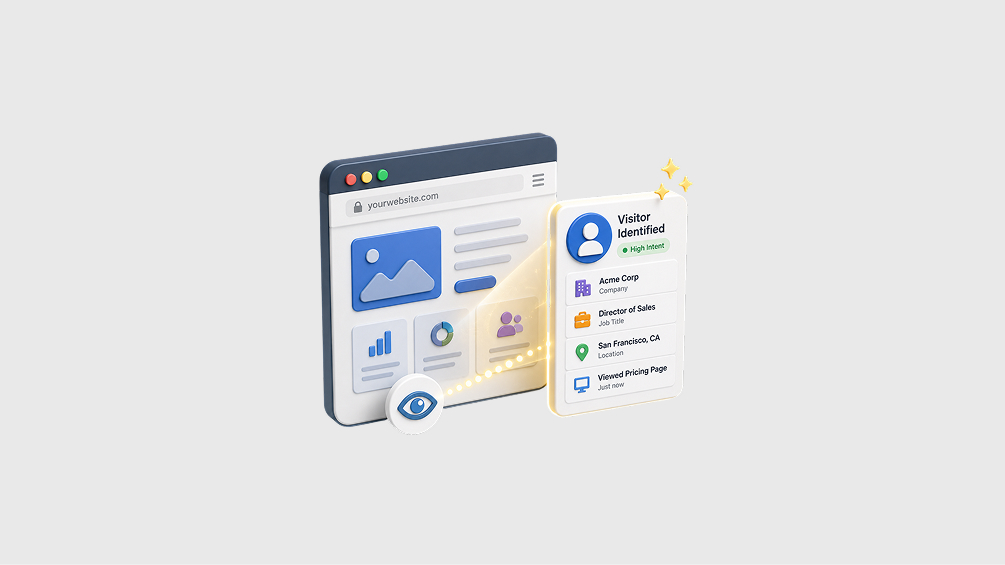
Website visitor identification is the technology that solves this problem. It reveals which companies and, in many cases, which specific individuals are behind your anonymous traffic, so your sales team can reach out while intent is high rather than waiting for a form fill that may never come.
This guide covers everything your team needs to know: what website visitor identification is, how to identify anonymous website visitors using both company-level and person-level methods, which visitor identification software produces real results, and how to connect identified visitors to pipeline-generating outreach before the intent window closes.
What Is Website Visitor Identification
Website visitor identification is the process of revealing the companies and individuals behind anonymous website traffic, without requiring those visitors to fill out a form or take any identifying action. It converts unknown sessions in your analytics into actionable account intelligence your sales and marketing teams can act on immediately.
Standard web analytics platforms, including Google Analytics, show you aggregate data: how many sessions your site received, which pages were viewed, and where traffic came from. They cannot tell you which company sent those sessions, which decision makers were browsing your pricing page, or which of your target accounts has been researching your product for the past three weeks.
Website visitor identification fills this intelligence gap. It uses IP address matching, cookie-based tracking, and identity resolution technology to connect anonymous sessions to real companies and, in some cases, real people. The result is a live feed of accounts showing purchase intent on your own website, surfaced before those accounts ever raise their hand through a form.
This matters enormously for B2B teams because of how modern buying actually works. According to 6sense's 2024 Buyer Experience Report, a primary study surveying over 2,500 B2B buyers, 81 percent of buyers have already selected a preferred vendor before they make first contact with any salesperson. By the time a prospect fills out your demo form, the decision is effectively made. Website visitor identification lets you engage prospects during the anonymous research phase, which is where buying preferences are actually formed.
Why Anonymous Visitor Identification Matters for B2B Revenue
The business case for anonymous visitor identification comes down to a simple gap: you are investing significantly to drive traffic to your website, but nearly all of that traffic leaves without identifying itself.
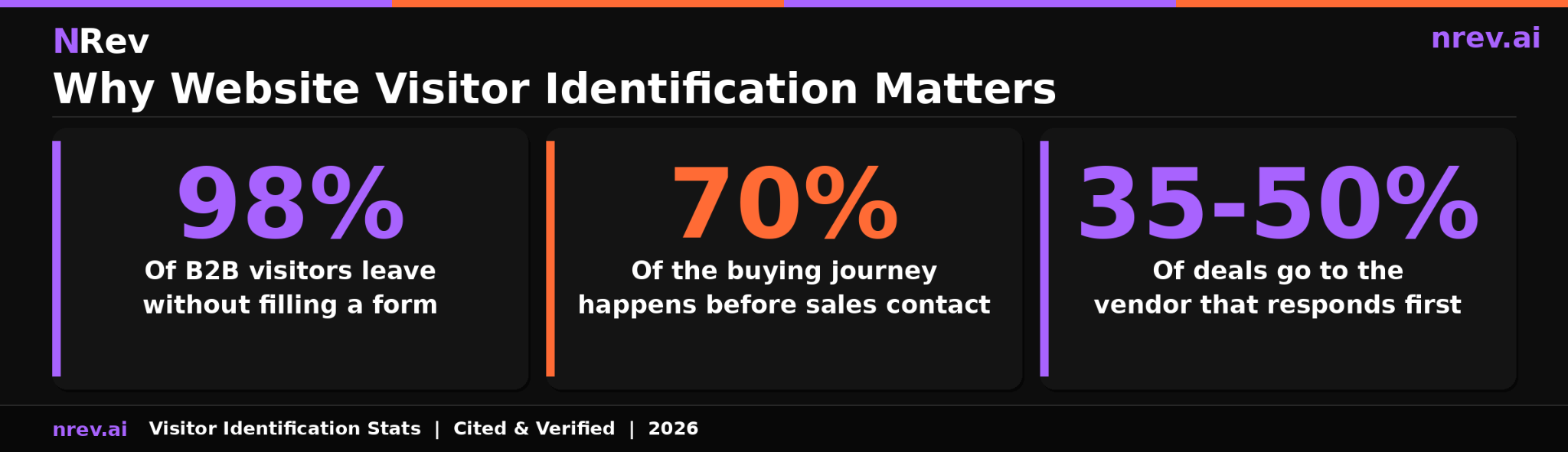
According to consistent data from across the visitor identification industry, up to 98 percent of B2B website visitors leave without filling out a form. They research, browse, compare, and leave. Your investment in paid ads, SEO, content marketing, and events generates sessions that immediately become anonymous.
The average B2B website converts only 2 to 3 percent of its traffic into known leads through form fills, according to MetricHQ's visitor-to-lead conversion rate research, which aggregates conversion benchmarks across industry sources. Every visitor who arrives and leaves without filling out a form represents a potential pipeline that your team has no visibility into.
Visitor identification changes the math on your website's contribution to the pipeline. If your site receives 10,000 monthly visitors and 2 percent convert through forms, you have 200 known leads. If visitor identification reveals the companies behind 15 to 20 percent of the remaining traffic, you suddenly have 1,500 to 2,000 additional accounts to qualify and prioritize, sourced from the same traffic budget.
The timing advantage is equally significant. According to 6sense's research on when B2B buyers reach out to sellers, based on a survey of over 900 B2B buyers, buyers consistently refrain from contacting sellers until they are approximately 70 percent through their purchase journey. That means your prospects are doing 70 percent of their evaluation invisibly. Website visitor identification gives your team access to that invisible research phase.
Two Methods to Identify Website Visitors
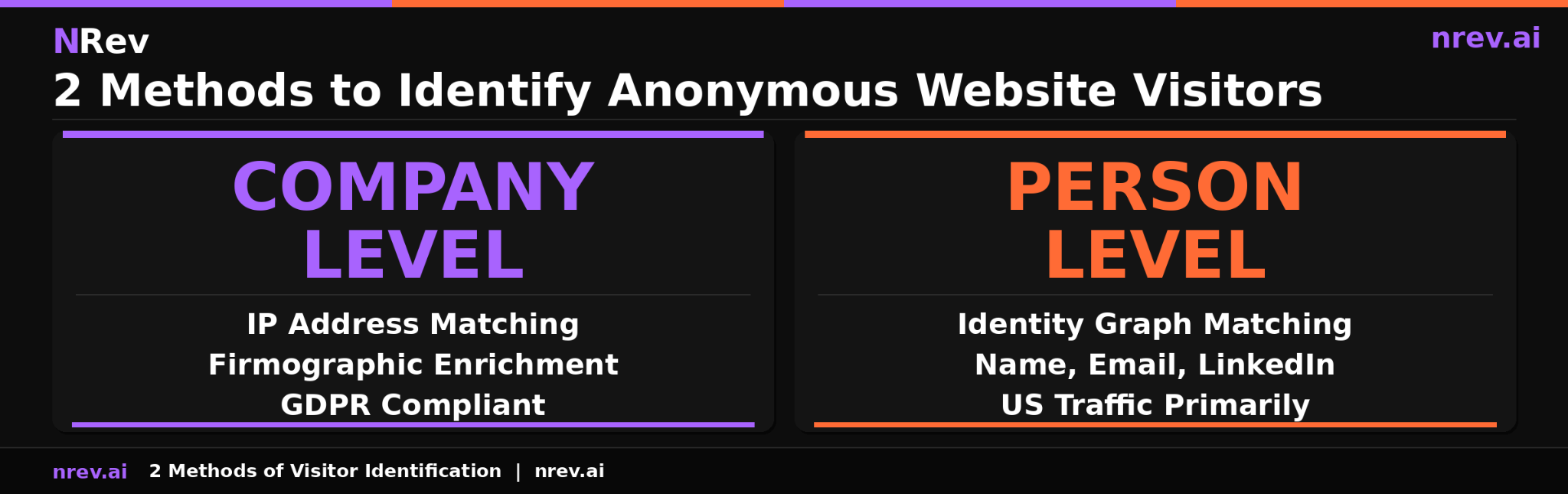
Website visitor identification operates at two distinct levels. Understanding the difference is essential before evaluating any tool, because the method determines what you get, how accurate it is, and what privacy requirements apply.
Method 1: Company-Level Identification
Company-level identification matches a visitor's IP address against a database of corporate network ranges to reveal which organization is behind the session. When an employee browses your site from a corporate network, their IP address maps to their employer. The identification tool surfaces the company name, industry, employee count, revenue range, location, and technology stack.
Company-level identification is the most widely used and most privacy-compliant approach. It falls outside GDPR personal data restrictions because it identifies organizations, not individuals. Most major visitor identification tools primarily operate at the company level.
The limitation is that it does not tell you which specific person at the company was visiting. Your team knows that Acme Corp spent 12 minutes on your pricing page, but not which person at Acme Corp was doing the research. You then need to use additional enrichment to determine who the right contact within that company would be and reach out accordingly.
Method 2: Person-Level Identification
Person-level identification goes further by attempting to identify the specific individual behind each visit. It cross-references browser signals, including IP address, cookie data, and device fingerprints, against identity graphs and data enrichment databases to surface names, work email addresses, job titles, and LinkedIn profiles.
Person-level identification provides directly actionable contact data. Your team does not need an additional enrichment step: you receive the visitor's name, email, and enough context to reach out immediately.
The trade-offs are significant. Person-level identification is primarily limited to US-based traffic due to GDPR and other privacy regulations in Europe and elsewhere. Match rates are lower than company-level tools. The technology relies on probabilistic matching, which introduces more uncertainty than IP-to-company resolution. And the privacy implications require more careful handling to ensure compliance with CCPA and other US state privacy laws.
For most B2B teams, the recommended starting point is company-level identification combined with manual or automated enrichment to find the right contact. Person-level tools are most valuable for teams with predominantly US traffic and a high-velocity sales motion where direct contact information creates an immediate advantage.
How to Identify B2B Website Visitors: Step-by-Step
Building a functional anonymous visitor identification system requires four sequential steps. Most teams that fail at visitor identification skip one or more of these steps and end up with a dashboard full of company names that never translates into pipeline.
Step 1: Install the tracking script and configure your data foundation.
Every visitor identification tool works by adding a lightweight JavaScript pixel to your website. This pixel collects session data including IP address, pages visited, time spent on each page, and return visits. Installation typically takes less than 30 minutes.
Before the pixel goes live, configure suppression rules to filter out your own team's visits, your agency partners' visits, existing customer visits, and known competitor IP ranges. Failing to exclude internal traffic creates noise in your identification feed and wastes rep time chasing signals from people who already know you.
Step 2: Define which pages trigger immediate sales action.
Not all pages carry equal weight. Visitor identification is most valuable when it alerts your team specifically about high-intent page visits, not every session on your site.
Configure your alerts around three tiers. Tier 1 pages, which require same-day response, include your pricing page, demo request page, and competitor comparison pages. Tier 2 pages, which warrant follow-up within two to three business days, include case study pages, integration documentation, and product feature detail pages. Tier 3 pages, which go into standard nurture, include blog posts, general company information, and career pages.
When a company visits multiple Tier 1 pages in a single session, treat that as the highest-priority signal regardless of company size. A 30-person company that visits your pricing page, reads a case study, and downloads a comparison guide in one session is showing stronger buying intent than a Fortune 500 company that reads one blog post.
Step 3: Enrich identified accounts with contact data and company context.
Company-level identification gives you the organization name. The next step is finding the right person to contact within that organization. Use your enrichment layer to identify decision makers in relevant roles based on your ICP definition.
Simultaneously, cross-reference the identified account against your CRM to determine whether the company is already in your pipeline, has been a customer, or is a net-new prospect. The appropriate response differs significantly across these three scenarios. An account already in the active pipeline needs a note to the responsible rep. A churned customer revisiting your site may be re-evaluating. A net-new ICP-matched account represents a fresh outbound opportunity.
Step 4: Route alerts to the right rep with full context.
An identified visitor alert that arrives without context creates more work than it saves. The alert your sales rep receives should include the company name and firmographic data, the specific pages visited in the session, the date and time of the visit, any previous visit history from that account, and a suggested contact based on enrichment.
When this workflow functions properly, a rep receives a morning alert telling them that a target account visited their pricing page three times last week, that the account matches their ICP, that the right contact is a VP of Sales who joined the company eight months ago, and that no previous outreach has been sent. The rep can act within minutes rather than spending 45 minutes researching before taking any action.
What High-Intent Visitor Behavior Looks Like
Not all visitor activity signals the same level of purchase intent. Being able to distinguish between casual browsing and active evaluation determines how your team prioritizes its response.
Pricing, integration and security pages are the classic website intent signals, and they are worth scoring well above a blog read.
Highest-intent behaviors requiring same-day response:
Multiple pricing page visits from the same account within a short window. This is the clearest first-party buying signal available. Someone at that company is building a budget case. Multiple people from the same company viewing pricing in the same week means a buying committee is forming.
Demo request page visits without form completion. The visitor navigated to the page but did not submit. Something stopped them, perhaps a question, a comparison they wanted to check, or a moment of hesitation. A well-timed follow-up referencing the topic of the page converts a significant portion of these near-misses.
Competitor comparison page views. A visitor reading a comparison between your product and a named competitor is actively building an evaluation framework. They are not deciding whether to buy. They are deciding whom to buy from.
Medium-intent behaviors requiring follow-up within 48 to 72 hours:
Case study views, particularly from companies in the visitor's industry or at their growth stage. This is decision-stage content consumption. Someone is using your case studies to build an internal business case.
Multiple return visits from the same account within 14 days. One visit is awareness. Multiple visits across different page types within two weeks suggests a structured evaluation is underway. The pages visited across sessions reveal which aspects of your product are being scrutinized.
Integration documentation and technical specification pages. A technical buyer has entered the conversation. The company is assessing whether your product fits their existing stack.
Monitoring-only behaviors not yet warranting direct outreach:
General blog posts and educational content. Top-of-funnel research that indicates category interest but not vendor evaluation.
About us or general company pages. Brand awareness browsing with no specific product intent.
Career pages. Likely a job seeker, not a buyer.
Best Visitor Identification Software for B2B in 2026
The visitor identification software market offers options for every team size, budget, and technical sophistication. Here is an honest assessment of the major categories without vendor spin.
For teams already using HubSpot:
Clearbit Reveal, now rebranded as HubSpot Breeze Intelligence following HubSpot's acquisition, is the most seamless option for teams already in the HubSpot ecosystem. It provides real-time company identification, enriches visiting accounts with over 100 firmographic attributes, and syncs directly into your existing HubSpot CRM records without any manual integration work. If your team lives in HubSpot, this is the path of least resistance.
For teams needing strong European coverage:
Leadfeeder, now part of the Dealfront platform, has built particular strength in European B2B markets. It connects to your Google Analytics account, uses reverse IP lookup to identify visiting companies, and provides GDPR-compliant company-level identification with strong CRM integrations for Salesforce, HubSpot, and Pipedrive. For teams selling into European markets, Dealfront's data coverage is a meaningful differentiator.
For enterprise teams with existing ZoomInfo contracts:
ZoomInfo WebSights connects visitor identification directly to ZoomInfo's database of over 320 million contacts and 100 million company profiles. When a target account visits your site, WebSights enriches the record with full firmographic data, surfaces appropriate contacts, and integrates the activity into your existing ZoomInfo GTM workflow. For teams already paying for ZoomInfo, WebSights is a natural addition.
For teams wanting person-level identification:
RB2B offers person-level identification for US-based traffic with a free entry tier that makes it accessible for early-stage teams. It surfaces LinkedIn profiles of identified visitors directly to Slack, allowing for immediate outreach. Limitations include US-only coverage for person-level data and lower match rates than company-level tools.
Warmly combines company and person-level identification with a multi-provider data waterfall approach that maximizes match rates. It includes real-time Slack alerts, automated routing, and built-in engagement workflows. Best for teams that want identification and workflow in a single platform.
Key evaluation criteria for any tool:
Match rate for your specific traffic geography and company size mix. CRM integration depth, specifically automatic data flow rather than manual CSV exports. Alert configurability, so you can filter and prioritize by ICP criteria and page tier. Privacy compliance documentation for both GDPR and CCPA.
How to Convert Identified Visitors Into Pipeline
Identifying which company visited your site is a starting point, not a result. Pipeline is created by what your team does with that information and how quickly they do it.
An identified visit is one of the strongest first-party buying signals you own, so it should reach a rep the same day.
Respond to Tier 1 signals the same day.
According to SPOTIO's 2026 sales statistics, which cites Peak Sales Recruiting research as the root source, 35 to 50 percent of all sales go to the vendor that responds first when a buying signal fires. For high-intent visitor signals, same-day response is the most controllable variable in your win rate.
The first message should reference the topic the prospect was researching, not the surveillance data itself. "Noticed your team has been exploring GTM automation options" works. "I saw you spent nine minutes on our pricing page Tuesday at 2:30 PM" crosses a line that makes prospects uncomfortable and reduces response rates.
Stack visitor identification with other buying signals.
A company visiting your pricing page is a useful signal. That same company visiting your pricing page while also having just posted a job for a Head of Revenue Operations and having recently closed a Series B funding round is a significantly stronger compound signal.
This is where visitor identification integrates with your b2b buying signals detection system. Stacked signals convert at dramatically higher rates than single-touch triggers because they provide your team with multiple angles to personalize the outreach and multiple confirmations that intent is genuine.
Build follow-up sequences for medium-intent visitors.
Not every identified visitor warrants immediate direct outreach. Companies that visited case study pages or technical documentation belong in a targeted follow-up sequence that continues to build familiarity without requiring a reply to trigger the next step.
These sequences work best when they reference the category of content the company was exploring, add new value in each touch, and monitor for escalation. A company that moves from a blog post visit to a pricing page visit mid-sequence has upgraded from medium-intent to high-intent and should be moved to immediate outreach.
Connect identified visitors to your broader outbound motion.
Visitor identification reveals who is warm. Your outbound sales automation system determines what happens next. When these two systems connect, a company identified on your pricing page does not simply receive an alert: it automatically enters a personalized sequence, the right rep is assigned based on territory, and the outreach includes context drawn from every available signal.
For teams building a comprehensive outbound lead generation engine, visitor identification is one of the warmest signal sources available. A prospect who sought out your website is already meaningfully warmer than a cold outbound contact.
How nRev AI Connects Visitor Identification to Outbound Sequences
Most visitor identification tools create alerts. nRev AI converts those alerts into sequences.
When nRev detects that a target account has visited a high-intent page, it does not simply send a Slack notification. It cross-references the visit with other available signals from that account: recent funding activity, executive hires, job postings that indicate a buying need, and competitor research behavior. It then builds a personalized first-touch sequence that references the most relevant combination of signals and queues it for same-day delivery.
The visitor identification signal becomes the trigger for a coordinated outbound motion rather than a one-off alert that competes for a rep's attention in a busy inbox. When multiple signals stack on the same account, nRev elevates the priority and increases the personalization depth accordingly.
For B2B teams that want to connect the visibility that visitor identification provides with the action that outreach requires, nRev builds the bridge. You see who is on your site. nRev ensures they hear from you before the intent window closes.
Start Identifying Your Anonymous Visitors and Converting Them Into Pipeline
The visitors who are researching you right now will make their vendor decision soon. Most of them will never fill out a form. They will choose based on the research they did anonymously and the vendor who reached out with a relevant message before anyone else.
nRev AI monitors your target accounts across every available signal, including website visitor intent, and builds personalized outreach the moment a high-intent signal fires. You describe the workflow you want. nRev builds it and runs it.
Build your first visitor-triggered outbound workflow on nRev AI and start reaching the buyers who are already researching you.
Frequently Asked Questions
What is website visitor identification?

How do you identify anonymous website visitors?
What is the best visitor identification software for B2B?