

Bhargav Chandrababu broke down a play on a recent webinar that explains why so much signal-based outbound is quietly failing. I want to walk you through it.
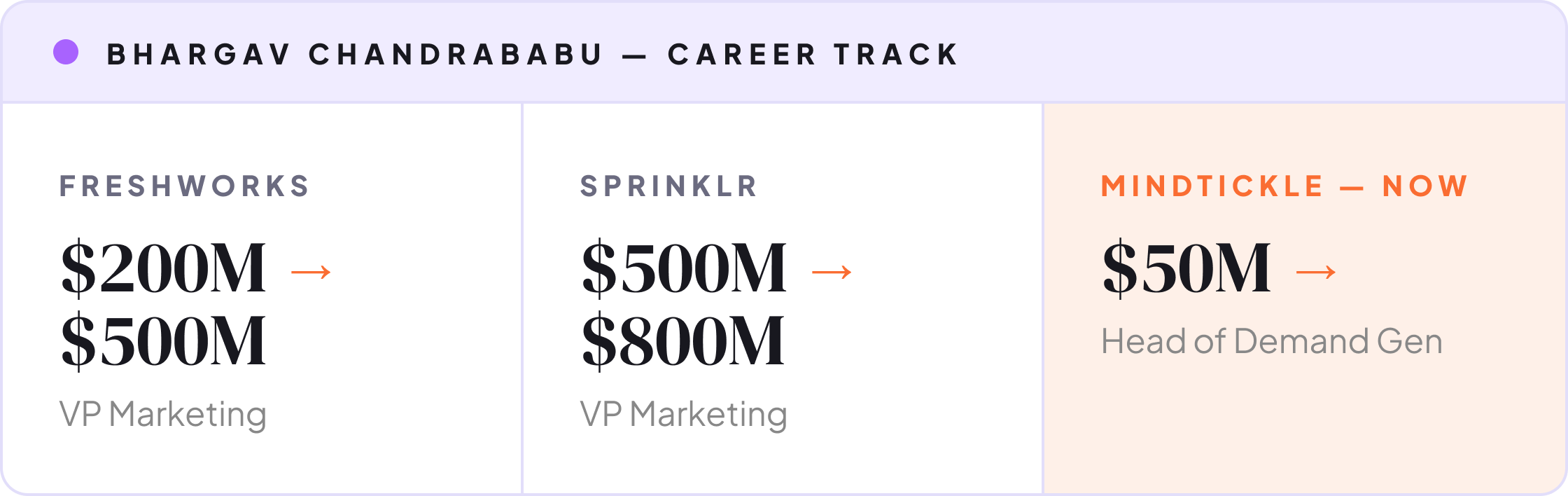
Quick context on Bhargav: he scaled marketing at Freshworks from $200M to $500M, Sprinklr from $500M to $800M, and now runs demand gen at Mindtickle starting at $50M.
When he says something is working, I pay attention.
The signal trap
Cold email reply rates dropped to 3.43% in 2026, according to Instantly's benchmark report. They were 5% in 2025 and 8.5% in 2019. The floor keeps falling.
Most teams respond by trying to fix the email. More personalization, tighter subject lines, A/B testing the opener.
That work is mostly wasted, because the email either hit the wrong inbox or the right inbox after twelve competitors already did.
Everyone with an Apollo or Clay subscription gets the same trigger the moment it fires, which means twelve BDRs land in the same inbox in the same week saying the same thing.
Funding rounds, job changes, tech stack installs, hiring spikes, none of it is private information anymore. The trigger has become the starting line everyone shares.
The buyer Mindtickle almost missed
One of Mindtickle's target accounts had a senior RevOps leader who suddenly became active on LinkedIn.
She wasn't posting, she was engaging, reacting to posts and replying in threads about sales enablement.
When Bhargav's team looked at who else was in those threads, they saw sales reps from three of Mindtickle's direct competitors.
Gong's AEs commenting on her posts. Highspot's reps in her replies. A third competitor in the same conversations.
She was in the middle of an active evaluation, and three competitors were already inside it.
Mindtickle had no idea. She had never opened a single email from them. She wasn't on any outbound list either, because no standard signal had triggered on her.
No job change. No funding event. No detectable tech stack install. Apollo, Clay, ZoomInfo, every data provider showed her as dormant.
Bhargav's team only found her because they were watching what her competitors' sales reps were doing on LinkedIn.

Three layers, one rule
His team built three independent signal layers and required any two of them to fire on the same account before a rep was allowed to touch it.
Layer one watches competitor sales rep activity on LinkedIn.
Which AEs and CSMs from Gong, Highspot, and other direct competitors are showing up in conversations with which specific contacts. Sales reps don't comment on RevOps leaders' posts for entertainment. When they do, a deal is usually warm.
Layer two pulls public web signals.
Earnings call transcripts, executive LinkedIn posts, press releases that mention sales enablement, AI coaching rollouts, new revenue enablement hires. Anything publicly disclosed becomes fair game to reference in outreach.
Layer three tracks champion movement.
Former Mindtickle users who changed jobs in the last 90 days and now sit inside accounts that don't use Mindtickle. Those people don't need convincing. They need a reintroduction.
The math is simple. One layer alone produces a list, and it's the same list every other vendor in the category bought that quarter. Two layers stacked points to something specific.
Competitor reps circling a contact plus a public initiative in the category usually means a deal already in motion. A champion movement plus a hiring spike usually means an account about to start an evaluation.
Once you know which two signals fired, the message writes itself.
The three outcomes that stuck out
Steal this
Bhargav demonstrated a master class in finding the signals that actually matter. Here's how you can do the same.
Step 1: Pull your last 20 closed-won deals and write down the situation each buyer was in when they bought.
Not the persona or the company size. What was happening in their world that made them ready to buy.
Step 2: For each situation, list the public artifacts that would prove it's happening to someone else.
A new VP shows up as a LinkedIn job change, a press release, a spike in posting activity. You're reverse-engineering the situation into its observable footprints.
Step 3: Group the artifacts by source. Pick three you can actually pull data from reliably.
Two signals from the same source are basically one signal, so the three sources have to be different. Two signals you can pull reliably beats five you can pull intermittently.
Step 4: Set the rule. Two signals from two different sources must fire on the same account within a 30-day window before a rep is allowed to touch it. That's the gate.
Wait for the second signal. Show up in the conversations your competitors think they're alone in.