


Account scoring ranks your target accounts by how likely they are to buy, so reps know which ones to work first. A score combines two things: fit (does this company match your ideal customer profile) and intent (are they showing signs they're in-market right now). Done well, it turns a flat list of 2,000 accounts into a short list worth calling this week. Done badly, it's a stale number nobody trusts.
Account scoring, in one line: ranking companies by fit plus intent signals so your team spends time on the accounts most likely to convert.
Account scoring vs lead scoring: what's the difference?
They sound alike and often run together, but they score different things.
| Account scoring | Lead scoring | |
|---|---|---|
| Scores | The company (account) | The individual person |
| Best for | ABM and complex B2B deals | High-volume inbound |
| Inputs | Firmographics + account-level intent | Person's behavior + demographics |
| Answers | Which accounts to target | Which people to route or follow up |
In a real motion you use both.Account scoring picks the companies. Lead scoring picks the right person inside them. If you sell into buying committees, account scoring is usually the one that matters most.
What goes into an account score?
A useful score blends two buckets.
The behavioral half of that score is mostly first-party signals, which is data you already own.
• Fit (do they look like a good customer):industry, employee count, revenue, region, tech stack, business model. This is stable and answers 'should we ever sell to them'.
• Intent (are they in-market now): hiring for roles you serve, recent funding, leadership changes, competitor mentions, website visits, and engagement with your content. This is time-sensitive and answers 'should we sell to them this week'.
Fit without intent gives you agood list with no urgency. Intent without fit gives you noise. The score has tow eight both, and the intent side has to stay fresh, because a hiring spike from three months ago tells you nothing today.
How to build an account scoring model
1. Define fit from your best customers. Review your last 20 to 30 closed-won accounts and pull the firmographic traits they share.That's your fit baseline.
2. Pick the intent signals you can actually detect.Choose signals tied to real buying behavior in your market (hiring, funding, tech changes, engagement), not vanity data.
3. Weight fit and intent. Decide how much each signal moves the score. A funding round might be worth more than a single website visit.
4. Set thresholds and actions. Define what an A, B, and C account looks like and what happens to each (rep outreach, nurture, orignore).
5. Refresh on a cadence. Re-score regularly so a hot account doesn't stay hot in your system after the signal is gone.
Where account scoring usually breaks
Most scoring models fail for the same reasons: they're built once and never refreshed, so the scores drift; they lean only on static firmographics, so everything scores the same; or the intent data is bought from a third party and aggregated to the point where it's stale by the time a rep sees it. The result is a score reps quietly stop trusting, which defeats the point.
AI account scoring with nRev
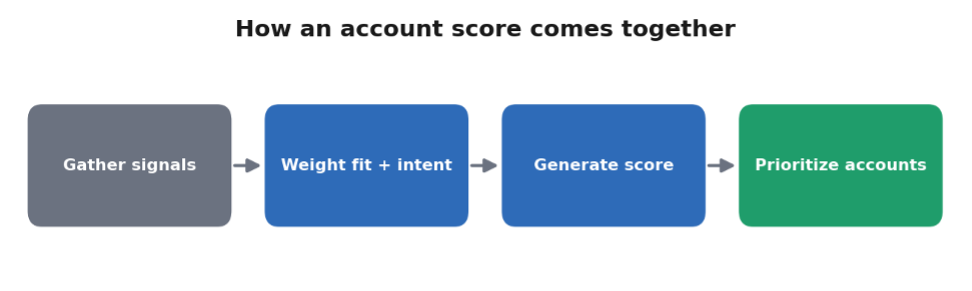
nRev's Company Scoring play builds an account score from live signals rather than a static spreadsheet. Foreach company it gathers signals like tech stack, recent job postings, LinkedInactivity, and company news, weights them into a single go-to-market intent score, and pushes the highest-intent accounts to the top. For the accounts worth pursuing, it also drafts a personalized opener with talking points, so the score comes with a next step attached. It runs at roughly 0.40 to 0.50dollars per account, and the logic is deterministic, so you can see why an account scored the way it did.
The point is a score that stays current and leads straight to action. If you want the person-level side, our B2B lead scoring guide covers that, B2B buying signals breaks down the intent inputs, and the signal-based outbound playbook shows the full detect-to-outreach motion. nRev's plays are shaped by more than 10,000 deployed GTM workflows.