

.jpg)
A sales engagement platform(SEP) is software that lets a sales team plan, run, and measure multi-step outreach across email, phone, and LinkedIn from one place. It handles the sequences (also called cadences), the templates, the reminders, and the reporting on what's getting replies. Outreach, Salesloft, and Apollo are the names most people know. Think of it as the rep's cockpit for running outbound at volume without losing track of anyone.
That's the clean definition. The messier truth is that plenty of teams buy a sales engagement platform before they need one, or expect it to fix problems it was never built to solve. This guide covers what an SEP actually does, how it differs from your CRM, the main options, when it earns its spot in your stack, and the one thing no SEP fixes on its own.
Sales engagement platform, in one line: a tool that automates and tracks multi-channel sales sequences (email, calls, LinkedIn, tasks) so reps can run more consistent outreach and see what works.
What does a sales engagement platform actually do?
Strip away the marketing and every SEP does roughly the same six things:
• Sequences and cadences. Build a multi-step play(day 1 email, day 3 call, day 4 LinkedIn) and run it on autopilot across a list of prospects.
• Multichannel outreach. Email, calls, andLinkedIn steps in one flow, so a rep isn't juggling five tabs.
• Templates and snippets. Reusable copy with merge fields, so reps aren't rewriting the same email 40 times.
• Dialer. Click-to-call, call logging, and sometimes local presence numbers.
• Analytics. Open, reply, and meeting rates by sequence, step, and rep, so you can cut what's dead.
• CRM sync. Two-way sync so activity and out comes land back in Salesforce or HubSpot.
In short, an SEP is the execution layer for outbound. It doesn't decide who to contact or why. It makes running the plan faster once you've made those calls yourself.
Sales engagement platform vs CRM vs sales automation
These three get mixed up constantly. They solve different jobs and most teams run all three.
| Tool | Core job | Owns |
|---|---|---|
| CRM (Salesforce, HubSpot) | System of record for accounts, contacts, and deals | Pipeline data and reporting |
| Sales engagement platform (Outreach, Salesloft) | Run and track multichannel outreach sequences | Rep activity and cadences |
| GTM / sales automation (nRev, Clay) | Detect signals, enrich, and build the outreach itself | Targeting, research, and personalization |
A simple way to hold it: the CRM stores the truth, the SEP runs the motion, and the automation layer decides whois worth the motion and what to say. An SEP with a weak list just helps you send mediocre emails faster.
Sales engagement platform examples
The category has a handful of serious players. A quick, honest read on each:
• Outreach. Enterprise-grade, deep sequence logic and analytics, priced for larger teams.
• Salesloft. Similar enterprise footprint, strong cadence and coaching features.
• Apollo. Bundles a contact database with sequencing, popular with smaller teams on a budget.
• Reply.io and Sales forge. Lighter, email-first sequencing for lean outbound teams.
• HubSpot Sales Hub. Sequences built into the CRM, fine if you already live in HubSpot.
Pricing moves around, so check current numbers, but the enterprise tools generally run per-seat per-month and add up fast across a team.
When do you actually need a sales engagement platform?
You probably need one when: you have three or more reps running outbound, you're sending enough volume that spreadsheets and manual follow-up break down, and you need shared reporting to see which sequences work. At that point the consistency and visibility pay for themselves.
You probably don't need one yet when: you're a founder or a one-to-two person team, your volume is low, and your problem is finding the right accounts, not sending faster. Buying an SEP to fix weak targeting is like buying a faster car to fix a wrong-way trip.You'll just get to the wrong place sooner.
The problem a sales engagement platform doesn't solve
Here is the gap. An SEP automates the send. It does not decide who to reach, when the moment is right, or why the message should land. Point it at a static list and it will happily send the same sequence to 500 people, most of whom had no reason to hear from you that week. Reply rates drop, and the platform reports it in a nice dashboard.
Timing and relevance are the levers that move outbound, and they live upstream of the SEP. That's where a signal-based approach comes in.
A signal-based approach to sales engagement
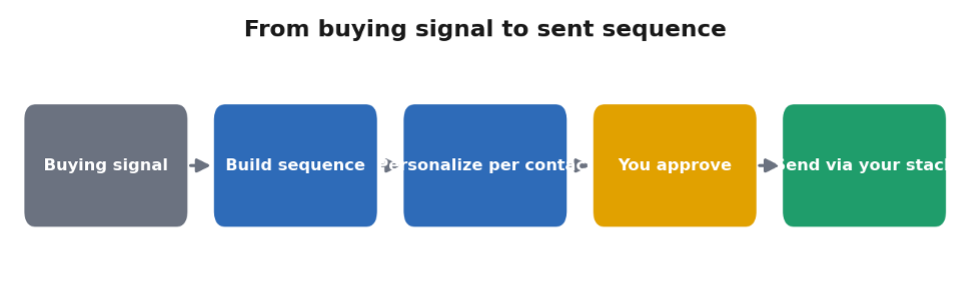
nRev isn't a sales engagement platform in the Outreach or Salesloft sense, and it doesn't pretend to be. It's the intelligence layer that sits in front of one. nRev watches for buying signals (a funding round, a relevant hire, a competitor mention, a prospect engaging on LinkedIn), scores the account against your ICP, researches the contact, and then builds a personalized email and LinkedIn sequence off that context. A human approves before anything goes out, and the sequence runs through your existing email sender and syncs to your CRM.
What changes is the thing that starts the sequence. Working from buying signals that should trigger a sequence beats enrolling everyone who downloaded something.
The practical difference is where the work starts. A traditional SEP starts with your list. nRev starts with a reason to reach out. Its plays are shaped by more than 10,000 deployed GTM workflows, and teams like PriceLabs have built full outbound agents on top of it while keeping their own sending infrastructure. If you want the wider view of tools in this space, our guide to the best outbound sales software maps the categories, and our outbound sales guide covers the strategy end. For teams that want the whole motion run for them, there's the AI SDR approach.
None of this replaces a good SEP if you have the volume to justify one. It just makes sure what flows into it is worth sending.
Frequently asked questions
What is a sales engagement platform?

What is the difference between a sales engagement platform and a CRM?
What is the best sales engagement platform?
Do I need a sales engagement platform?
How much does a sales engagement platform cost?