


Most go-to-market advice is written for the whiteboard, not the week ahead. It hands you a framework, a few quadrants, and a sense that you have done strategy. Then Monday arrives and nobody knows which accounts to call.
A go-to-market strategy is not a deck. It is the set of decisions that determine whether your product reaches the people who will actually pay for it, and how. Who you sell to, how you position it, where you reach them, and what the motion looks like in practice. Get those right and the rest is execution. Get them wrong and no amount of activity saves you.
This guide treats the topic the way an operator would. The components that matter, the frameworks worth knowing, real examples by motion, a build sequence you can run this quarter, and the honest reason most strategies stall before they ship.
What is a go-to-market strategy?
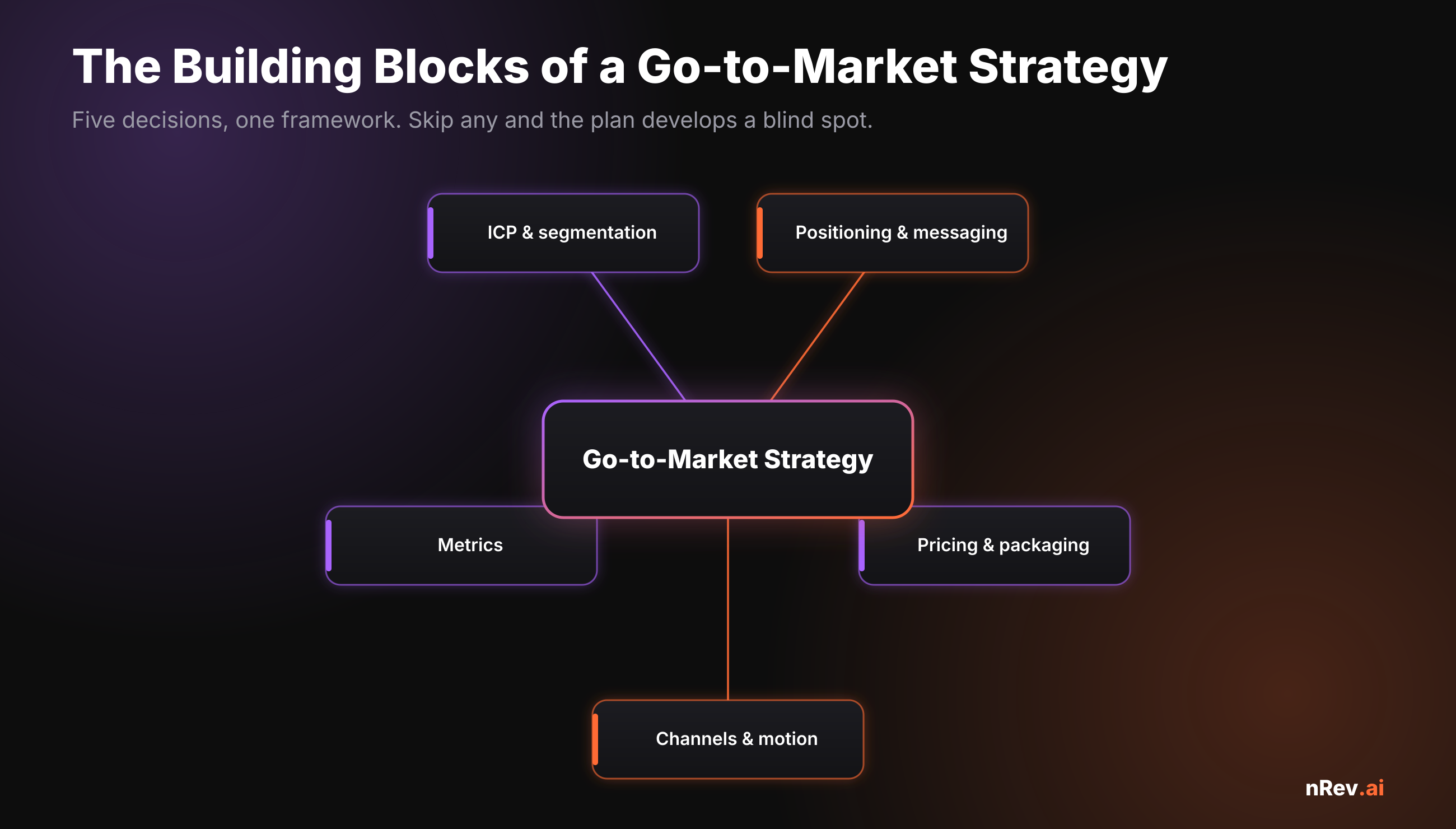
A go-to-market strategy is the plan a company uses to bring a product to its target customers and win in the market. It defines the buyer, the positioning, the pricing, the channels, and the sales motion, and it ties them together so they point in the same direction.
People confuse it with two neighbors, so it helps to draw the lines. A business plan covers the whole company and its economics. A marketing plan covers how you generate awareness and demand. A go-to-market strategy is narrower and sharper than both. It is specifically about how a given product reaches and converts a given buyer.
It is also not a one-time launch document. You build a go-to-market strategy every time you enter a new segment, ship a new product line, or change how you sell. The discipline is ongoing, not an event.
The core components of a go-to-market strategy
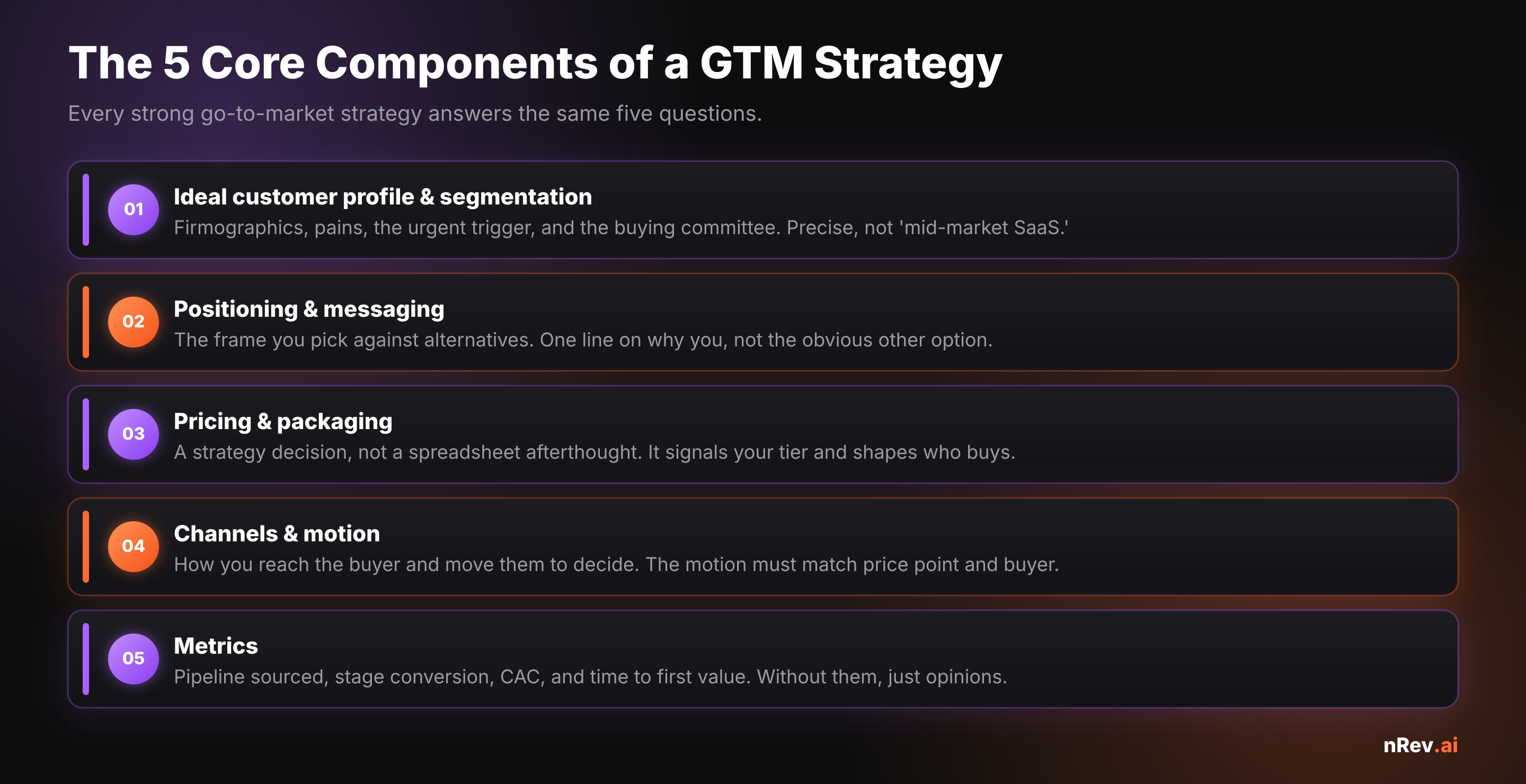
Strip away the jargon and every strong go-to-market strategy answers the same five questions. Skip one and the plan develops a blind spot you will pay for later.
Ideal customer profile and segmentation
Everything starts with a precise picture of who you serve. Not "mid-market SaaS," but the firmographics, the pain points, the trigger that makes the problem urgent, and the people on the buying committee. A loose ideal customer profile spreads effort across accounts that were never going to buy, which is the most common way a strategy quietly fails.
Positioning and messaging
Positioning is the frame you choose against the alternatives, and messaging is how you make that frame land. The test is simple. Can a prospect tell, in one line, why you and not the obvious other option. If the answer takes a paragraph, the positioning is not done yet.
Pricing and packaging
Pricing is a strategy decision, not a spreadsheet afterthought. It signals where you sit in the market, it shapes who buys, and it determines which sales motion the economics can support. A low price point cannot carry a high-touch sales team, and a high price point rarely sells itself.
Channels and motion
This is how you actually reach the buyer and move them to a decision. Outbound, inbound, product-led, partnerships, events, or some mix. The motion has to match the price point and the buyer. A self-serve buyer does not want a six-week sales cycle, and an enterprise committee will not swipe a credit card.
Metrics
Finally, the numbers that tell you whether any of this is working. Pipeline sourced, conversion at each stage, customer acquisition cost, and time to first value. Without metrics, a go-to-market strategy is a set of opinions that nobody can correct.
Go-to-market strategy frameworks
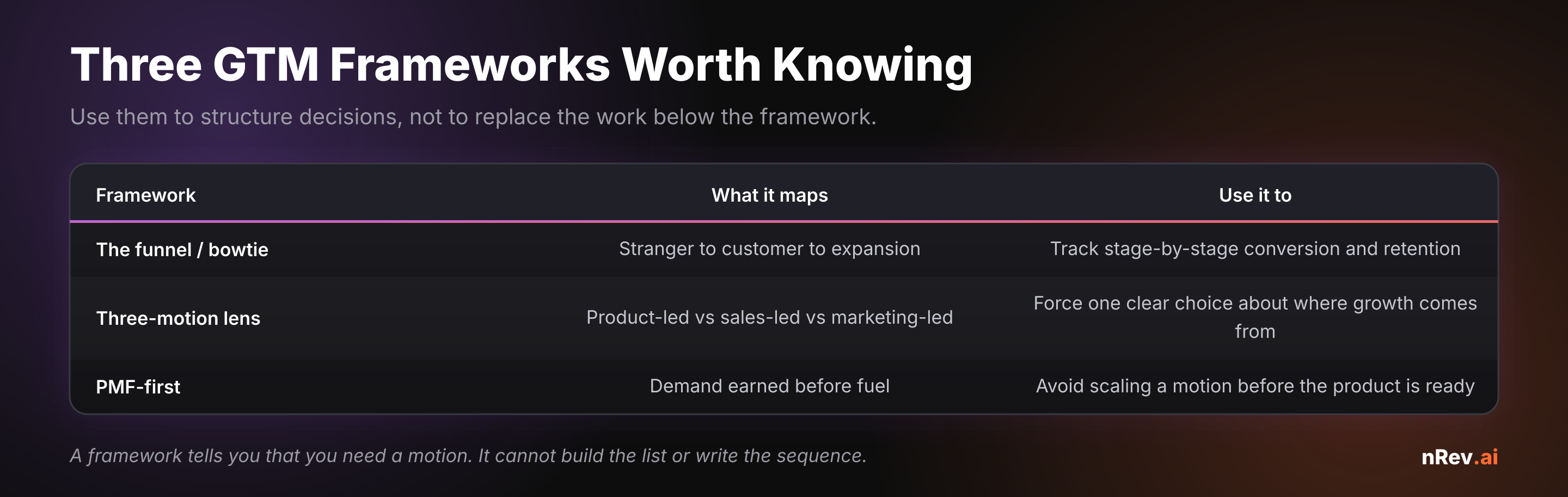
A few frameworks are worth knowing because they organize the thinking well. The funnel, and its updated cousin the bowtie, map how a stranger becomes a customer and then expands. The three-motion lens splits go-to-market into product-led, sales-led, and marketing-led, which forces a clear choice about where growth comes from. And the product-market-fit-first principle reminds you not to pour fuel on a motion before the product has earned demand.
Use them to structure your decisions. Just do not mistake the map for the territory. A framework can tell you that you need a sales motion. It cannot build the list, write the sequence, route the lead, or update the record. The work that produces pipeline lives below the framework, and that is exactly where most strategies run out of road.
Go-to-market strategy examples
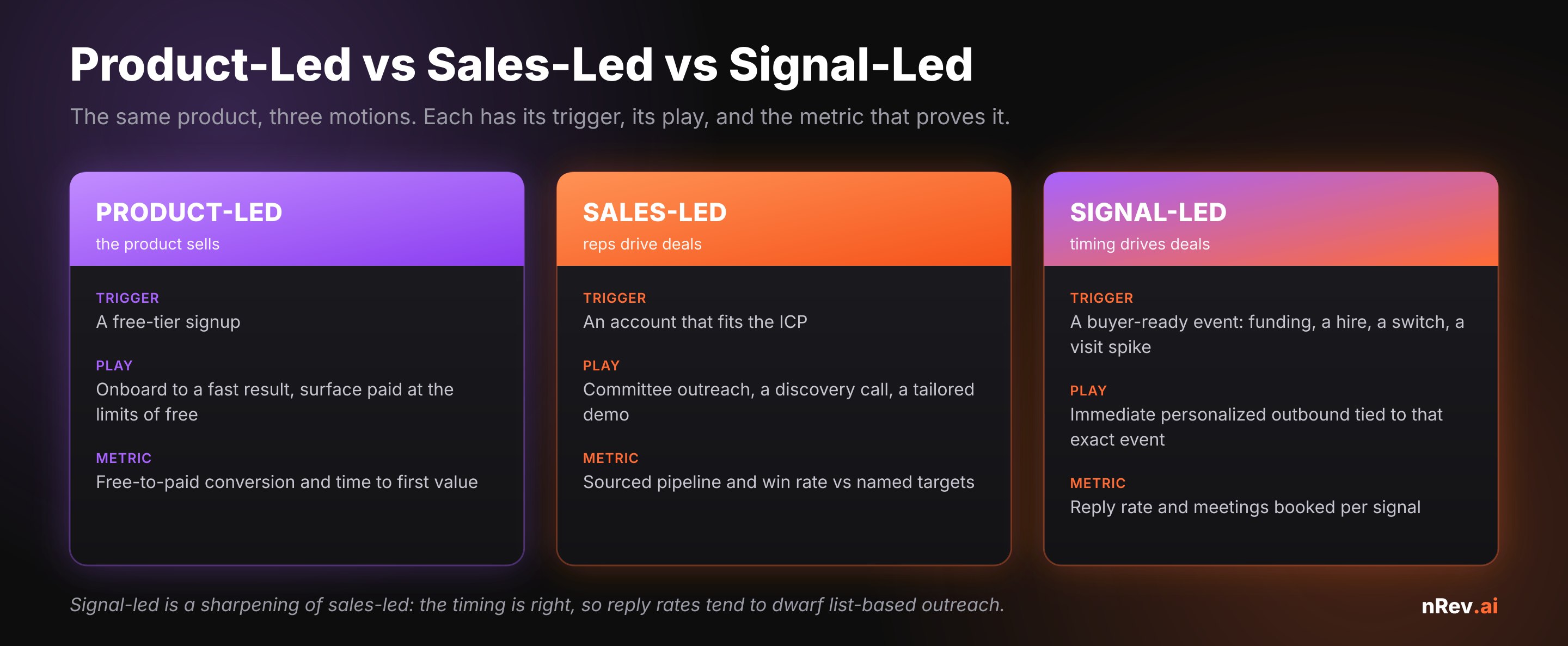
The clearest way to understand a go-to-market strategy is to see how the same product could go to market three different ways. Here are three motions, each with its trigger, its play, and the metric that proves it works.
Product-led example
A developer tool launches a free tier and lets the product do the selling. The trigger is a signup. The play is an onboarding sequence that gets the user to a working result fast, then surfaces paid features at the moment a team hits the limits of free. The metric that matters is conversion from active free user to paid, and the speed at which users reach first value.
Sales-led example
A platform selling to enterprise revenue teams runs a classic sales-led motion. The trigger is an account that fits the ideal customer profile. The play is coordinated outreach across the buying committee, a discovery call, and a tailored demo. The metric is sourced pipeline and win rate against named target accounts, not raw activity.
Signal-led example
The same platform sharpens the motion by leading with signals instead of static lists. The trigger is an event that says a buyer is ready now, a funding round, a relevant new hire, a competitor switch, or a spike in site visits. The play is immediate, personalized outbound tied to that exact event, often through a cold email follow-up sequence. The metric is reply rate and meetings booked per signal, which tends to dwarf list-based outreach because the timing is right.
How to build a go-to-market strategy, step by step
You can build a working go-to-market strategy in a focused sprint, not a quarter of planning. The sequence matters more than the polish.
Start by defining the ideal customer profile tightly enough that you could name twenty accounts that fit and twenty that do not. Vague targeting poisons every step after it, so spend real time here.
Next, nail the positioning. Write the one-line reason a prospect should pick you over the alternative they already know, then build the messaging out from that line. If you cannot get it to one line, the strategy is not ready to ship.
Then set pricing and packaging in a way the chosen motion can actually support, and pick the channels that match your buyer and price point. A self-serve product leans on product and content. A six-figure deal leans on sales and outbound.
From there, turn the motion into concrete plays. Not "do outbound," but the specific list, the trigger, the sequence, and the handoff. This is the step that separates a strategy that ships from one that sits in a doc.
Finally, instrument it. Decide the two or three metrics that tell you the motion is working, and commit to revisiting them on a fixed cadence so the strategy stays honest as the market moves.

Why most go-to-market strategies stall
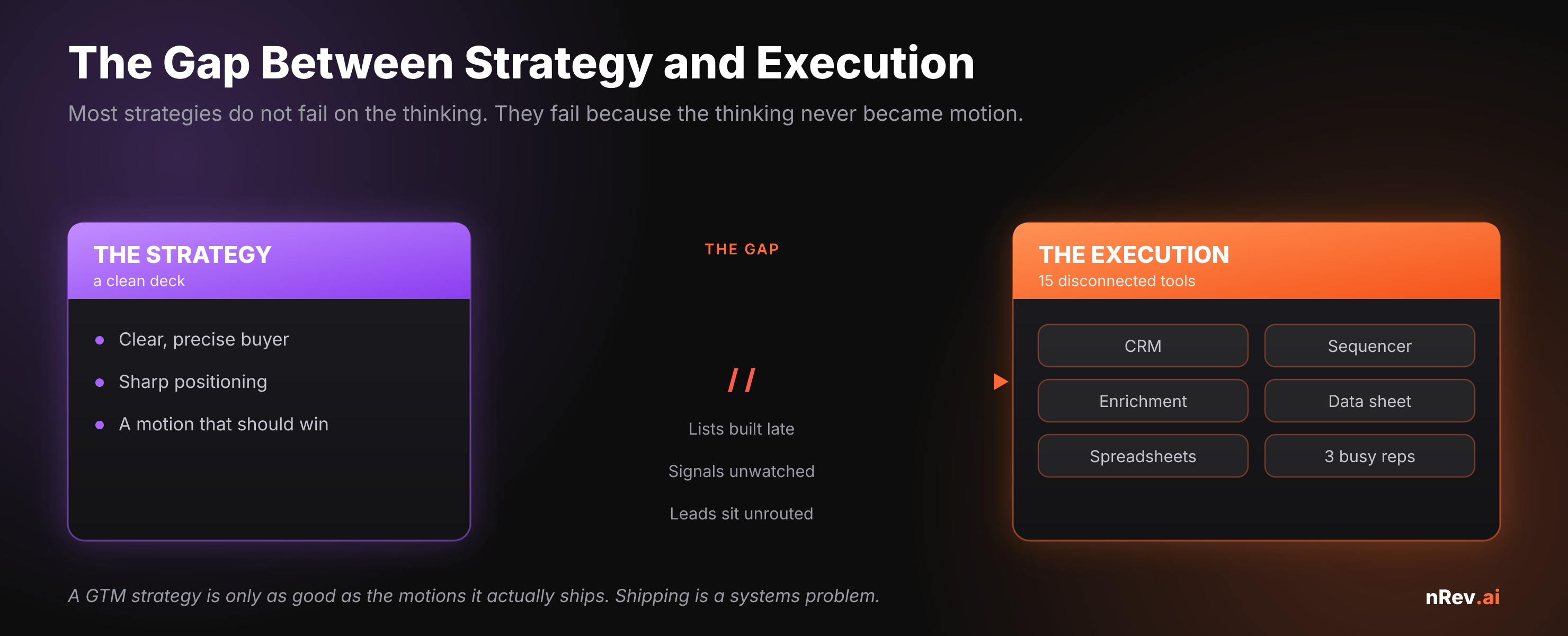
Here is the uncomfortable part. Most go-to-market strategies do not fail because the thinking was wrong. They fail because the thinking never became motion.
The strategy lives in a deck. The execution lives across fifteen disconnected tools, a CRM, a sequencer, an enrichment vendor, a data sheet, a few spreadsheets, and the heads of three people who are already underwater. Between the deck and the doing, the plan leaks. Lists get built late, signals go unwatched, leads sit unrouted, and the brilliant motion you designed runs at a fraction of its intended speed.
This is the gap nobody puts on the whiteboard. A go-to-market strategy is only as good as the motions it actually ships, and shipping is a systems problem, not a strategy problem. The teams that win are not the ones with the cleverest framework. They are the ones who closed the distance between deciding and doing.
Closing the gap between strategy and execution
If the bottleneck is execution, the answer is an execution layer. Something that takes a defined motion and runs it, watching for the signals, building the list, enriching the contacts, firing the outreach, and updating the system of record, without a human stitching the steps together by hand.
That is what nRev is built to do. As the agent OS for GTM teams, it turns the motion you designed into a running workflow, so the strategy on the page becomes pipeline in the funnel rather than a plan that decays. The plays are not theoretical either. They are shaped by 10,000+ deployed GTM workflows, which means the system reflects what has actually moved pipeline across real teams, not what looks tidy in a slide.
The shift is subtle but it changes everything. Strategy and execution stop being two separate exercises handed between two separate teams. The motion you decide on is the motion that runs. If you want to see a defined strategy become a live workflow, the signal-based outbound playbook and the Revops Solution are the places to start.
Frequently asked questions
What is a go-to-market strategy?

How is a go-to-market strategy different from a marketing strategy?
Who owns the go-to-market strategy?
What are the main types of go-to-market motion?
How often should you revisit your go-to-market strategy?
What does a good go-to-market strategy example look like?
What is the difference between a go-to-market strategy and a go-to-market plan?
How do you measure a go-to-market strategy?