

Most deals don't die on the first email. They die in the sales follow-up, or the lack of one. A prospect goes quiet, the rep gets busy, the thread slips down the inbox, and a deal that was alive quietly ends without anyone deciding to end it. The reps who consistently hit quota aren't better closers on the first call. They just have a system that makes sure no interested prospect gets forgotten. This guide covers how many times to follow up, when, what to say, and how to stop relying on memory to do it.
Sales follow-up, in one line: the structured set of touches after the first contact that keeps a deal moving until the prospect says yes, no, or not now.
Why follow-up is where deals are won or lost
Buyers are busy, and silence usually means 'not right now', not 'no'. A prospect who didn't reply this week might be mid-quarter-close, on vacation, or waiting on budget. The rep who follows up with something useful a week later is the one who's there when the timing turns. The rep who sent one email and moved on never finds out.Follow-up is how you convert 'later' into 'now' without being annoying.
How many times should you follow up?
More than most people do, and fewer than a spammer. A practical range is four to six total touches on a cold or early-stage thread before you pause. The first email rarely gets the reply.The value shows up across the follow-ups. Past six with no response, you're hurting your reputation more than helping, so it's time to send a clean break-up message and stop.
Follow-up timing and cadence
Space the touches so you stay present without crowding. A cadence that works for most B2B threads:
1. Day 0: first touch.
2. Day 2 to 3: first follow-up, in the same thread, adding a new angle or proof point.
3. Day 5 to 7: second follow-up, ideally with afresh subject line and something genuinely new.
4. Day 10 to 14: third follow-up, shorter, easy to say yes or no to.
5. Day 18 to 21: break-up message that gives them a clean exit and often earns a reply on its own.
Mid-morning on Tuesday,Wednesday, or Thursday tends to land better than Monday or Friday. Even spacing that looks automated (every two days on the dot) reads as a machine, so vary it.
What to say in a follow-up (so it isn't just a bump)
A follow-up has to re-earn attention, not just repeat the ask. Retire 'just checking in' and 'bumping this to the top of your inbox'. Every touch should add one new thing:
• A relevant customer result or proof point.
• A new angle on the problem they mentioned.
• A genuinely useful resource with no strings.
• A reference to something new at their company (a hire, a launch, a funding round).
• A short, specific question that's easy to answer.
The strongest follow-ups are triggered by a real signal, like the prospect visiting your pricing page, opening the last email several times, or changing roles. A message that references what just happened beats any generic bump. Our guide to cold email follow-up has copy-and-paste templates for each of these.
The real problem: follow-up depends on memory
Every rep knows they should follow up. The reason it doesn't happen isn't knowledge, it's bandwidth.Threads scroll out of view, reminders pile up, and the follow-up that would have closed the deal never gets sent. Doing it by hand across a full pipeline is exactly the kind of task that slips when a rep gets busy, which is always.
Building a follow-up system that runs itself
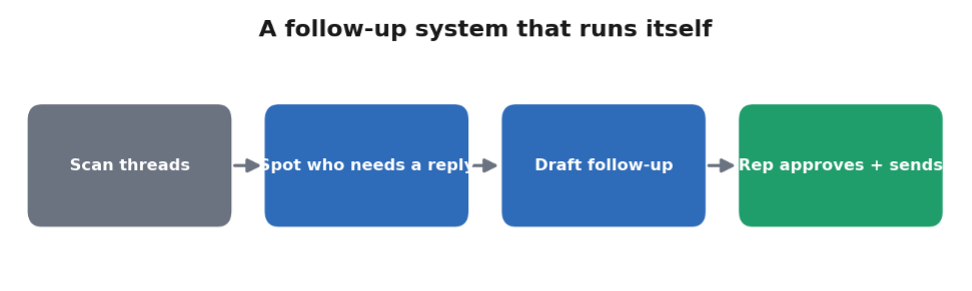
This is where a system beats willpower. nRev's Sales Reply Monitoring play scans your recent sales threads, uses AI to spot the conversations that have gone quiet or need a reply, and figures out what should happen next: a follow-up if the last message was yours, or a response if the customer wrote last. It then writes a short summary of the thread and drafts a proposed reply, and drops it into Slack so the rep can review and send in seconds. Nothing goes out without a human, and no live thread gets forgotten.
The point isn't to automate the relationship. It's to make sure the follow-up that would have slipped actually happens, with context attached. For the broader motion, our outbound sales guide covers strategy, and teams that want the whole follow-up and outreach loop run for them can look at the AI SDR approach. nRev's plays are shaped by more than 10,000 deployed GTM workflows.
Frequently asked questions
How many times should you follow up in sales?

How long should you wait between follow-ups?
What should a sales follow-up say?
When is the best time to send a follow-up?
How do you make sure you never miss a follow-up?